Flitto Supplies AI Interpretation Tool Vogl to Kyobo Book Centre, Expanding Into Book and Culture Retail
TECHWORLD ·
✦ AI Summary
Flitto supplied Vogl, its AI interpretation and translation solution, to major offline Kyobo Book Centre stores as it expands the tool's use into the book and culture retail sector.
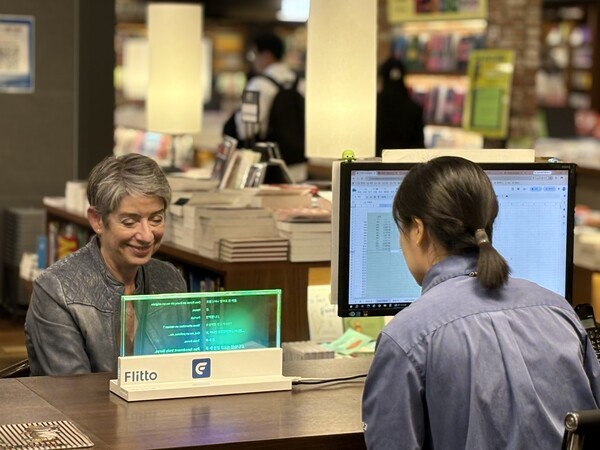
The pilot rollout took place at the Gwanghwamun, Gangnam, and Dongdaemun branches, with a Vogl Zone mini display installed at Gwanghwamun and Gangnam and the Vogl app applied to a tablet at Dongdaemun.
Flitto views the Kyobo Book Centre PoC as the first application of a stationary offline interpretation and translation solution in the book and culture retail sector, and plans to pursue formal adoption and expansion into other retail and service sectors.
Flitto supplied Vogl, its AI interpretation and translation solution, to major offline Kyobo Book Centre stores as it expands the tool's use into the book and culture retail sector. Flitto disclosed on the 14th that it had conducted a proof of concept (PoC) for serving foreign customers.
The pilot rollout was carried out at Kyobo Book Centre's Gwanghwamun, Gangnam, and Dongdaemun branches. A mini display for customer counseling, the Vogl Zone, was installed at the Gwanghwamun and Gangnam branches, while the Vogl app was applied to a tablet at the Dongdaemun branch.
The Dongdaemun branch operates by supporting staff on the move. Accordingly, Flitto tested the potential for serving foreign customers by combining fixed counseling and mobile assistance.
Vogl supports real-time on-site interpretation and translation through speech recognition and automatic language detection. To improve on-site translation accuracy, Flitto pre-trained terminology and proper nouns tailored to the store environment, seeking to reduce misrecognition issues that can occur with general-purpose translators.
In the Kyobo Book Centre deployment process, the company incorporated category names for books such as self-help, fantasy, and history, as well as author names including Han Kang and Bernard Werber, into the training data. As a result, it said general conversation speech recognition accuracy improved, along with speech recognition and translation accuracy for proper nouns commonly used in book inquiries.
It also applied an automatic language detection function. As a result, employees do not need to separately select the customer's language, and the system performs language recognition itself, which the company said is intended to support on-site use by employees of various age groups.
Flitto sees this Kyobo Book Centre PoC as the first application of a stationary offline interpretation and translation solution in the book and culture retail sector. It also broadened the scope from retail settings centered on product information to counseling areas that include cultural context, such as work titles, author names, and book categories.
The company plans to pursue formal adoption at Kyobo Book Centre based on the PoC results. It also aims to expand supply to retail channels such as warehouse-style stores and fashion and lifestyle stores, as well as service sectors that require multilingual support, including hotels and medical tourism.
Lee Jeong-su, CEO of Flitto, said the collaboration with Kyobo Book Centre has helped create an offline environment that eases language barriers. He added that, building on this partnership, the company will pursue ways to expand the application of its AI interpretation and translation solution across various industries, including the book and culture sector.
Source: TECHWORLD · Kim Seung-gi
Original: https://www.epnc.co.kr/news/articleView.html?idxno=408175
References
This article was produced with the help of an automated content generation algorithm.
Source: TECHWORLD
View originalThis article was summarized and organized by BizCrush based on the original article from TECHWORLD. For exact quotations and full details, please refer to the original article.