A “Market of Value” Opened by the Public and Private Sectors ... 2026 Heavy Disability Product Expo Concludes
TECHWORLD ·
✦ AI Summary
The “2026 Heavy Disability Product Expo,” hosted by the Ministry of Health and Welfare and organized by the Korea Association of Vocational Rehabilitation Facilities for the Disabled, was held on October 6-7 at Hall 1 of the aT Center in Yangjae-dong, Seoul.
The expo drew 4,031 visitors, involved more than 350 public institutions, and featured 105 production facilities operating 96 booths.
The event addressed sales-channel expansion and entry into the public market through exhibitions and sales, 1:1 customized purchase consultation sessions, procurement plan briefings, hands-on programs, and presentations of innovation cases.
The “2026 Heavy Disability Product Expo,” hosted by the Ministry of Health and Welfare and organized by the Korea Association of Vocational Rehabilitation Facilities for the Disabled, concluded after being held on October 6-7 at Hall 1 of the aT Center in Yangjae-dong, Seoul. The expo drew 4,031 visitors and involved more than 350 public institutions. Under the slogan “Creating Shared Prosperity Together, Living Value Together,” it was run as a joint event involving both the public and private sectors.
This year’s event aimed to move perceptions of heavy disability products beyond the narrow frame of welfare policy support. It also sought to expand them into products that are continuously chosen in public and private markets based on quality and competitiveness. To that end, 105 heavy disability product production facilities from across the country participated and operated 96 booths.
At the expo, food, household goods, office supplies, furniture, and IT products and services were presented as exhibits, while the event was organized around product displays and sales, purchase consultations, corporate partnerships, hands-on programs, and policy discussions. In addition to exhibitions and sales, the event focused on expanding practical sales channels by operating a range of programs.
As a key program, the expo included a “1:1 Customized Purchase Consultation Session” in which public institutions and production facilities were directly matched. The consultation session was operated with an emphasis on actual purchasing connections rather than on “display.” Participating demand-side institutions included central government ministries, local governments, provincial and metropolitan offices of education, offices of education support, public enterprises, and local public enterprises, and the participants were purchasing officials from those institutions.
The consultations were conducted as in-depth discussions based on the production facilities’ and institutions’ purchasing needs. During the event, a total of 270 consultations were held with 66 public institutions. The consultation volume was about KRW 16 billion.
After the event, follow-up connections will continue in order to lead to actual contracts and purchases. Through the purchase consultation session, the expo directly connected production facilities with public demand-side institutions, expanding an exhibition-centered event into one with real purchasing potential.
The Public Procurement Service and the Korea SMEs and Startups Agency then held a “Demand-Side Institution Procurement Plan Briefing Session.” The briefing session was intended to support production facilities’ entry into the public market and covered system explanations as well as the procurement plans and purchasing information of public institutions. Through this, production facilities were given an opportunity to approach the public procurement market in a systematic way.
Over the two days of the event, the expo was visited by a total of 4,031 people, including ordinary citizens, and it was designed so that citizens would not stop at simply viewing heavy disability products but would directly observe and experience them to confirm their potential uses. Visitors directly observed and experienced heavy disability products.
On site, a lifestyle-themed showroom was operated to recreate actual office and cafe spaces. The showroom introduced ways in which heavy disability products can be used in everyday and work environments.
A “Job Trip Lounge” was also operated, and the vocational rehabilitation experience program consisted of cookie icing, miniature chrysanthemum pots, dried seaweed snacks, key rings, keycaps, car air fresheners, and tote bag making. Through this, visitors were able to experience the products firsthand and confirm the quality and diversity of heavy disability products.
Those experiences were reflected in a visitor survey, which found that the intention to repurchase products and revisit future expos stood at 96.6%. The share of respondents who said their perception of heavy disability products had improved was 93.7%.
To help introduce heavy disability products to the general public, the expo released participatory unboxing content before and after the event. The released unboxing content featured participation from Kang Mi-yeon, as well as Park Seul-gi and Saori.
The unboxing content was intended to be used to promote heavy disability products to the general public. Through this, the expo operated the program in a way that broadened points of contact with heavy disability products.
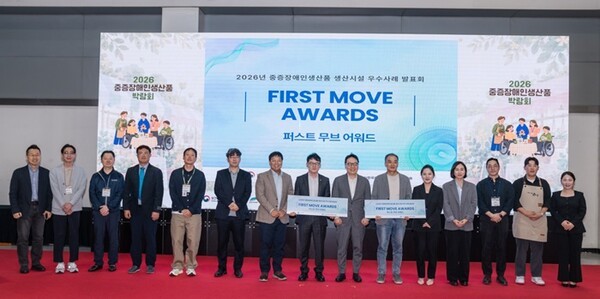
The expo also held the “First Move Awards.” The program was designed as an innovation competition that evolved from the previous presentation session for best practices.
Nine facilities took part in the presentation of innovation cases. Common to all 9 facilities was that they went beyond simply exceeding sales targets to drive change on the ground, and that change took the form of improved production processes, expanded employment of people with disabilities, and stronger brand competitiveness.
In addition, expert mentoring was used to refine on-site ideas, AI-based business advancement was pursued, and those ideas were developed into concrete business models. Through this, the event suggested the possibility that vocational rehabilitation facilities could grow not as entities limited to protection and support, but as productive actors with market competitiveness.
This year’s expo was meaningful not just as a product sales event, but as one that aimed for a virtuous cycle linking expanded sales channels with stable jobs and income for workers with disabilities. Rather than sales itself, the expo focused on widening sales channels to support employment and income stability for workers with disabilities.
The article said that if purchases of heavy disability products increase, the stable production and sales base of vocational rehabilitation facilities for the disabled will strengthen. It then explained that if that base is strengthened, it may become possible to maintain employment and improve working conditions for workers with disabilities.
Lee Sang-heon, president of the Korea Association of Vocational Rehabilitation Facilities for the Disabled, said that the starting point for change is someone’s new attempt. He added that on-site challenges for new job development, production-method improvements, and product and brand innovation are the driving force behind stronger competitiveness for vocational rehabilitation facilities, and said he hopes such innovation cases will spread nationwide. He said he expects the spread of innovation cases to lead to expanded employment of people with disabilities, sustainable jobs, and the creation of new sales channels.
The association plans to continue managing the cooperative relationships formed between public institutions and private companies at the expo. It also intends to continue providing follow-up support so that consultation results lead to actual purchases and contracts.
Source: TECHWORLD · Kim Gyeong-ju
Original: https://www.epnc.co.kr/news/articleView.html?idxno=408180
References
This article was produced with the help of an automated content generation algorithm.
Source: TECHWORLD
View originalThis article was summarized and organized by BizCrush based on the original article from TECHWORLD. For exact quotations and full details, please refer to the original article.