Google Simplifies How Users Run Personal Apps on Smartphones Made With AI
IT DAILY ·
✦ AI Summary
Google said it will make AI-based personal apps easier to use on smartphones.
The apps in question are personal Android apps made in Google AI Studio, and they can be run through Google Play with a regular Google account.
Google also said it plans to provide a feature within the next few months that will let users share personal apps with people close to them.
Google said it will support smartphone use of AI-based personal apps. The goal is to reduce the steps required to use personal apps on smartphones. The process uses so-called "vibe coding," in which users describe the functions they want and an app is built from that description.
Google is pushing ahead with a plan to streamline the steps needed to use completed apps on personal devices. Google announced the move on the 13th through its official blog. The apps in question are personal Android apps built in Google AI Studio. They can be run on users' own devices through Google Play. No separate developer account is required, and a regular Google account can be used.
The rollout is for users aged 18 and older in some markets, including the United States. The release will be phased. Google did not specify in the announcement whether or when it will be available in Korea.
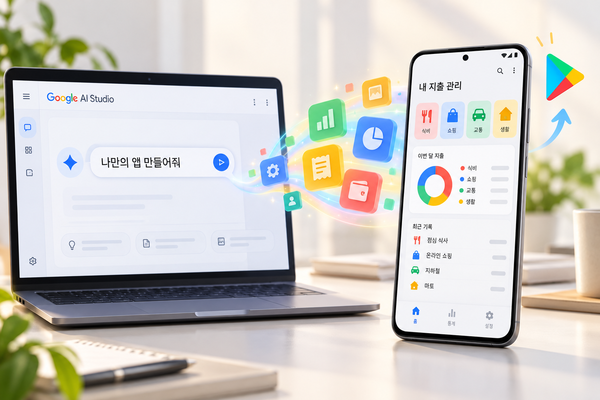
Vibe coding is a method in which AI writes code based on the user's natural-language description, and the user then reviews the result and continues making changes. For example, a user might ask for an app that records daily spending and shows totals by category, and then add or modify screens and functions afterward.
In May, Google unveiled Android app-building features for AI Studio at Google I/O 2026. In the official announcement at the time, Google said apps could be built without installing a separate development environment, and that results could be checked with an Android emulator that runs in a browser. The code generated by AI uses the Kotlin language.
The focus of this update is to simplify the process of using created apps on actual smartphones. Under the method outlined in May, installation on devices via Android Debug Bridge (ADB) was presented as an option.
In May, Google also outlined a method of linking a Google Play developer account and then distributing the app for internal testing. That path has now been joined by a way to run personal apps through Google Play with a regular Google account.
Personal apps are kept private, separate from Google Play's public app listings. Right after a personal app is built, other users cannot search for or download it.
Google said it plans to provide a feature within the next few months that will allow users to share personal apps with people close to them, such as friends and family. The move is intended to broaden use by letting people first use apps they need themselves and then share them with those around them.
A separate process is required to release an app to the general public. Users who want public distribution must switch to a professional developer account, and apps released publicly will be subject to the same trust and safety review and the same quality standards as other developers' products, said Sam Bright, vice president and head of Google Play and the developer ecosystem, in the official blog.
The significance of this change is that apps built with vibe coding move beyond the result stage inside the creation screen. It also points to a direction in which apps built with vibe coding become everyday tools.
As a result, the barrier to creating and using apps for tracking personal spending is being lowered. The barrier to creating and using apps for managing hobbies is also being lowered.
An industry source stressed that ease in the AI-based app-building process alone is not enough, and that if installation and distribution remain complicated, it is difficult for such apps to lead to real-world use. The source added that this change could expand the trend of directly building and using tools for personal needs. However, the source also said that as use expands, a system for verifying the security and stability of generated apps will become more important.
Source: IT DAILY · Lee Jae-young
Original: https://www.itdaily.kr/news/articleView.html?idxno=242172
References
This article was produced with the help of an automated content generation algorithm.
Source: IT DAILY
View originalThis article was summarized and organized by BizCrush based on the original article from IT DAILY. For exact quotations and full details, please refer to the original article.