[Tech Report] Nordic Opens the Age of Intelligent IoT With Edge AI
TECHWORLD ·
✦ AI Summary
Edge AI makes it possible to deliver real-time, low-power intelligence in IoT devices, and rising demands for real-time decision-making and stronger privacy are accelerating on-device AI.
As with building energy use, ultra-low-power local AI can reduce costs and latency in refrigeration and HVAC control, as well as in medical wearable data analysis.
Through the Neuton model, the Axon NPU, and related development tools, Nordic has presented an Edge AI architecture that simultaneously supports battery life, performance, and scalability.
When people think of AI, they usually think of ChatGPT, DeepSeek, Google Gemini, LLMs, and text-based image generation systems. But IoT consists of billions of connected devices, and AI in the form of intelligence inside those devices plays an important role in IoT. Edge AI makes it possible to deliver real-time, low-power intelligence across many connected devices, and its spread expands innovation opportunities across IoT.
Factors accelerating the trend toward AI inside IoT devices include the need for real-time decision-making and stronger privacy protection. The growing scale of data generated by applications and the need for data-driven decision-making are also speeding up the move toward on-device AI.
As an alternative architecture for this trend, local execution is being proposed instead of full reliance on the cloud. The target for local execution is a highly efficient model optimized for specific tasks, running under minimal resource and energy conditions. This can extend intelligence capabilities across tens of billions of ultra-low-power devices.
To explain the size of the opportunity, it is necessary to present a real application example, and building energy use is one such case. Buildings account for about 30% of global energy use, and the impact of consumption from refrigeration and HVAC systems is especially significant.
A typical smart thermostat adjusts temperature based on simple schedules and manual input, but a true intelligent thermostat processes occupancy sensors, external weather information, and real-time grid pricing signals together. It also learns the thermal characteristics of a building and occupant usage patterns, and based on that learning, it can run preheating and precooling during off-peak hours. During off-peak hours, cheaper and cleaner energy can be used, and output can be reduced when spaces are vacant.
If this kind of control method is applied to billions of systems around the world, the effect could grow even larger. In many applications, energy savings reach 20-40%, leading to lower operating costs and reduced carbon emissions.
Global health care systems are already seen as overloaded. In this situation, AI-based wearables can collect vast amounts of data related to patient health indicators, analyze the collected data, and then filter out meaningful information to deliver only the key details needed for treatment to medical staff, greatly reducing their burden. This can enable more efficient use of medical resources, personalized care, early diagnosis, remote patient monitoring, and adherence management.
Meanwhile, since the emergence of IoT, industrial connected devices have typically collected data, sent it to the cloud, waited for processing to finish, and then operated based on the results. This traditional approach has generally been effective.
However, in the context of intelligence moving to the edge, the traditional approach has limitations because it consumes massive bandwidth and causes latency of hundreds of milliseconds to several seconds. That kind of delay is very long for applications that require near-real-time operation.
As an alternative to cloud-centric processing, a solution has been proposed that moves intelligence from the cloud to the device where the data is generated. This so-called Edge AI is considered one of the fastest-growing areas in AI. Edge AI improves the smartness, autonomy, and energy efficiency of IoT devices constrained by performance and resources.
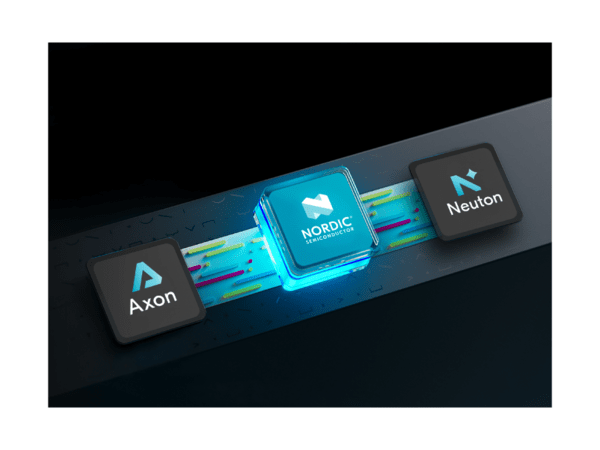
Ultra-low-power Edge AI is implemented by using complementary technologies within the same ecosystem. Examples include Nordic Semiconductor's Neuton model and Nordic Semiconductor's Axon neural processing unit (NPU). The Neuton model can be flexibly applied across Nordic's product portfolio and is implemented through a neuron-level automated process. This creates very compact and efficient neural networks without the overhead of conventional architectures, greatly reducing memory and computing requirements and making them suitable for resource-constrained devices.
The Axon NPU is Nordic's AI accelerator core. This NPU is integrated directly into some devices, including the nRF54LM20B SoC. It is used to process workloads that require high performance in an energy-efficient and high-speed manner.
Implementing Edge AI capabilities requires ultra-low-power processing performance built into advanced chips. An example is Nordic's nRF54L series. The nRF54L series SoC stays in deep sleep mode for 99% of total operating time and wakes up within microseconds.
After waking up, it reads sensor data and runs inference. If needed, it transmits small data packets. This shows how ultra-low-power processing and instant startup capabilities are realized in actual operation.
At the same time, using AI requires a solution that streamlines the entire development process, from data collection and model training to deployment and OTA updates. Accordingly, the focus is shifting from explaining the potential of Edge AI to how engineers actually implement it.
Nordic is redesigning AI not as a cloud-dependent function but as a native capability of embedded systems. The goal of this redesign is to ensure that it operates without performance degradation even under limited power, memory, and latency requirements. Chandra said Nordic is focusing on implementing a physical AI layer that fuses sensing, computing, and real-world interaction.
Vegar Ueland, CEO, said Nordic's role is not to be a place where AI is learned, but to help implement intelligence learned in the AI factory on real-world edge devices. He said Nordic's Edge AI solution supports latency-free, millisecond-level decision-making by bypassing the cloud. He also said it ensures regulatory compliance through local processing and significantly extends battery life across billions of connected devices. He added that the solution sets a new standard for ultra-low-power Edge AI, and that Nordic is building that benchmark.
Nordic said its philosophy for delivering solutions is focused on minimizing complexity and friction throughout the entire development lifecycle. As concrete tools for this Edge AI philosophy, it pointed to the Neuton model and the Axon NPU. Nordic said the Neuton model is its proprietary model, enabling embedded developers to create optimized models based on their own datasets even without machine learning expertise, and that the resulting models can run in very small amounts of memory. It said the Axon NPU provides hardware optimized for general AI workloads.
Nordic said it supports a seamless development environment for developers through software that complements the hardware. The software development environment supports TensorFlow Lite/LiteRT models and is closely integrated with Nordic Edge AI Lab, allowing embedded engineers to smoothly and easily carry out the full process of model implementation, optimization, testing, and deployment.
By combining this with the Neuton model's small size and high efficiency, Nordic said Edge AI applications can run on any Nordic SoC or CPU-equipped cellular module. It explained that the model can solve tasks based on time-series sensor data such as accelerometers, IMUs, PPG, temperature, and power-measurement sensors, and can continuously run anomaly detection, gesture recognition, activity classification, and biometrics monitoring in real time without consuming much battery power or requiring cloud connectivity.
The Neuton model supports efficient AI implementation on a CPU basis. However, some applications require higher computing performance. In particular, high-frequency sensor data, audio processing, and image classification tasks require high performance in terms of processing speed, memory, and energy efficiency. In such cases, resource-constrained devices can use the Axon NPU to implement high-performance AI workloads. The Axon NPU is designed for ultra-low-power environments and has dedicated hardware acceleration for TensorFlow Lite models.
This acceleration feature of the Axon NPU reduces energy consumption compared with CPU execution and delivers inference performance up to 15 times faster than CPU execution. This acceleration feature goes beyond simple speed improvements and fundamentally expands the possibilities of Edge AI. As a result, tasks such as keyword spotting, sound classification, and image-based detection, which were previously difficult to implement on battery-powered devices, can now run locally with minimal latency and energy consumption.
As questions are often raised about whether the Neuton model can be accelerated by the Axon NPU, Chandra said the Neuton model was designed with that characteristic in mind because its computing load is very low and it is built to maintain very low power consumption based on high efficiency. Accordingly, he explained that the entire model can run on the MCU's CPU alone and does not require hardware acceleration. He said the answer to whether Axon NPU acceleration is possible is no.
Nordic then presented flexibility and scalability as defining characteristics of its Edge AI architecture. Based on this, developers can implement intelligence features at the concept stage without a complicated process and can build intelligence that meets hardware, application, and energy requirements.
Nordic said its Edge AI solution consists of a combination of ultra-efficient models and dedicated acceleration functions, supporting a variety of applications that use IoT devices and helping drive AI innovation. It also identified shorter latency, lower energy consumption, stronger privacy protection, and improved system resilience as common benefits across all use cases.
In developing intelligent devices, developers do not need to stick to a single approach. They can choose the optimal technology for each use case, and they can also combine multiple technologies within a single system.
One example is a configuration in which the Neuton model handles continuous anomaly detection and the Axon NPU performs precise analysis when a specific event is detected. This device implementation method corresponds to a stepwise structure of anomaly detection and precision analysis, and a hierarchical approach that maximizes the effectiveness of intelligence use.
Over the past several years, adding AI to wireless IoT devices meant choosing between battery life and performance. Now developers can secure both battery life and performance at the same time. As a result, the era centered on simple data-collection sensors is fading, and the many devices around us are evolving beyond data collection toward understanding, responding, and selective delivery.
The technologies needed to build intelligent devices are already available. Embedded engineers can use the relevant tools. There are sufficient reasons to adopt the technology from both an economic and a market-competitiveness standpoint.
Source: TECHWORLD · Park Gyu-chan
Original: https://www.epnc.co.kr/news/articleView.html?idxno=408163
References
This article was produced with the help of an automated content generation algorithm.
Source: TECHWORLD
View originalThis article was summarized and organized by BizCrush based on the original article from TECHWORLD. For exact quotations and full details, please refer to the original article.