Ibis to Join SW Development Project for Next-Generation High-Performance Vehicle Computers
TECHWORLD ·
✦ AI Summary
Ibis will participate as a co-research and development organization in a project under the Ministry of Trade, Industry and Energy's "Automotive Industry Technology Development" program.
The project aims to secure real-time processing and synchronization technologies for sensor data such as cameras and radar in HPVC environments and verify them in actual vehicles.
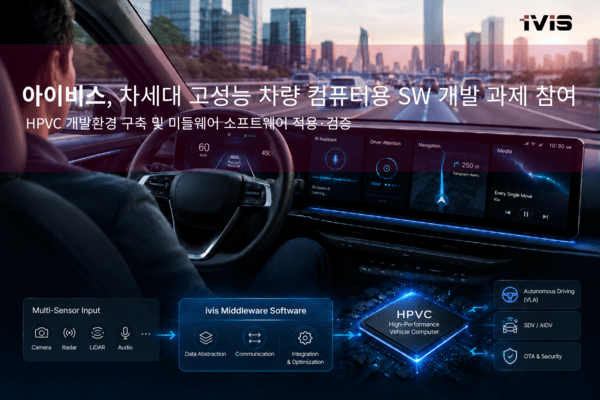
Ibis will be responsible for building the HPVC software development environment, applying, verifying and optimizing middleware, and operating a stable integration environment for vehicle sensor data.
Ibis announced that it will participate as a co-research and development organization in the project, "Development of Multimodal Sensor Fusion and High-Precision Synchronization Technologies for HPVC Verification," under the "Automotive Industry Technology Development" program promoted by the Ministry of Trade, Industry and Energy.
The project is a subtask of the overarching project, "Development of AI-Driven High-Performance Computers with up to 2000 TOPS of artificial intelligence computing performance." The program is part of efforts to develop a High-Performance Vehicle Computer (HPVC) capable of up to up to 2,000 trillion AI operations per second.
Hyundai Mobis is the lead research and development organization, while the co-research and development organizations are Ibis, Ajou University Industry-Academic Cooperation Foundation, Korea Electronics Technology Institute and Korea Automotive Technology Institute. The project runs through December 2029.
The goal of the project is to support VLA (Vision-Language-Action)-based autonomous driving and to help connect visual and language information to driving actions. It also aims to secure real-time processing and synchronization technologies for sensor data such as cameras and radar in HPVC environments, and to verify those technologies in actual vehicles. Ibis said the project is aimed at securing HPVC-based sensor data processing and synchronization technologies and supporting VLA autonomous driving through verification in real vehicles.
Under the project, Ibis will be responsible for building the HPVC software development environment. It will establish the HPVC platform software development environment and handle the application, verification and optimization of middleware that connects various in-vehicle hardware and software. It will also operate a stable integration environment for various vehicle sensor data.
Ibis plans to apply the technologies it secures through the project in the future. The intended uses are supporting development of next-generation vehicle computing platforms for automakers and electronics companies, as well as supporting the transition to SDV.
The vehicle software architecture is expected to evolve around high-performance central computing. Accordingly, the scope of technologies for stable application, verification and optimization of vehicle software in new hardware environments is also expected to expand.
Nam Gi-mo, CEO of Ibis, said that vehicle computing environments are becoming more high-performance and integrated as AI and autonomous driving technologies advance. He added that the role of middleware software that helps high-performance hardware deliver its performance inside actual vehicles is important. He also said the company will use the project to strengthen its technological capabilities covering the development, verification and optimization of middleware for next-generation high-performance vehicle computer environments.
Source: TECHWORLD · Lee Gwang-jae
Original: https://www.epnc.co.kr/news/articleView.html?idxno=408146
References
This article was produced with the help of an automated content generation algorithm.
Source: TECHWORLD
View originalThis article was summarized and organized by BizCrush based on the original article from TECHWORLD. For exact quotations and full details, please refer to the original article.