AI-Driven Cyber Threats Grow More Sophisticated...Only 1% of South Korea's Most Prepared Defenders Are Ready
IT DAILY ·
✦ AI Summary
Cisco shared the findings of its "Relentless Defense" report at a media briefing on the 13th at its Gangnam-gu, Seoul office.
The report surveyed 8,000 security professionals in 30 countries worldwide, and the share of domestic organizations that were fully prepared was 1%.
Internal friction, rather than technology, was identified as a factor hindering stronger cybersecurity, and top defenders showed differences in governance.
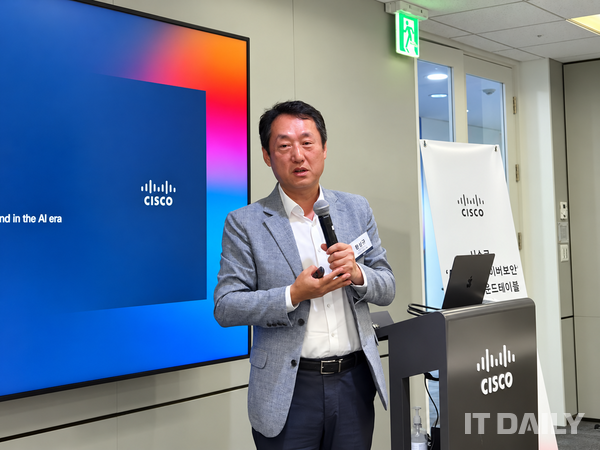
Cisco shared the findings of its "Relentless Defense" report at a media briefing on the 13th at its Gangnam-gu, Seoul office. At the event, Cisco Korea Managing Director Hwang Sung-gyu introduced the report. The briefing photo was taken by reporter Kim Ho-jun.
The report, conducted by Cisco, surveyed 8,000 security professionals in 30 countries worldwide. Among respondents, 27% were chief information security officers (CISOs). More than 60% of respondents had worked on security teams for 6 years or longer.
According to the findings, even as AI-advanced cyber threats intensify, the share of domestic organizations that are fully prepared remained at just 1%. This result shows the state of preparedness among domestic organizations in relation to the article's main topic, AI-advanced cyber threats.
The report also identified internal friction within organizations as a factor hindering stronger cybersecurity. It said internal friction stood out more than technology or speed among the barriers.
Cisco released the "Relentless Defense" report for the first time this year. Since 2023, Cisco has published its annual "Cybersecurity Readiness Index" report, but this new report marks a shift away from the existing Readiness-centered format.
This report focused on assessing defense capabilities and internal conditions for the AI era. Accordingly, the survey also shifted its focus from advance preparedness levels to security operations status and defensive capabilities. Hwang Sung-gyu, managing director of Cisco Korea, said the Korean meaning of "Relentless Defense" is "endless defense," adding that it refers to continuously blocking evolving threats. He also said this report focused on organizations' security operations status compared with previous surveys.
According to the report, the average cybersecurity capability of organizations worldwide was 64 out of 100. South Korea's cybersecurity capability came in at 58, below the global average.
Among global organizations, the share of top defenders was 8%. Top defenders refer to organizations with the highest level of capability across speed, scope, and operational management. South Korea's share of top defenders was 1%, lower than the global figure.
Compared with the global figure, South Korea had a higher share in the lowest cybersecurity maturity stage, "Exposed Defenders." "Exposed Defenders" are organizations with gaps in security coverage and a focus on post-incident response. The global share of "Exposed Defenders" was 12%, while South Korea's was 24%, twice as high.
Internal friction, rather than technology, was identified as the main obstacle to advancing security capabilities. In an open-ended question asking what respondents wanted to change about their cybersecurity approach, 6 out of 10 respondents cited issues related to organizational operations and collaboration. Responses in this category included a lack of decision-making authority, unclear responsibilities, and complex approval procedures.
The report found the difference between top defenders and other groups in governance. 86% of top defenders were applying consistent security controls to AI agents and non-human identities. In addition, 83% of top defenders had an integrated organizational structure spanning security, network, and infrastructure, compared with 37% for other groups.
Managing Director Hwang said that establishing top-defender-level capabilities and governance is a prerequisite for improving security. He said that the process of establishing governance should lay the groundwork for collaboration among multiple organizations. He also explained that integrated teams spanning development, security, and operations are needed, along with clear definitions of authority and responsibility.
The report said it confirmed that AI can improve security operations efficiency. More than 8 out of 10 global security practitioners said using AI improves threat detection and response capabilities by at least 25%, and more than 1 out of 4 said AI significantly reduces workload. However, the share of organizations broadly using AI-based security functions was less than half.
By field, AI was used most often in network security and least often in security operations and investigations. Security operations and investigations were presented as areas where AI could ease workload. However, AI adoption in security operations and investigations was relatively delayed.
Source: IT DAILY · Kim Ho-jun
Original: https://www.itdaily.kr/news/articleView.html?idxno=242155
References
This article was produced with the help of an automated content generation algorithm.
Source: IT DAILY
View originalThis article was summarized and organized by BizCrush based on the original article from IT DAILY. For exact quotations and full details, please refer to the original article.