K-Physical AI Ecosystem Takes Shape, from Full-Stack R&D to Demonstration and Governance
IT DAILY ·
✦ AI Summary
On the 13th, the "Physical AI Alliance Performance Review and On-Site Roundtable" was held, where operating results since the launch of the second term in June and technology development and demonstration plans by subcommittee were shared.
NIPA Headquarters Director Jung Su-jin said the number of participating companies had risen from 120 to 437, and introduced the steering committee and subcommittee meetings, the landscape, the website, robot adoption consulting, and inter-ministerial collaboration results.
Lee Jae-wook, director of the AI Research Institute at Seoul National University, Park Sang-won, executive vice president at KT, and Jang Young-jae, professor at KAIST, each presented key tasks for technology development, demonstration and commercialization, and standards, law, institutions, and infrastructure for subcommittees 1, 2, and 3, respectively.
The public-private cooperation framework and future roadmap for building the K-Physical AI ecosystem are taking shape. On the 13th, a "Physical AI Alliance Performance Review and On-Site Roundtable" was held.
At the roundtable, participants discussed operating results since the second term launched in June. The meeting also unveiled plans for key technology development by subcommittees 1, 2, and 3, as well as plans to push ahead with demonstration and commercialization projects.
Jung Su-jin, head of the Korea Information & Communications Industry Promotion Agency (NIPA), introduced the current activities of the alliance secretariat. Jung said the number of participating companies had expanded from 120 at launch to 437.
Jung also said that the alliance is linking practical demand with policy through steering committee and subcommittee action group meetings. He said an "alliance landscape" had been built to support industry-academia-research collaboration, an official website had also been built, and consulting on introducing robots into manufacturing sites was also being promoted.
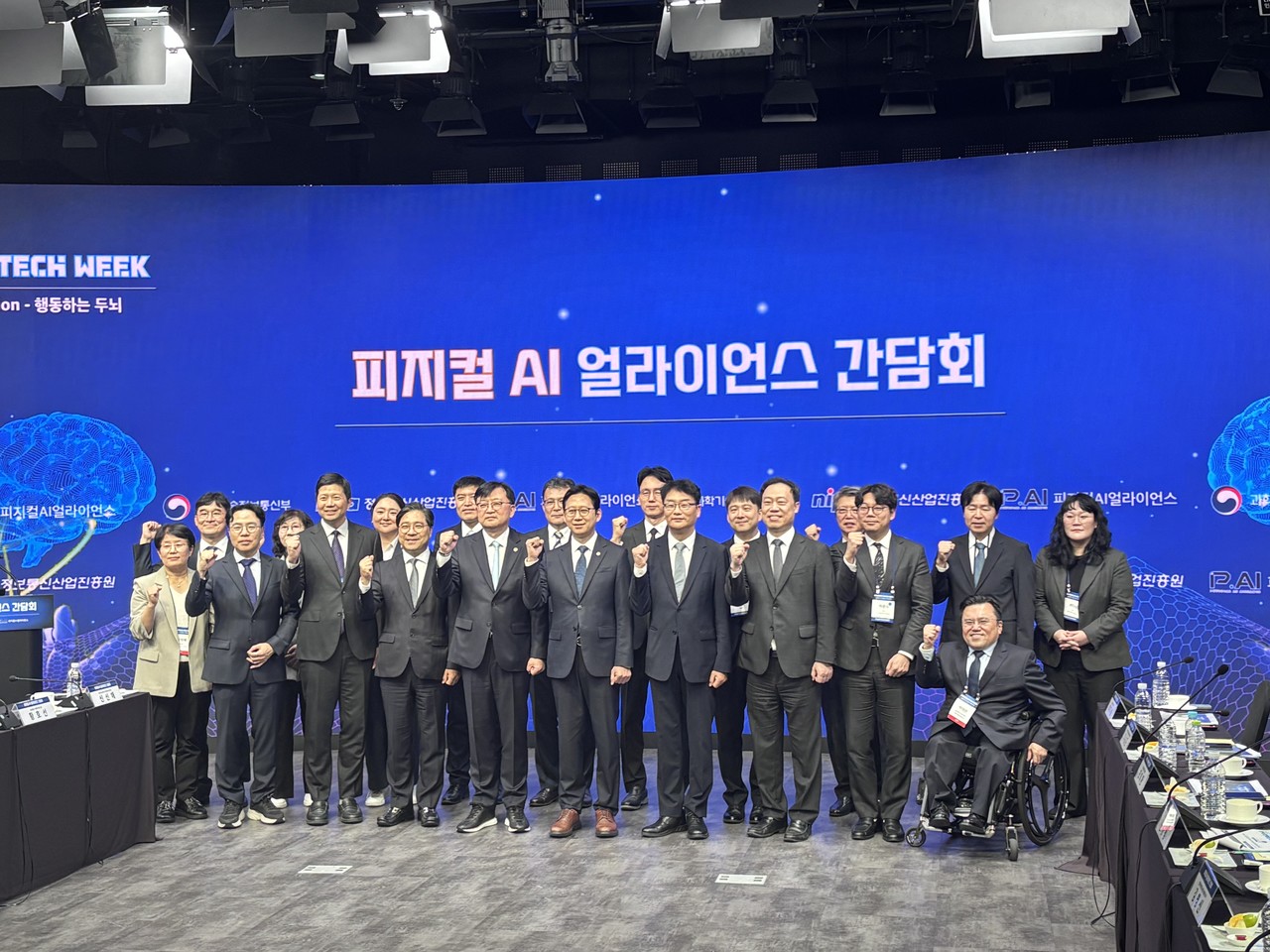
Jung also introduced inter-ministerial collaboration results, including support programs for smart factory construction under the Ministry of SMEs and Startups. A photo at the site showed a group photo of attendees at the "Physical AI Alliance Performance Review and On-Site Roundtable," and the photo credit reads Kwon Young-seok.
Jung said the alliance would not stop at operating a consultative body, adding that it would continue reflecting inter-ministerial cooperation and industry-site demand to support visible results that companies can actually feel.
Lee Jae-wook, director of the AI Research Institute at Seoul National University, presented the subcommittee plan as chair of the K-Physical AI full-stack subcommittee. Lee said the goal of subcommittee 1 is to connect on-site demand with national R&D and to integrate fragmented technologies into a full stack.
Subcommittee 1 activated 6 action groups and identified 32 detailed technical elements, focusing on uncovering technologies that are missing. Based on those findings, Lee said it plans to design and reflect tasks such as a general-purpose foundation model, fine-tuning, on-device NPU, and an integrated system platform in the "Physical AI Core Technology Development" project, which is scheduled to begin in 2027.
Lee said the goal is to precisely reflect on-site voices and technology gaps in national R&D projects and to closely link ministry-led projects with corporate demonstrations, thereby pushing ahead with the completion of a virtuous-cycle R&D ecosystem.
Park Sang-won, executive vice president at KT, presented demonstration and commercialization strategies so that the technologies being developed can take root at the sites of companies with real demand, as chair of the vertical industry bridge subcommittee. Park said he would push ahead with a full-cycle linkage from demand discovery to proof of concept (PoC), demonstration, and business expansion.
Subcommittee 2 is operating around extreme manufacturing, safety, disaster response, maritime, and ports. These areas are expected to deliver large workforce-replacement and productivity-innovation effects, and subcommittee 2 has identified 26 demonstration projects and is pushing ahead with portfolio upgrades.
To that end, subcommittee 2 is considering matching large and small companies, linking with local government mega projects, and connecting public and private funds, with the goal of building a sustainable commercialization model. Park also said he intends to serve as a bridge so that Physical AI can take root as a core competitive advantage in industrial settings.
Next, Jang Young-jae, professor at KAIST, emphasized the importance of standards, law, institutions, and infrastructure as chair of the governance subcommittee. Jang said standards, law, institutions, and infrastructure are the foundation that supports technology and industry.
Subcommittee 3 is developing a cloud-based solution to support automation process design for small and medium-sized manufacturers, and it is also pushing ahead with free distribution of the solution. In addition, subcommittee 3 is carrying out certification criteria work and reliability criteria work in parallel with the enactment of the Framework Act on AI, while also conducting international standardization work.
Professor Jang said Physical AI is still at an early stage in which concrete products and business models have not yet been established, making framework design across the industrial ecosystem essential. He also said he intends to strengthen institutional foundations and the foothold of the industrial ecosystem to prevent Physical AI from remaining at the research stage and to realize standard products and business models that meet market demand.
Source: IT DAILY · Kwon Young-seok
Original: https://www.itdaily.kr/news/articleView.html?idxno=242157
References
This article was produced with the help of an automated content generation algorithm.
Source: IT DAILY
View originalThis article was summarized and organized by BizCrush based on the original article from IT DAILY. For exact quotations and full details, please refer to the original article.