Maum AI to Unveil Quadruped Robot Mine Detection System, Following Thailand Field Test and Mass Production Development
TECHWORLD · · 1 views
✦ AI Summary
Maum AI will unveil a quadruped robot-based mine detection system at the 'Physical AI Tech Week' taking place on the 13th and 14th at COEX in Seoul.
The system integrates a military magnetic detection sensor and a GPR sensor onto a single robot platform.
Maum AI developed the first PoC system in about 5 months and supplied it for field testing in Thailand, and is currently developing a second system.
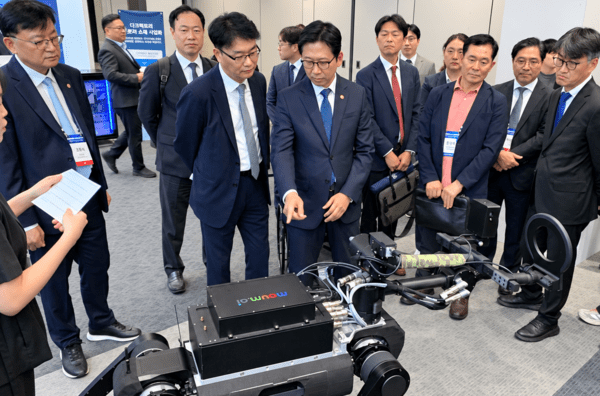
Maum AI will participate in the 'Physical AI Tech Week' taking place on the 13th and 14th at COEX in Seoul and unveil a mine detection system based on a quadruped walking robot. The exhibit is a quadruped robot-based mine detection system developed for a field test in Thailand.
The system combines a military magnetic detection sensor and ground-penetrating radar (GPR). Specifically, it integrates a performance-upgraded magnetic detection (MD) sensor applied to the PRS-17KM military mine detection equipment and a GPR sensor used in the civilian sector onto a single robot platform.
The detection method varies by target. Metallic mines and buried objects are identified through magnetic detection technology, while nonmetallic buried objects are detected through GPR-based image analysis. The GPR sensor can visualize and analyze reflected signals from underground buried objects as 2D images.
This configuration expands the detection range to include nonmetallic buried objects, which are difficult to detect using magnetic detection alone. In that sense, it complements the limitations of existing magnetic detection methods.
Maum AI focused on shortening the development period for defense unmanned systems by combining two types of sensors and remote operation capabilities with a commercial quadruped robot, and by pursuing a method that merges a commercial robot platform, existing military technology and civilian sensors. Through this approach, it developed the first PoC system in about 5 months and supplied the equipment for a field test in Thailand.
The company plans to progressively advance the system based on a method that reflects field test requirements after deployment. It is currently developing a second system that incorporates improvements and additional requests identified during the operation of the first PoC.
The goal of the second system development is to improve sensor integration, robot operation stability, field applicability and maintainability. It also aims to develop the system into a mass-producible model.
Going forward, the company plans to expand the range of applications based on a modular mission equipment structure. Areas for expanded application include surveillance, reconnaissance and hazardous object detection in addition to mine detection, and the target fields are defense and safety. This reflects a plan to leverage the mobility and remote operation capabilities of the quadruped robot to carry out missions in hazardous areas that are difficult for people to access directly.
Son Byung-hee, head of Maum AI's Defense AI & Robotics division, said that among the factors determining the competitiveness of future unmanned systems are the rapid integration of fast-evolving technologies and whether they are applied to actual operating systems. Son added that the company plans to develop a second PoC system based on field test experience and advance it into a mass-producible product.
Source: TECHWORLD · Kim Seung-gi
Original: https://www.epnc.co.kr/news/articleView.html?idxno=408130
References
This article was produced with the help of an automated content generation algorithm.
Source: TECHWORLD
View originalThis article was summarized and organized by BizCrush based on the original article from TECHWORLD. For exact quotations and full details, please refer to the original article.