Nutanix Deepens Push Into Korea's Cloud Market as an 'AI Integration Platform' Beyond Virtualization
TECHWORLD · · 3 views
✦ AI Summary
Nutanix is strengthening its push into Korea's cloud market and presenting a direction that spans hybrid cloud and AI beyond its virtualization-centric business.
At the event, '.NEXT on Tour Seoul 2026' introduced enterprise AI and hybrid multicloud strategies.
The company also discussed expanded use of servers and storage, integrated management of VMs, containers, and AI on a single platform, NUS 5.3, Data Lens 2.0, and Hanwha Systems' plan for a group-wide integrated cloud platform.
Nutanix is strengthening its push into Korea's cloud market by shifting from its existing virtualization-centric business toward one that spans hybrid cloud and artificial intelligence (AI). To that end, it has highlighted a strategy that leverages the servers and storage systems companies already own.
Nutanix outlined a scope that would enable management of virtual machines (VMs), containers, and AI workloads on a single platform. Through this, it aims to ease the burden of infrastructure migration and operations.
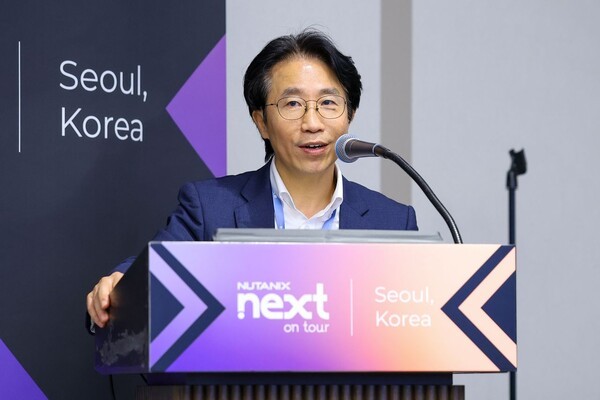
On the 13th, Nutanix held '.NEXT on Tour Seoul 2026' at the Grand InterContinental Seoul Parnas. At the event, the company presented its enterprise AI business strategy and hybrid multicloud business strategy.
At the press briefing that followed, Mandy Dhaliwal, Nutanix chief marketing officer (CMO) and vice president, and Byun Jae-geun, president of Nutanix Korea, introduced the company's global business status and technology strategy. Kim Myeong-gu, a team leader in Hanwha Systems' cloud business division, shared plans to build a group-wide integrated cloud platform, while Paul Harb, Nutanix vice president of solutions and performance engineering, took part in the Q&A session.
CMO Mandy Dhaliwal said the growing adoption of AI is increasing the complexity of companies' IT infrastructure and operating systems. He explained that complexity has expanded as Kubernetes-based applications and GPU-centric AI environments have been added to existing on-premises and public cloud setups, which in turn has increased the number of systems and organizations that must be managed.
Use of AI agents is also increasing. Dhaliwal noted that the spread of AI agents is bringing resource consumption, cost management, and corporate data protection to the fore as key issues.
A new operational challenge has emerged: isolating and controlling execution environments to ensure agents stay within their assigned scope. Dhaliwal said AI is creating more silos and more complexity.
As Nutanix's answer, Dhaliwal proposed operating virtualized servers, containers, and AI on a single platform while providing a consistent management environment.
Nutanix presented 'One Platform, One Experience' as its core strategy. At its heart, the strategy is about enabling consistent management of applications and data across on-premises, public cloud, and edge environments. In line with this, Nutanix is expanding its support beyond virtualized environments to cloud-native workloads based on physical servers.
As a tool for this direction, the company pointed to 'NKP Metal,' an expanded feature of 'Nutanix Kubernetes Platform (NKP).' 'NKP Metal' is designed to run Kubernetes clusters directly on physical servers without going through a hypervisor. Through this, Nutanix said the defining feature is the ability to use hardware resources without a virtualization layer for GPU-intensive AI training and edge environments.
Nutanix is automating physical server deployment, operating system updates, firmware updates, and Kubernetes cluster management. Based on this, it aims to provide an operating model similar to a traditional virtualized environment. In addition, Nutanix plans to run VMs and containers in environments suited to their respective characteristics while managing them in an integrated manner.
Nutanix has strengthened storage and security functions to better support AI data processing. The enhanced storage capability is aimed at AI data processing, and 'Nutanix Unified Storage (NUS) 5.3' is a platform for managing various data types, including files and objects. 'Nutanix Unified Storage (NUS) 5.3' supports large-scale data storage and utilization for AI training and inference.
In this version, the company expanded its Smart Tiering feature. The expanded functionality includes support for moving data to Google Cloud and OVH Cloud S3-compatible storage, and it also strengthened storage segmentation and quota management when a single object storage environment is used by multiple customers or organizations. It was also improved to support data location management and storage cost management when operating large-scale AI data repositories.
In the data security area, it offers 'Data Lens 2.0.' 'Data Lens 2.0' includes ransomware analysis, data access history audits, and governance features, and it can also be used in network-isolated environments separated from the external internet. Its use in such isolated environments is on-premises, meeting the needs of companies and institutions that manage sensitive data.
Nutanix continues to collaborate with global technology companies and is expanding the scope of cooperation in storage, hybrid cloud, and AI. Partners in storage include Dell Technologies, NetApp, and Pure Storage, while partners in hybrid cloud include Amazon Web Services (AWS), Microsoft Azure, and Google Cloud. Partners helping expand the AI technology ecosystem include Nvidia, AMD, and Hugging Face.
These partnerships were presented as a way to help customers run workloads with choice across diverse hardware and service environments. Dhaliwal said the company is focused on providing customer choice through close collaboration with leading industry players and on helping customers efficiently run workloads in the hardware environment they choose.
At the same time, Nutanix's business performance continued to grow. The company's fiscal 2026 revenue reached USD 2.85 billion, up 12% from a year earlier, and annual recurring revenue (ARR) totaled USD 2.55 billion, up 16% year over year. During the same period, it secured more than 3,000 new customers, and its global customer base exceeded 32,000.
Byun Jae-geun, president of Nutanix Korea, said Korean companies are shifting their attention from securing AI infrastructure to actual use and operational efficiency. He identified selecting applicable workloads and linking them with existing IT environments as the key challenges after adopting expensive GPUs.
Korean companies face a growing burden because they must keep existing virtualization systems and business applications while also introducing new cloud-native and AI environments. Byun said that if separate operating systems have to be created every time a new technology is introduced, customer operational burdens will only continue to grow even as technology advances.
In response, Nutanix is supporting the adoption of new technologies on the basis of existing IT assets. At the same time, it is broadening hardware support.
Byun said the company intends to make the most of existing investments and support a consistent operating model.
The company is broadening infrastructure support on both the server and storage sides to lower migration barriers. Its support scope is expanding beyond existing OEM-partner-certified servers to standard rack servers that meet HCL requirements. Going forward, it plans to expand support to blade servers and other systems.
Storage support is also expanding beyond a structure centered on HCI to include the use of external storage. It also supports integration with NCP and existing storage assets. The goal is to ease the burden of replacing both servers and storage at the same time during platform transitions.
The company emphasized its experience in virtualized environment migration technology. It has completed more than 70,000 migrations worldwide, and has more than 1,500 ISV solution validations and certifications.
In AI, it is strengthening cooperation with major GPU companies. With AMD, it is pursuing a strategic partnership worth a total of USD 250 million, including a USD 150 million equity investment and up to USD 100 million in joint R&D and market expansion support. It has worked with Nvidia for more than 10 years and is linking enterprise AI platform technology with software technology for building AI factories.
Nutanix Korea said revenue in the fourth quarter of fiscal 2026 rose 30% from a year earlier. The company's customer count and partner count increased 9% and 11%, respectively.
Based on these domestic business indicators, the company said its identity is moving beyond the HCI and virtualization-centered solution stage. Byun said Nutanix's position is moving away from the HCI and virtualization-centered solution stage.
Byun also said Nutanix's support scope is expanding to hybrid cloud, data, and AI. He then presented a direction toward evolving into a comprehensive platform company.
The company also introduced Hanwha Systems' plan to build a group-wide integrated cloud platform as a domestic customer case. Hanwha Systems plans to work with Nutanix to upgrade the operating environment of 'AONCloud' and connect its existing data center with a second data center.
Kim Myeong-gu, team leader in Hanwha Systems' cloud business division, said the role of the IT organization is changing as the group's business expands. Hanwha Systems faces the challenge of responding to different work environments across defense, aerospace, shipbuilding, energy, manufacturing, and financial affiliates, and it has set maintaining security and data control levels as requirements.
Kim said that in the past, the focus of IT was on building and operating systems stably. He explained that the focus of IT has now shifted to quickly and flexibly scaling IT infrastructure in line with the group's growth. He said the key is to provide the IT environment the business needs without delay.
In line with this direction, Hanwha Systems is pushing ahead with a second data center. The second data center is not simply a facility expansion; rather, it will be used as an opportunity to build an integrated platform spanning disaster recovery (DR), cloud, and future AI services. To that end, the company plans to connect the existing center and the new center under a single operating system and promote standardization and automation across the group's IT environment.
Before adopting Nutanix, Hanwha Systems compared and reviewed several technologies and platforms. The main evaluation criteria were Simple, Hybrid, and Future Ready. The review focused on whether the solution could reduce the complexity of operating existing infrastructure, connect on-premises and public cloud environments, and accommodate future AI and cloud-native environments.
Hanwha Systems determined that for industries with high security requirements, such as defense and shipbuilding, it needed a system that could integrate compute, data, and container-based applications on a common cloud platform rather than build AI as a separate infrastructure, in order to safely manage critical data while also laying the groundwork for AI utilization. Kim said he does not view AI as separate infrastructure.
Kim said the goal is not simply AI infrastructure, but an enterprise AI platform that can expand continuously while maintaining security and control. Hanwha Systems is planning a model in which it selects the appropriate cloud operating environment by considering the security, regulatory, and cost requirements of each workload, while managing them consistently across multiple cloud environments at the group level.
Hanwha Systems plans to apply that operating environment to its domestic affiliates and then expand it to overseas businesses. In the long term, it also plans to provide cloud and AI services to external corporate customers based on the operational experience accumulated within the group.
Against this backdrop, the relationship between Hanwha Systems and Nutanix is evolving beyond the supply of individual products into long-term technology and business cooperation.
The Q&A session at the press briefing covered both enterprise infrastructure migration and the burden of AI operations. The topics included demand for migration from VMware environments, the cost of building AI infrastructure, and ways to use GPU resources.
First, regarding demand for VMware replacement, Byun said inquiries about transitioning from existing VMware virtualization environments in Korea are increasing. He said many companies are considering VMware migration, and that there are already many cases of completed transitions.
Byun said Nutanix has secured numerous migration customer cases and is supporting the transfer of legacy systems through its migration tool, Move. He also relayed customer feedback that using Move makes migration stable and easy.
Paul Harb vice president then responded to a question about AI operating costs. Introducing Nutanix's own infrastructure-building experience, he said AI is being used in the company's internal operations for code generation, quality assurance (QA), and documentation.
He said the company's internal AI usage reached more than 1 trillion tokens per month. As a result, AI service costs increased, and the company had to reevaluate model selection, usage management, and how it operates its inference infrastructure in response to rising costs.
Nutanix changed its operating model by adopting an open-weight model, investing about USD 20 million, and building its own AI infrastructure with 48 nodes. Nutanix internally estimated that this reduced related AI costs by about 50%.
At the same time, for customers it proposed starting small rather than building at large scale from the outset. Harb said small customers may start with around 4 nodes, which can ease the burden of initial capital expenditure. He also explained that even without building their own clusters yet, customers can lease the GPU resources they need through neocloud and public cloud providers.
To support this, Nutanix has secured GPU workload scheduling technology and is pursuing partnerships with neocloud providers such as Chronoscale. Nutanix plans to help customers use the resources they need without directly building GPU clusters and to offer AI infrastructure based on operating expense (OPEX) as an alternative to upfront capital expenditure (CAPEX).
At the press briefing, the company emphasized the expanding scope of enterprise AI adoption. It pointed out that companies' criteria for adopting AI are broadening from a focus on securing infrastructure to also considering integration with existing systems, cost management, and operational efficiency. Against that backdrop, Nutanix introduced its platform strategy. As examples based on the platform strategy, it cited Hanwha Systems' integrated cloud buildout plan and Nutanix's own AI cost-reduction case. It also explained that the platform strategy is about supporting cloud-native and AI workloads in virtualized environments.
Nutanix said it will continue pushing ahead with expanded use of existing hardware, broader support for external storage, stronger GPU resource management, and enhanced AI operations capabilities. It said this direction is intended to address demand from Korean companies for infrastructure migration and AI adoption.
Source: TECHWORLD · Kim Seung-gi
Original: https://www.epnc.co.kr/news/articleView.html?idxno=408120
References
This article was produced with the help of an automated content generation algorithm.
Source: TECHWORLD
View originalThis article was summarized and organized by BizCrush based on the original article from TECHWORLD. For exact quotations and full details, please refer to the original article.