Kolong Benit: "What AI Needs to Read Is the 'Business Context' Beyond Data"
IT DAILY ·
✦ AI Summary
It was suggested that to achieve AI results, what matters is not the adoption itself, but connecting data, understanding business context, and reflecting analysis results in actual work.
Jang Jae-yong, head of the DX Division at Kolong Benit, presented ways to turn AI adoption into performance centered on manufacturing-site cases at the "Kolong Benit AX Boost Summit 2026" held at Seoul Dragon City on the 13th.
He introduced principles for reducing the time spent searching for, collecting, and cross-checking data, separating anomaly detection, root-cause analysis, action recommendation, human approval, and execution within the allowed scope, as well as Kolong Benit’s manufacturing AX achievements and AX methodology.
To deliver AI results, it was suggested that what matters is not the adoption itself, but connecting data, understanding business context, and reflecting analysis results in actual work. Jang Jae-yong, head of the DX Division at Kolong Benit, gave a presentation on this point on the 13th at the "Kolong Benit AX Boost Summit 2026" held at Seoul Dragon City in Yongsan-gu, Seoul.
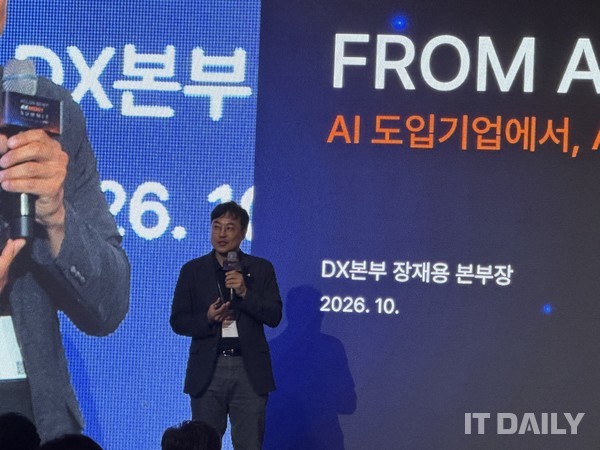
Jang spoke under the theme "FROM AI TO VALUE: From an AI-adopting company to an AI-performing company," focusing on manufacturing-site cases. He reviewed why AI adoption does not lead to results and presented ways to turn AI adoption into performance.
Jang stressed that attention should be paid to cases in which on-site work methods remain unchanged even after AI is introduced. He explained that when a defect occurs at a factory, production, equipment, and quality records are scattered across multiple systems, and the process continues in which these dispersed records are collected one by one, an experienced worker judges the cause, and action is decided by phone or meeting.
Through such manufacturing-site cases, Jang pointed out situations in which data is scattered across multiple systems and judgment and action processes remain centered on manual work. The photo shows Jang Jae-yong, head of Kolong Benit’s DX Division, giving a presentation, and it was taken by reporter Yang Seung-gap.
As a way to solve problems at manufacturing sites, connecting relationships between data was proposed. It was explained that a single piece of information such as equipment temperature of 92 degrees makes it difficult to determine whether there is an anomaly, but the cause can be identified when the context of a temperature increase at a specific piece of equipment after a raw-material change is also understood. The key is to diagnose problems on the basis of AI understanding the on-site situation.
He said that in existing factories, most of the time is spent searching for, collecting, and cross-checking related data, and analysis comes afterward. In contrast, he said that in factories where data is connected, this preparation time can be greatly reduced. The capabilities needed for this were presented as ontology, process intelligence, and AI agents.
The focus was placed on reflecting AI diagnostic results in actual work. Diagnostic results are to be reflected in work instructions and proposals for changes to operating conditions. However, he explained that in manufacturing sites, because AI judgments can affect actual factory operations such as equipment running, control over the execution process is necessary.
He first stated the principle that the roles AI should perform at manufacturing sites and the scope of human approval must be separated. He said AI cannot arbitrarily control a factory, and explained that it is necessary to divide the stages of anomaly detection, root-cause analysis, action recommendation, human approval, and execution within the allowed scope.
He then introduced Kolong Benit’s manufacturing AX achievements. Kolong Benit automated valve operation, supported vision AI and measurement technology for workers’ visual boundary judgments, and shortened waiting time for sample analysis results. Along with this, Jang explained that production capacity improved by 28.6%.
Jang also presented an AX methodology. He explained that the AX methodology consists of task selection, infrastructure setup, work redesign, organizational change, performance measurement, and operations, and is an approach that designs work application, performance management, and post-adoption operation together from the stage of defining the problem to be solved.
He said the future of AI lies not in the technology itself, but in the business that AI changes. He also said that Kolong Benit’s position is not limited to introducing technology, but extends to helping customers with on-site operations and performance creation.
Source: IT DAILY · Yang Seung-gap
Original: https://www.itdaily.kr/news/articleView.html?idxno=242146
References
This article was produced with the help of an automated content generation algorithm.
Source: IT DAILY
View originalThis article was summarized and organized by BizCrush based on the original article from IT DAILY. For exact quotations and full details, please refer to the original article.