At KES, Home Appliance Profit Models Expand... Samsung Bets on
IT DAILY ·
✦ AI Summary
KES 2026 opened at COEX in Seoul, and Samsung Electronics and LG Electronics showed different ways of expanding revenue streams in their AI-based home appliance businesses.
Samsung Electronics emphasized mobile, TV, and home appliance integration, subscriptions, and installation and management services, while LG Electronics applied home appliance technologies to data centers, factories, and robots.
Samsung emphasized connectivity and subscriptions, while LG emphasized industrial technologies, and AI data center cooling and HVAC were mentioned as areas where the two companies intersect.
At Korea Electronics Show (KES 2026), which opened at COEX in Seoul on the 13th, the exhibition highlighted the expanding home appliance profit models seen at KES, along with Samsung Electronics and LG Electronics diversifying revenue streams in their AI-based home appliance businesses. The two companies shared AI as a common foundation, but expanded profits in different ways. Samsung Electronics linked mobile, TV, and home appliances, paired them with subscriptions, and targeted demand after product sales by combining installation and management services. LG Electronics, meanwhile, leveraged air conditioning, motor, and manufacturing technologies accumulated in home appliances and applied them to data centers, factories, and robots.
That difference in direction was also reflected in each company's booth setup at KES 2026. Samsung Electronics' booth covered 869 square meters (about 263 pyeong), with mobile, TV, and home appliances displayed together and subscription services introduced in a separate space. LG Electronics' booth covered 902 square meters (about 273 pyeong) and was divided into a 'daily life layer' and an 'industrial layer.' The 'daily life layer' focused on consumer lifestyles, while the 'industrial layer' presented B2B technologies as a collection.
At 'KES 2026 (Korea Electronics Show)' held at COEX in Seoul, the areas emphasized by Samsung Electronics and LG Electronics differed. At this year's exhibition, Samsung Electronics focused on connectivity between devices and post-sale services, while LG Electronics highlighted use cases expanded into industrial applications.
Samsung Electronics displayed the Bespoke AI Family Hub refrigerator, Bespoke AI Combo, home appliances, TVs, and mobile devices. The company presented AI features in individual products and SmartThings connectivity across different devices. As an effect of SmartThings connectivity, it highlighted operating environments tailored to user situations.
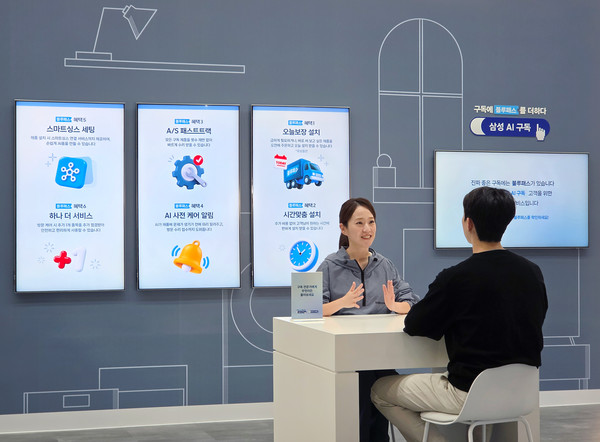
Samsung Electronics expanded that direction into a subscription-linked strategy. At this exhibition, the company presented a consultation booth for the 'Samsung AI Subscription' service. Last month, the existing 'AI Subscription Club' was renamed 'Samsung AI Subscription.'
Samsung Electronics strengthened its 'Blue Pass' service, which bundles delivery, installation, and after-sales management. It also segmented services by customer group, including newlyweds and older adults. It introduced 'B2B Samsung AI Subscription,' a service for corporate customers, as well.
LG Electronics arranged solutions for data center cooling, smart factories, robot actuators, and automotive applications. The company emphasized industrial applications of technologies secured in home appliances. Photo source: Samsung Electronics.
Samsung Electronics presented a way to ease the upfront cost burden when large-scale product adoption is needed through corporate subscriptions for public institutions, hotels, medical services, finance, and other sectors. Corporate subscriptions include up to 6 years of free AS, and corporate Blue Pass includes emergency on-site dispatch within 48 hours on a business-day basis after an AS request, along with assignment of a dedicated engineer for each workplace.
At this year's KES, Samsung Electronics set up a separate space to introduce subscription product installation and after-sales services. In the mobile exhibition area, it unveiled the 'New Galaxy AI Subscription Club' alongside new products such as the Galaxy Z Fold8 series, and the service provides damage coverage, loss coverage, water damage coverage, and residual value coverage.
Samsung Electronics is using the smartphone, TV, and home appliance lineup, along with SmartThings, as the foundation of its subscription business. It is also expanding subscriptions, previously centered on home appliances, to mobile and corporate customers, and the scope of the subscription business now includes installation, management, and coverage services after product sales.
LG Electronics participated in the 57th Korea Electronics Show held at COEX in Gangnam-gu, Seoul. It divided the exhibition into consumer and industrial sections. The consumer section featured home appliance subscriptions, the modular home 'Smart Cottage,' and the AI mobility space 'Spielraum.'
The industrial section displayed AI data center cooling, smart factories, robot actuators, and automotive solutions. Among these, the area given the greatest weight in the industrial section was AI data center cooling. One of the exhibition items was a 'chip-to-chiller' total cooling solution.
This solution links a chiller, a cooling distribution unit (CDU), and a cold plate. The chiller produces cold water. The abbreviation for cooling distribution unit is CDU, and the cold plate directly absorbs heat from semiconductor chips.
This exhibition reflects rising computing density in AI servers. As a result, demand for liquid cooling, which complements conventional air cooling, is increasing. LG Electronics has about 60 years of accumulated heating, ventilation, and air conditioning technology, and it has also built a product lineup covering chillers, CDUs, and cold plates.
Last month, it unveiled liquid cooling products, including 1㎿ and 2.6㎿ CDUs, as well as modular cooling infrastructure. Based on these technologies and product lines, LG Electronics also presented a plan to expand its business scope across data center design, build, and operations.
LG Electronics is expanding the motor and manufacturing technologies accumulated in home appliances into robotics and smart factory areas. Based on motor technology used in washing machines and other products, it developed the robot actuator brand 'Axium' and displayed both 'Axium' and DD motors at the same time. In the smart factory space, it is operating 3 autonomous mobile collaborative robots, 'LG MoMA,' which handle materials transport and work tasks.
LG Electronics is pushing ahead with the commercialization of its manufacturing technologies accumulated at its own production sites in the B2B business. It has experience in designing and operating production processes using AI, digital twins, and robots, and it is supplying those capabilities to outside companies in the form of smart factory solutions.
These business changes were also reflected in revenue indicators. In the second quarter of this year, LG Electronics' B2B revenue was KRW 6.5 trillion, up 5% from a year earlier, and B2B accounted for 36% of total revenue excluding LG Innotek. Revenue from the combined product-and-service subscription business was KRW 660 billion in the same period, up 5%.
At this year's KES, Samsung's relative emphasis was on connectivity and subscriptions, while LG's relative emphasis was on industrial technologies. However, it is difficult to apply a simple consumer-versus-corporate dichotomy to the two companies' business directions.
One point of overlap is the HVAC field, including AI data center cooling. In this area, Samsung and LG's business territories intersect.
After acquiring FläktGroup last year, Samsung Electronics is moving ahead with building a domestic production base. Last month, it broke ground on a FläktGroup HVAC production line at its Gwangju plant, with an investment of about KRW 240 billion. The production line covers 21,800 square meters (about 6,600 pyeong), and the new line is scheduled to begin operations in early 2028.
The production line will make cooling distribution units (CDUs), fan wall units (FWUs), computer room air handlers (CRAHs), and air handling units (AHUs). The main target markets are AI data centers, semiconductor manufacturing facilities, battery manufacturing facilities, and large commercial facilities.
Samsung Electronics plans to combine FläktGroup's central air conditioning technology with 'SmartThings Pro,' a B2B connectivity and integrated control platform, and to pair it with building integrated solutions as well, creating a structure in which SmartThings, which originated in home appliances, will be used not only for corporate subscriptions but also for integrated control of industrial HVAC equipment.
Source: IT DAILY · Kim Byeong-ju
Original: https://www.itdaily.kr/news/articleView.html?idxno=242149
References
This article was produced with the help of an automated content generation algorithm.
Source: IT DAILY
View originalThis article was summarized and organized by BizCrush based on the original article from IT DAILY. For exact quotations and full details, please refer to the original article.