“In the AI Era, You Need Both Network and Security” ... Cisco Accelerates Push Into the Market With SASE
TECHWORLD · · 1 views
✦ AI Summary
At a press briefing on the 13th, Cisco unveiled its SASE business strategy in response to the expansion of AI threats.
In the Relentless Defense Report, the share of respondents saying they could respond to AI agent attacks was 54% globally and 37% in Korea, while Korea's cyber defense capability was 58 points.
Cisco said it would expand SSE on top of its SD-WAN customer base and intensify its push into the domestic market by leveraging the Seoul Region and AI Access.
Cisco is accelerating its push into the domestic security market amid the expansion of AI threats and has positioned SASE as the centerpiece of that effort. As it outlined its strategy against the backdrop of growing AI-related threats, Cisco said it will strengthen its network-security integrated SASE business and boost its market competitiveness based on a Seoul Region dedicated to Korea.
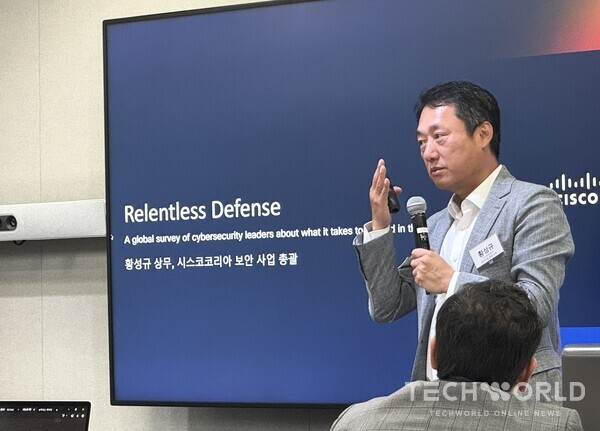
Cisco held a press briefing on the 13th. At the briefing, it presented the security threats companies are currently feeling and its SASE business strategy.
Cisco also released the results of the 'Relentless Defense Report' at the event. The report surveyed 8,000 security professionals across 30 countries and found that companies adopting AI agents were lacking in their ability to respond to security threats. In the responses, 54% said they could respond to attacks by AI agents, while the figure in Korea was 37%.
The global average cyber defense capability of organizations was 64 out of 100, while Korea's cyber defense capability came in at 58. Under Cisco's classification, the share of 'Relentless Defenders' was also 8% globally but only 1% in Korea. In both average score and share of top-tier defenders, Korea was shown to be below the global figures.
The main factor hindering stronger cyber defense capability was identified as internal friction within organizations rather than a lack of technology. Specifically, poor collaboration between teams, unclear decision-making authority, and data fragmentation were cited as problems. Such weak collaboration, unclear authority, and data fragmentation make AI adoption and management more complex, which in turn hampers security teams' ability to respond quickly.
Hwang Seong-gyu, executive director in charge of Cisco's security business, explained that the obstacle to corporate security response lies more in internal organizational issues than in a lack of technology. He added that security organizations need clearer authority and responsibility, along with stronger cross-department collaboration. He also said that, as AI is speeding up attack velocity, adopting AI on the defensive side is essential as well.
Cisco said it believes network and security can no longer be viewed separately amid changes in access environments and the expanding use of cloud, SaaS, and AI, and it emphasized the need to establish an integrated network-security framework. As companies' access environments have become more diverse, the linkage between network and security has strengthened, and Cisco also presented the view that network and security are inseparable.
Cisco said it recognizes the changing role of the network in response to these shifts. In the past, the network played a central role focused on connecting branches and data centers, but now it has expanded beyond a simple branch router to support access to a variety of applications and respond to hybrid work, the company said.
Looking ahead, Cisco said the network will continue evolving into an AI-based enterprise that supports connectivity among AI agents. Accordingly, Cisco plans to accelerate its push into the domestic market centered on SASE. SASE is a model that delivers integrated network and security functions through the cloud.
Cisco's strategy is to expand SSE on top of its existing SD-WAN customer base. To that end, it supports unified management through a single policy and dashboard, and it also supports seamless migration for Umbrella and VPN customers. It also addresses security threats related to generative AI use through AI Access and provides visibility and control for more than 3,800 AI applications.
Since the official launch of the Seoul Region in July this year, Cisco has been highlighting the advantages of the Seoul Region. The company said the Seoul Region supports high availability based on multiple domestic data centers and can process local traffic, helping companies reduce network latency and improve performance, while also enabling compliance with domestic data regulations.
Cisco also presented a strategy to support visibility across the network through ThousandEyes. Mukesh Chand Thapliyal, Cisco APJC SASE business leader, said that fully realizing cloud security requires strengthening both network and security at the same time, and added that Cisco is helping companies build a strong security framework through SASE, which combines network and security.
Source: TECHWORLD · Kim Hye-jin
Original: https://www.epnc.co.kr/news/articleView.html?idxno=408117
References
This article was produced with the help of an automated content generation algorithm.
Source: TECHWORLD
View originalThis article was summarized and organized by BizCrush based on the original article from TECHWORLD. For exact quotations and full details, please refer to the original article.