“Out of the Lab and Into the Field”: Physical AI Alliance Outlines Commercialization Road Map
IT DAILY · · 6 views
✦ AI Summary
On the 13th, Physical AI Alliance Day and the pre-event for Physical AI Tech Week were held at COEX in Seoul. The Ministry of Science and ICT and the Physical AI Alliance emphasized the 2027 cross-ministerial project direction, the technology architecture, the multi-ministry demonstration system, and the need for participation from demand-side companies. The event also featured Krafton, Nvidia, and Intel introducing technologies and directions related to robotics, simulation, and an open ecosystem.
The Physical AI Alliance Day, held under the theme of unveiling the Physical AI Alliance’s commercialization road map, took place on the 13th at COEX in Gangnam-gu, Seoul. The event was organized as a pre-event for Physical AI Tech Week.
The event was held amid a broader push to connect Physical AI research achievements with industrial sites. It was positioned as a venue to improve the structure of domestic manufacturing and industrial sites and secure leadership in global Physical AI, while bringing together a public-private-academic collaborative ecosystem.
Hosted by the Ministry of Science and ICT and organized by the Physical AI Alliance and the National IT Industry Promotion Agency (NIPA), the event drew more than 400 alliance member companies. More than 500 people gathered, including representatives from research institutes, venture capital (VC), and industry.
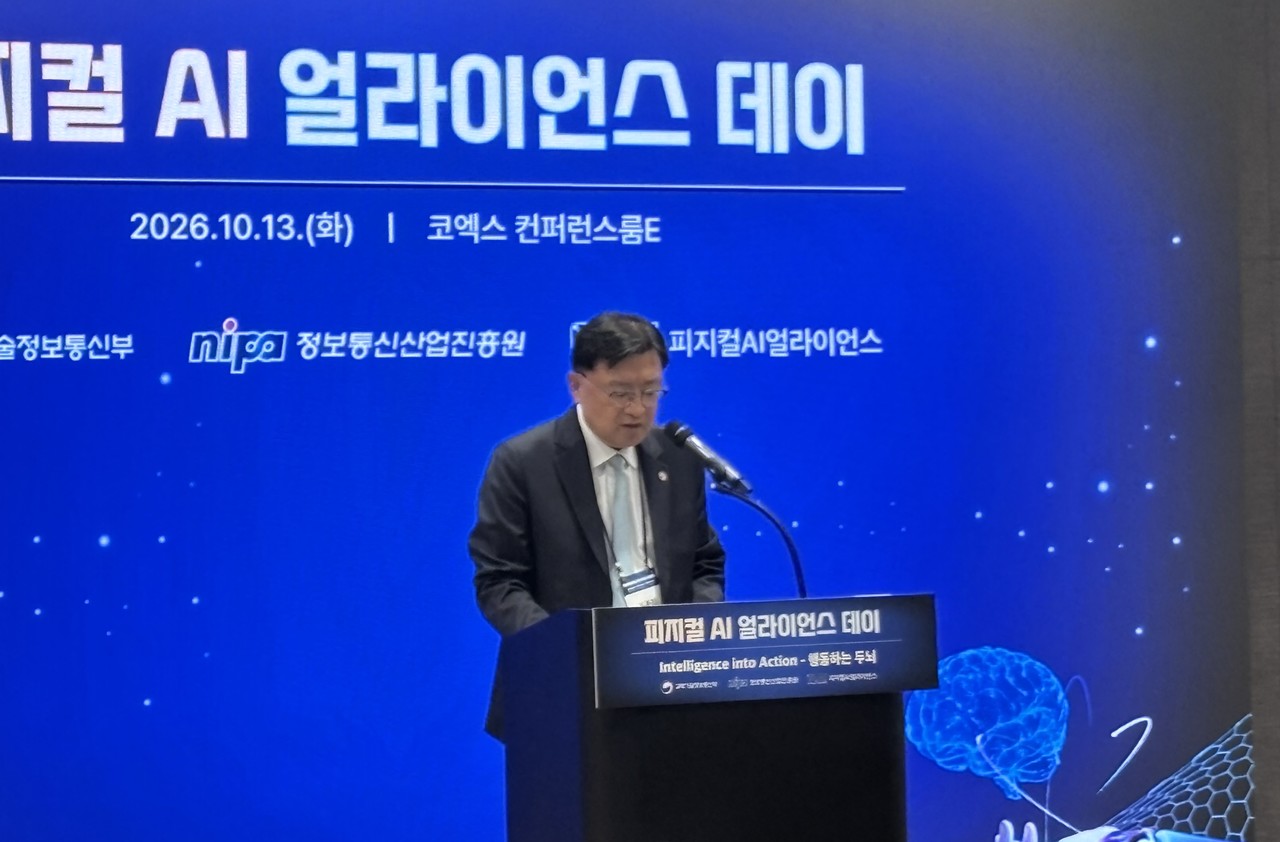
At the event, the 2027 cross-ministerial project direction and the next-generation robotics and physical intelligence technology architecture were shared with companies, research institutions, investors, and industry officials. KOSA President Cho Jun-hee delivered the presentation, and the photo was taken by reporter Kwon Young-seok.
At the opening stage of the event, the ministry and the alliance presented solidarity among demand-side companies and cross-ministerial cooperation as key preconditions that would determine the success or failure of Physical AI.
Lee Do-gyu, director general for ICT policy at the Ministry of Science and ICT, said Physical AI is a comprehensive industry that requires a combination of models, AI semiconductors, sensors, robot hardware, and industrial domain data. He also explained that tasks will be refined around three subgroups — technology full stack, industry bridge, and foundational governance — and that the ministry plans to link them with the 2027 cross-ministerial large-scale Physical AI project.
Cho Jun-hee, president of the Korea Software Industry Association (KOSA) and cochair of the Physical AI Alliance, said factory deployment of robot foundation models and on-device AI cannot be pursued by suppliers alone. He stressed that demand-side companies with factory and domain data must participate from the early planning stage.
Cho Jun-hee, president of the Korea Software Industry Association (KOSA) and cochair of the Physical AI Alliance, said a multi-ministry demonstration system is needed, involving not only the Ministry of Science and ICT but also the Ministry of SMEs and Startups, the Ministry of Agriculture, Food and Rural Affairs, and the Ministry of Oceans and Fisheries. He added that such a multi-ministry demonstration system should be used to create global export references.
Lee Kang-wook, CAIO of Krafton, who appeared as a speaker at the event, focused in his main session on attempts to expand the human interaction domain of robotics centered on physical control. The session addressed the trend of broadening the center of gravity in robot technology from physical control to interaction with humans.
Lee Kang-wook’s presentation was titled “AI for Socially Intelligent Robots.” He pointed out that the current robotics industry is skewed toward physical intelligence, citing manipulation and walking as examples.
He presented safe coexistence between robots and humans as a challenge in industrial and everyday settings. He then cited the ability to understand a person’s words and the ability to re-ask or judge context when given ambiguous instructions as conditions for safe coexistence.
Lee said that safe coexistence with humans would be difficult under existing manipulation- and walking-centered approaches alone, and argued for the essential combination of physical intelligence and social intelligence. He presented a direction to add social intelligence.
As the structure to implement this, he presented the Agent Harness architecture. The structure targets simultaneous processing of 3 inputs — visual, auditory, and tactile — and 2 outputs — physical action and voice — and aims to secure real-time responsiveness by linking separate LLM and physical manipulation VLA models.
At the site, Krafton and its subsidiary Ludo Robotics presented a live on-site demonstration, “Ludo 0.1,” jointly developed by the two companies. The demo ran in an edge local environment without cloud latency.
The demo implemented natural conversation with a person. It also showcased a function that identifies requested items and a function that performs item-delivery actions, and the motions were described as smooth.
The CAIO explained that the current harness approach is a transitional stage. He added that what is currently under development is a single integrated robot foundation model that accepts visual, text, and voice inputs.
He said the output form of the model is the simultaneous generation of physical action and voice. He added that the target timeframe is early 2027.
Alongside this, under the subheading that the Sim-to-Real simulation infrastructure is the solution, the importance of simulation infrastructure for overcoming the strict physical laws of the real world was highlighted. The photo caption identified Nvidia Korea President Jung So-young’s presentation at the event.
Nvidia Korea President Jung So-young gave a lecture on “Physical AI for Complex and Industrial Digital Twin.” In her presentation, Jung emphasized the need for a virtual simulation pipeline.
Physical AI involves physical constraints such as gravity and friction, so it requires an approach different from text-centered AI. In particular, Teleoperation-based data collection in real environments is not only astronomically expensive but also carries safety risks. For this reason, it was noted that relying only on data gathered in actual environments has limitations.
As a solution to reduce these limitations, Nvidia introduced Omniverse and Cosmos. Omniverse is a digital twin platform, and Cosmos is a world foundation model. Robot behavior outcomes can be pre-simulated in a virtual environment based on a physics engine, and this was explained as being intended to minimize Sim-to-Real error when deploying models learned in virtual environments to the real world.
Jung emphasized a full-stack ecosystem that unifies training, inference, and deployment based on the edge-embedded Jetson lineup and the Isaac robotics SDK. She also said domestic manufacturers such as LG Electronics are integrating Isaac and Omniverse. In addition, she pointed to next-generation smart factories and autonomous mobile robots as the main areas for deeper use of Isaac and Omniverse.
Intel Vice President John Healy said in a session presentation titled “Shaping the Future of Physical AI” at the event that industrial sites remain insufficiently prepared for mass production compared with the pace of Physical AI technology development. The on-site photo was taken by reporter Kwon Young-seok.
Intel Vice President John Healy explained, based on a survey of more than 800 corporate leaders worldwide, that there is a gap between progress in Physical AI technology and readiness for adoption in real industrial settings.
He said that a majority of respondents in the survey expected productivity to more than double when adopting Physical AI. On the other hand, he explained that the share of companies fully prepared for large-scale deployment was only 4%.
He then presented strategy, capability, safety, form, and scalability as conditions for large-scale establishment of Physical AI. He said these conditions are necessary for broader adoption.
He also stressed that field suitability, economic efficiency, and built-in functional Safety by design should take priority over outward humanoid appearance. He explained that field applicability and a safety-centered approach are needed over appearance.
As technical measures for implementing Physical AI, low-latency control-oriented Real-time Determinism and heterogeneous computing were presented. The purpose of applying TCC and TSN is to ensure immediate, no-delay responses to sensor input and motor control. A SoC optimization concept spanning CPU, GPU, and NPU was also presented, and its goal is to resolve the power, heat, and cost constraints of robot devices.
Healy then said that the major opportunity for Physical AI will be realized in an Open Ecosystem that is not tied to a specific vendor. He also said Intel will provide full support so that Korean partners can move from prototypes to large-scale mass production based on its open software framework and migration playbook.
The main program of Physical AI Tech Week on the 14th will be held as Physical AI Tech Day. Physical AI Tech Day will consist of in-depth technical sessions and talk concerts featuring experts from industry, academia, and research. The on-site technology exhibition will run throughout the event at COEX Conference Room Hall E, with 20 companies participating, including Rebellions, FuriosaAI, Nota, Yuil Robotics, and Rainbow Robotics.
Source: IT DAILY · Kwon Young-seok
Original: https://www.itdaily.kr/news/articleView.html?idxno=242142
References
This article was produced with the help of an automated content generation algorithm.
Source: IT DAILY
View originalThis article was summarized and organized by BizCrush based on the original article from IT DAILY. For exact quotations and full details, please refer to the original article.