[On Site] Directly Connect AI Agents Built by KakaoTalk Users... To Be Released in the First Half of Next Year
IT DAILY · · 5 views
✦ AI Summary
At if(kakao)26, Kakao unveiled services and technologies aimed at making KakaoTalk the touchpoint for using AI agents.
It released Kanana Space and Canvas, and plans to release a space for connecting agents built in other development environments to KakaoTalk in the first half of next year.
Kakao said it will add a browser-based execution path to reduce partners' development burden, while leaving final approval steps for important actions such as message sending and payments.
Kakao laid out a direction for making KakaoTalk the point of contact for AI agent use. At the event 'if(kakao)26,' held on the 13th at Kakao AI Campus in Yongin, Gyeonggi Province, the company unveiled related services and technology plans, and Kakao CEO Jeong Sin-a said the company's goal is a common touchpoint linking users' daily lives and agents. Kakao said it is pushing ahead with connecting AI agents made by partners and users to KakaoTalk.
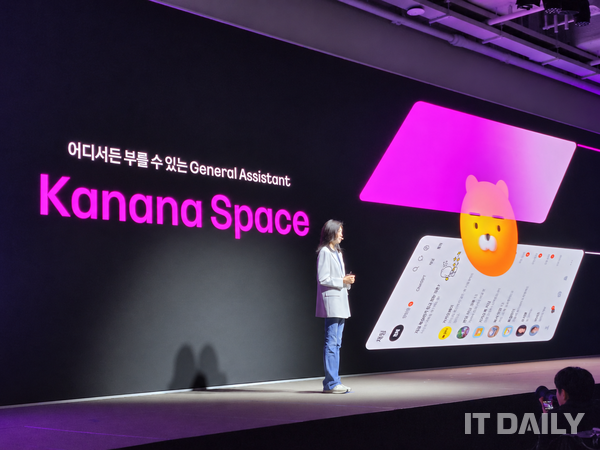
To that end, Kakao unveiled 'Kanana Space,' an AI calling feature inside KakaoTalk, as well as 'Canvas,' a PC agent-building tool. When users give instructions in conversation, the agent carries out tasks by using the services it needs and then delivers the results. Kakao said it plans to release a space for connecting agents built in other development environments, including 'Canvas,' in the first half of next year.
Kakao plans to add a browser-based execution path to direct service integration. It said the purpose of adding the browser path is to reduce partners' development burden.
Kakao said CEO Jeong introduced Kanana Space at the 'if(kakao)26' event on the 13th. Jeong said the challenges in expanding the agent ecosystem include partner investment in development and validating business viability.
Jeong said Kakao is using methods that connect AI and external tools through MCP and support collaboration between agents through A2A, and that it is pursuing partner service integration through these approaches. She added, however, that the integration process requires development resources and that existing revenue structures are also a consideration.
She also said validation is needed on whether the system can actually connect to traffic and revenue, and that such validation takes time and persuasion. She added that Kakao feels the need for easy partner participation and that business value must be confirmed quickly.
To ease these constraints, Kakao said it plans to maintain server-based agent authentication and payment integration while adding a task path based on a managed browser environment. If direct integration is possible, a commerce agent will process a user's bottled water order request through MCP or A2A, and if browser work is needed, a browser agent will handle it in a separated cloud environment.
Kakao said authentication information will be protected by keeping it in an isolated environment. As a principle for using information, it said only the information needed for the order will be used among the information the user has permitted.
Jeong said users can delegate tasks within conversations they are already familiar with. She added that service providers can also choose the integration method depending on the situation.
Canvas was introduced as a service that lets users build agents themselves. On a PC, users assign roles and tasks, then connect tools and functions to create an agent. The agent performs repetitive and scheduled tasks within the scope permitted by the user.
Canvas consists of a core engine that remembers task context, a separate browser for each agent, and a sandbox that restricts the execution scope. The separate browser is intended to keep users' everyday web services separate from each agent's access information. The sandbox is designed to limit the agent's tasks from affecting other areas of the PC.
Canvas is also preparing a feature for users to share agents they have built with one another. The company plans to conduct a private test with a small group of users as early as later this year. Kim Dae-nyeon, Kakao's head of design and performance leader, explained a use case for Kanana Space using personal schedules and activity records. The photo was taken by Kim Byung-joo.
Kanana Space is the entry point for task requests within KakaoTalk, designed so users can call up AI and delegate work directly on the screen they are viewing without leaving KakaoTalk. When users swipe with two fingers on the screen, the Ryan character appears, and requests can be entered by voice or text. It is a method for calling AI on the current screen without moving to a separate tab.
Kim Dae-nyeon, Kakao's head of design and performance leader, explained the design background. As the tasks to be done, relationship context, and user intent all change each time KakaoTalk moves to a different screen, the system was designed to call AI at the needed moment without disrupting the existing flow of use.
Accordingly, the company made both the calling method and the input method adjustable to suit the situation. In situations where speaking is difficult, users can switch to text mode, and it is also possible to set the system so that a floating button on the screen can be used as an alternative to the two-finger gesture.
In the demonstration, the AI called in this way organized work-related content among unread messages and handled a request to send a reply in a project chat room. It also showed extracting to-do items such as reply deadlines and linking them to follow-up actions, as well as changing settings such as marking messages as read or turning off notifications, and searching past conversations for needed information.
Kakao presented a structure in which AI supports the process but leaves the user's final approval in place for important actions. Final approval is required for each important action in the case of sending messages and making payments. Kim said AI supports the process while the user retains final decision-making authority.
Kakao also disclosed the schedule for Kanana Space. Pre-registration for Kanana Space begins on the 13th. In December, the company plans to begin a private test with some applicants.
Future items slated for advancement include ordering, gifting, reservations, and remittances. With this announcement, Kakao said these functions will be the targets of later upgrades.
For the use of personalized information, Kakao said it will manage usage conditions and the scope of permitted actions separately. 'Project Mosaic' will handle organizing users' memories and experiences. It also said the scope of information provided by 'Project Mosaic' will be limited to information needed for the current request, the range for which consent was given, and service and agent targets.
Song Jae-ha, Kakao's CTO, explained the scale of the company's data, messaging, and computing operations, and said user preferences should not be inferred from purchase history alone. As an example, he pointed to the possibility that a record of buying children's shoes as a gift for a nephew could be mistaken for the user's own preference. Such misunderstandings can lead to incorrect recommendations.
Accordingly, Kakao plans to manage facts separately from interpretations. It also plans to manage sources, timing, and status together. The purpose is to verify the basis for judgment and the validity of information.
The criterion for deciding which services receive memories is user consent. Information consented to for a specific service also applies to information for the same user, but is not provided to other services. If consent is withdrawn, the relevant memory provision will stop in the information-provision interface, and that will apply from the next request.
However, because the memory system is non-retrievable, memories already received and stored by a service are excluded. Song, the CTO, said that even at the stage of using information that has already been delivered, complying with user choices is a shared responsibility of the service and the memory platform.
The authority to use information and the authority to actually execute an order are also separate. Song said the role of memory is only to provide a basis for judgment, not authority to act.
The execution conditions when delegating an order to an agent are allowable products and purchase limits. Even if the task is redelegated to another agent, the execution conditions must be maintained. If conditions change due to stock shortages or price changes and the task goes beyond the scope of the delegation, user confirmation is obtained.
Kakao intends to examine the scope of safety verification not only for the final response but also for the decision-making process and tool-calling process. Song said that if the order API is called before a denial response for the order, a problem may already have occurred. Accordingly, before execution, the system checks the action plan, and services also verify account authority and the scope of user delegation.
Kakao plans to use a test environment that does not affect the outside world. In this test environment, stockout and price-change situations are reproduced. Based on this, the company plans to evaluate both whether dangerous execution is blocked and whether normal requests are handled.
Meanwhile, for large-scale user-support operations, Kakao will apply a workload distribution method based on request difficulty. According to the photo caption, Ro Byung-seok, head of development for Kakao's foundation model and performance leader, explained the Kanana model allocation structure by request difficulty. Ro said the company aims for the best result for every request, but does not use the largest model for every request.
Tasks that can be handled on the device are assigned to an on-device model. Complex requests are handled by a large server model. In this process, the 'AI conductor' is responsible for coordinating the appropriate model, tools, and execution order.
For the time spent waiting for order results, the company proposed maintaining the state needed to continue subsequent processing, and in the meantime redistributing execution resources elsewhere. It also said it is preparing an internal operating environment and an external cloud connection method to respond to traffic spikes, and is also preparing a plan to configure the internal operating environment and external cloud as a single cluster.
Source: IT DAILY · Kim Byung-joo
Original: https://www.itdaily.kr/news/articleView.html?idxno=242144
References
This article was produced with the help of an automated content generation algorithm.
Source: IT DAILY
View originalThis article was summarized and organized by BizCrush based on the original article from IT DAILY. For exact quotations and full details, please refer to the original article.