MS to Scale Azure Maia In-House AI Chip Infrastructure to Multiple Gigawatts
IT DAILY ·
✦ AI Summary
Microsoft is expanding its in-house AI accelerator Azure Maia infrastructure to multiple gigawatts (GW).
On the 13th, Microsoft unveiled the next-generation roadmap and detailed architecture for the Azure Maia program, outlining plans for Maia 200 and Maia 300.
Maia 300 adopts an inference-first design and a multi-chiplet architecture, and it is scheduled to be deployed in production environments starting in 2027.
Microsoft has begun expanding its Azure Maia AI accelerator infrastructure. The expansion will reach multiple gigawatts (GW), with the goal of accelerating self-sufficiency in AI infrastructure built on its own chips. On the 13th, Microsoft unveiled the next-generation roadmap and detailed architecture for the Azure Maia program.
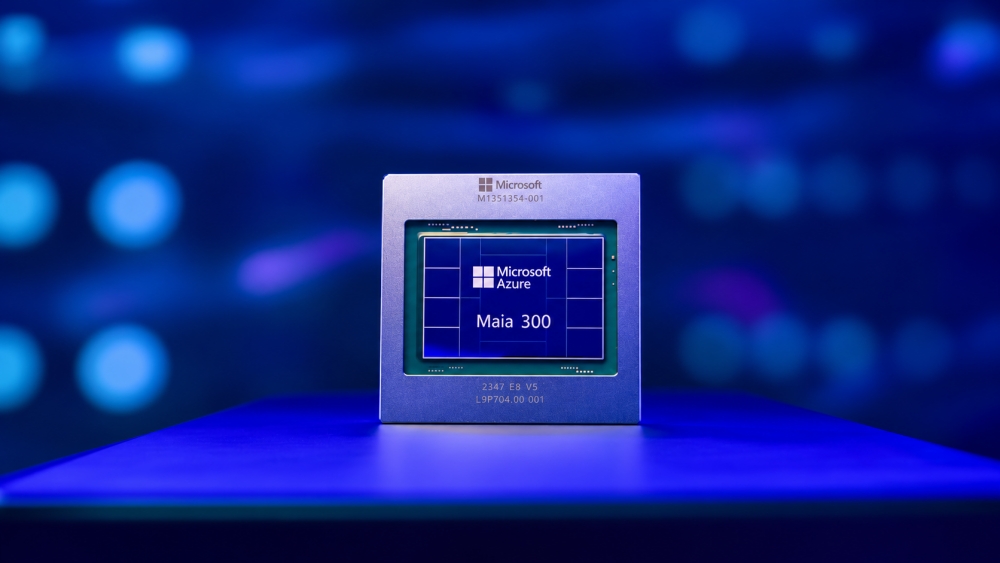
Microsoft is currently deploying "Maia 200" in Copilot services and other products, and it presented a roadmap centered on the next-generation chip, "Maia 300," as the next step. It also showed a prototype image of Azure Maia 300.
"Maia 300" is designed to deliver stronger inference performance and better energy efficiency. It is also intended for use in large-scale Agentic AI workloads.
Microsoft said it plans to expand global data center deployments of the Maia family to several gigawatts starting in 2027. It also plans to use the Maia family as the core AI inference engine for its own products and services.
The unveiling centers on the third-generation system, "Maia 300." "Maia 300" is designed with an "inference-first" architecture, targeting optimization for long-context processing, multi-step Agentic tasks, and ultra-low-latency conversational inference.
To that end, "Maia 300" adopts a multi-chiplet architecture. The aim is to minimize compute bottlenecks and data movement. The compute chiplets are manufactured on TSMC's N2P process, which is a 2-nanometer-class node. The memory configuration consists of 8 HBM4 stacks, and the thermal design power (TDP) range is 950 watts (W). Memory bandwidth reaches up to 18.0TB/s. On-die SRAM is used as temporary storage directly controlled by software, and Microsoft said it maximized per-watt compute efficiency by applying software-defined dataflow technology.
That configuration extends to the Scale-up network at the data center level as well. The Scale-up network uses Ethernet-based, custom AI transport technology. The power range of a single rack system is 167 kilowatts (kW), and the number of accelerators per rack system is 96. HBM capacity per rack is 27.6TB, and total bandwidth per rack is 1.7PB/s.
Microsoft said the next-generation Maia 300 is expected to deliver 40% higher token throughput per MW than existing GPU-based systems, and up to 7 times higher rack-level throughput than its predecessor, Maia 200. Maia 300 is scheduled to be deployed in production environments starting in 2027.
The current-generation Maia 200 has been deployed in data centers in the U.S., Europe, and Australia, and its footprint is expanding rapidly. Maia 200 is powering OpenAI models, in-house models, and major open-source models in Microsoft Copilot and the Microsoft AI (MAI) team's model development environment. Expansion of Maia 200's deployment is set to extend to GitHub Copilot and the enterprise platform Microsoft Foundry by the end of the year.
Microsoft said it will push ahead with expanding the Maia system. The goal is to strengthen its vertically integrated infrastructure competitiveness across silicon, systems, and higher-level AI agents.
Source: IT DAILY · Kwon Young-seok
Original: https://www.itdaily.kr/news/articleView.html?idxno=242140
References
This article was produced with the help of an automated content generation algorithm.
Source: IT DAILY
View originalThis article was summarized and organized by BizCrush based on the original article from IT DAILY. For exact quotations and full details, please refer to the original article.