AMD Unveils 'Helion' Agentic AI Rack, Supporting 32,768 CPU Cores
TECHWORLD · · 1 views
✦ AI Summary
AMD unveiled 'AMD Helion,' a rack-scale computing solution aimed at the era of agentic AI.
Helion is an open infrastructure blueprint based on OCP specifications and is designed to flexibly combine CPU and GPU resources for agentic AI workloads.
AMD said it plans to propose the Helion specification to OCP and is developing the rack with ecosystem partners for a scheduled release in November 2026.
AMD unveiled 'AMD Helion,' a rack-scale computing solution aimed at the era of agentic AI. AMD announced the 'AMD Helion Agentic AI Rack' in Santa Clara, California, on the 12th local time and said on the 13th that it had made the announcement.
The announcement lays out an open agentic AI infrastructure blueprint based on Open Compute Project and OCP specifications. 'AMD Helion' extends the open-platform approach of AMD's existing rack-scale solution, 'AMD Helios,' by combining AMD computing technology with open hardware and software.
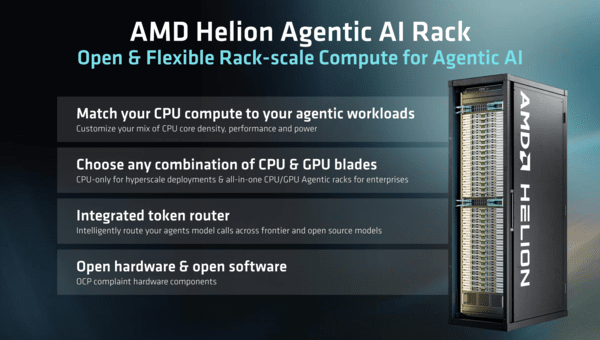
'AMD Helion' is designed to let customers adjust CPU core density, performance and power consumption for agentic AI workloads. The product supports 32,768 CPU cores.
AMD said agentic AI is spreading across personal AI agents, enterprise applications, code execution and complex business workflows, and that computing requirements vary accordingly by workload. It added that as the use cases for agentic AI broaden, the required computing resources also differ from task to task.
Accordingly, AMD said the core value of AMD Helion is that it does not treat agentic AI as a single computing environment. The company said it supports flexible combinations of CPU and GPU resources by task type and presented a rack design for optimizing the overall infrastructure, including AI model inference, agent execution and general computing.
The first configuration is a CPU-only rack for hyperscale customers. Based on 6th Gen AMD EPYC processors, it supports up to 32,768 CPU cores. AMD said the rack is designed to provide dedicated computing capacity for agent execution and to connect with separate model inference infrastructure.
The enterprise all-in-one rack combines AMD EPYC CPU nodes, AMD Instinct MI350P GPU nodes and general-purpose computing resources into a single platform. This allows enterprises to build agentic AI systems that integrate agent execution, GPU-based model inference and general computing.
The rack supports both air-cooled and liquid-cooled configurations. That makes it possible to build systems tailored to existing IT infrastructure, data center environments, power conditions and cost requirements.
Dan McNamara, senior vice president and general manager of AMD's Compute and Enterprise AI business, said agentic AI is not a single workload. He said AMD Helion combines AMD EPYC performance, open software and a flexible rack design, helping partners build customer-specific systems and efficiently use available power.
AMD said it is focusing Helion on improving the flexibility of agentic AI infrastructure based on open hardware and software, and proposed an integrated token router architecture. The integrated token router can distribute AI agents' model requests across frontier models and open-source models. AMD said this design supports the use of different models depending on the agent task.
AMD emphasized that agentic AI can be introduced into existing IT infrastructure. As a result, enterprises and service providers can keep existing infrastructure investments while adjusting CPU and GPU configurations. It also said they can allocate agent execution, model inference and supporting computing resources based on the performance, power and cost requirements of each deployment environment.
AMD plans to propose the Helion specification to OCP, with the goal of supporting further development and adoption within the relevant community. That aligns with its aim of avoiding dependence on proprietary systems from a single vendor and building on open standards. AMD also plans to expand the ecosystem through rack-scale AI infrastructure development with a range of partners, and the AMD Helion agentic rack is being developed with ecosystem partners and is scheduled for release in November 2026.
AMD is expanding its collaboration with global server, network and infrastructure companies to develop and bring Helion to market. In this process, Cisco, Dell Technologies and Hon Hai Technology Group are participating based on their respective infrastructure, systems integration, design and manufacturing capabilities.
Cisco plans to combine AMD Helion with its full-stack infrastructure capabilities. The company plans to use that combination to support the deployment, operation and scaling of agentic AI workloads. Jeremy Foster, senior vice president and general manager of Cisco's Compute business, said that in the era of agentic AI, not only computing performance but also system connectivity, manageability and security are important.
Dell Technologies will combine PowerRack, networking and storage capabilities with the AMD Helion reference design. Based on that, the company plans to support system deployment for large-scale agentic AI computing. It also plans to strengthen manageability and reliability.
Hon Hai Technology Group will support a Helion reference design based on 6th Gen AMD EPYC processors and flexible CPU and GPU configurations. It also plans to leverage rack-level systems integration and global manufacturing capabilities. Through this, it plans to cooperate in building hyperscale data center and enterprise agentic AI infrastructure.
Multiple companies are participating in or supporting the AMD-related open rack-scale and Helion/Helios ecosystem with their own deployment, cooling and integration capabilities. HPE has continued its collaboration with AMD and highlights open large-scale system deployment, air-cooling technology and direct liquid-cooling technology as core capabilities. HPE referred to customer contracts related to AMD Helios deployment and emphasized the importance of open rack-scale architectures.
Lenovo is supporting Helion, aiming to expand options in its hybrid AI infrastructure strategy. Supermicro is supporting market adoption and cites OCP ORv3-compliant rack-scale architecture, liquid-cooling capabilities, software capabilities and deployment services as core elements. Wiwynn plans to support it through rack integration and advanced cooling technology, and intends to support system configurations tailored to power and data center environments for hyperscale customers.
The background to this trend is that agentic AI is evolving beyond simple question-and-answer interactions toward the autonomous execution of multi-step tasks. As a result, CPU resources are becoming increasingly important in AI infrastructure alongside GPU compute performance, and CPU resources handle agent execution. In addition, the importance of AI infrastructure is expanding to overall system efficiency, including power, cooling and networking.
Against this backdrop, AMD is seeking to expand its position in the agentic AI infrastructure market by highlighting the openness of infrastructure design through Helion, emphasizing Helion's open rack design and the flexibility of CPU and GPU combinations.
Source: TECHWORLD · Park Kyu-chan
Original: https://www.epnc.co.kr/news/articleView.html?idxno=408111
References
This article was produced with the help of an automated content generation algorithm.
Source: TECHWORLD
View originalThis article was summarized and organized by BizCrush based on the original article from TECHWORLD. For exact quotations and full details, please refer to the original article.