Veterans Edu Releases Score Progress of 3 Students Who Reached SAT 1500
TECHWORLD · · 1 views
✦ AI Summary
Veterans Edu disclosed that it runs SAT, AP, TOEFL, U.S. college admissions, and special admissions preparation programs for Korean diaspora and international school students, and that as of July 2026, 1,538 of its enrollees had scored at least 1500 on the SAT.
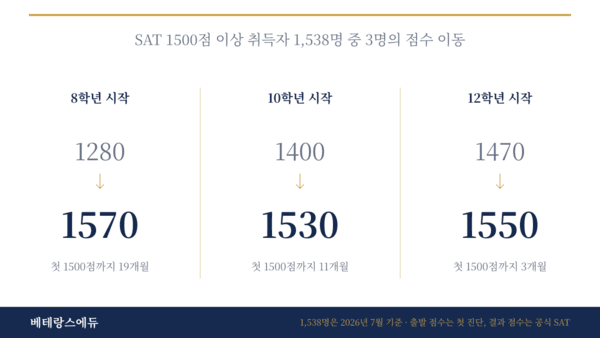
The disclosure highlighted 3 students who began preparing in 8th grade, 10th grade, and 12th grade; the periods until they first surpassed 1500 on the official SAT were 19 months, 11 months, and 3 months, and their final scores were 1570, 1530, and 1550.
The article said the students' score changes were linked to changes in how wrong answers were reviewed, and that, along with the starting point, initial scores, school schedules, and workload also affected differences in preparation time.
Veterans Edu, a college admissions education institute founded in 2011, runs programs for Korean diaspora and international school students covering the SAT, AP, TOEFL, U.S. college admissions, and special admissions for Korean nationals living abroad. Veterans Edu said it has 1,538 students among its own enrollees who have scored at least 1500 on the SAT, with the tally as of July 2026.
The latest disclosure presents the time it took 3 students, who started in different grade levels, to first surpass 1500 on the official SAT after beginning preparation, along with their final scores. The 3 disclosed students began preparing in 8th grade, 10th grade, and 12th grade, respectively, and the periods until their first official SAT score above 1500 after enrollment were 19 months, 11 months, and 3 months, respectively. Their final scores were 1570, 1530, and 1550, respectively.
Veterans Edu verified the official SAT scores of the 3 disclosed students by comparing them against the original College Board score reports. The disclosure was made with the consent of the 3 students to release their scores.
Student A attended an international school in South Korea and scored 1280 on the first diagnostic test in 8th grade. At the time, the English score was 610 and math was 670. In 8th grade, Student A studied sentence structure, vocabulary, and reading methods through academy classes and mock tests, and began taking official exams in 9th grade.
In the 3 to 4 months leading up to 1500, Student A's mock test scores fluctuated between 1460 and 1490. During this period, when reviewing wrong answers, Student A first explained the reasons for choosing each answer choice rather than the official explanation, and separately recorded where the judgment had gone off track. Student A also redid incorrect questions after mock tests, as well as questions that had been answered correctly but took a long time. Through this process, the English score rose from the low 700s to the high 700s. Student A first surpassed 1500 in the fall of 10th grade and scored 1570 in the same grade.
Student B, by contrast, attended an international school in Vietnam and scored 1400 on the first diagnostic test in 10th grade. At the time, English was around 680 and math around 720. Student B then prepared mainly by solving problems for about 6 months, but scores stagnated at 1400 to 1410 for about 6 months. After 10th grade ended, Student B enrolled in a summer intensive course, but scores in the first 5 to 6 months after enrollment in the course also showed only limited movement, at 1420, 1450, and 1440.
In a self-assessment, the first student said the amount of study was large but the quality of review was low. After the winter intensive course, the student began distinguishing and recording judgment errors for each wrong answer, practiced marking ambiguous questions and moving on for the time being, and redid wrong answers a few days later with the correct answer hidden. From March to May of 11th grade, the student also prepared for AP exams in parallel and studied only the questions that had been missed. As a result, the score was 1480 in the spring, the student first surpassed 1500 in May of 11th grade, and then rose to 1530 a month later.
Student C is affiliated with an international school in China and was preparing for the 3-year special admissions track. Student C scored 1470 on the first diagnostic test in March of 12th grade, with section scores of 700 in English and 770 in math. There were 2 official test opportunities before the July application deadline for special admissions, in May and June. From the end of April for one month, mock test scores fluctuated between the low 1500s and the mid-1400s, and Student C scored 1490 on the May test, with section scores of 710 in English and 780 in math.
This interview, conducted based on the student selection process Veterans Edu previously disclosed, records the cases of 3 students. It included a case in which a student scored 1550 on the final June test before the application deadline, with 760 in English and 790 in math. In the classes leading up to the June test, rather than adding new problems, the review focused on rechecking previously missed questions, and for questions where 2 answer choices were confused, the reasons for the correct and incorrect choices were explained based on evidence from the passage. Unresolved questions were also marked and left for later so that the student would not remain on a single question for too long.
The article said the catalyst for the score changes was a shift in how wrong answers were reviewed. The common difficulty for the 3 students was finding textual evidence in the English section and getting stuck between 2 answer choices. Accordingly, just before the June test, the students focused on reanalyzing existing wrong answers rather than increasing the number of problems, and this change in the wrong-answer review process was cited as a common factor linked to score movement for all 3 students.
The 3 students started at different grade levels and needed different amounts of time. Student C said that while when to start the SAT is important, it is equally important to set the preparation period differently depending on the current score level. The article summarized the differences in preparation time among the students as the result not only of the starting point, but also of factors affecting the time needed to reach their targets, including initial scores, school schedules, and workload.
Source: TECHWORLD · Kim Gyeong-ju
Original: https://www.epnc.co.kr/news/articleView.html?idxno=408105
References
This article was produced with the help of an automated content generation algorithm.
Source: TECHWORLD
View originalThis article was summarized and organized by BizCrush based on the original article from TECHWORLD. For exact quotations and full details, please refer to the original article.