Kolon Benit Moves Beyond AI Adoption to Value Creation... Unveils 6-Step AX Methodology
TECHWORLD ·
✦ AI Summary
Kolon Benit held the 'KOLON BENIT AX BOOST SUMMIT 2026' on the 13th at Seoul Dragon City.
At the event, action strategies for connecting AI use to real-world business innovation and results, along with industry-specific cases, were shared.
CEO Kang I-gu said productivity gains are not guaranteed by AI adoption alone, and that change at the customer site is the criterion for AX success.
Kolon Benit presented an AX strategy aimed not merely at introducing AI, but at creating business results. The company focused on outlining a direction that leads to business transformation and value creation.
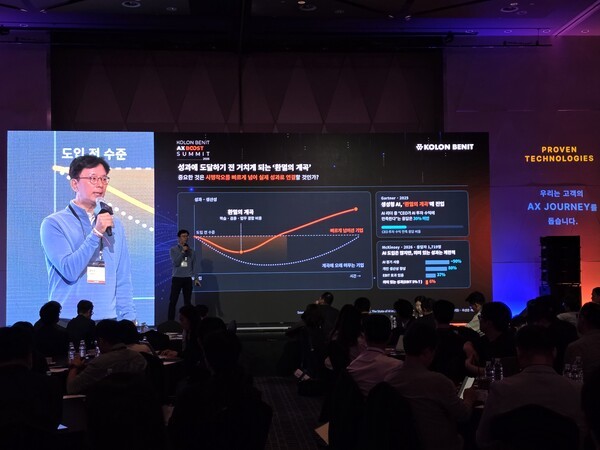
Kolon Benit held the 'KOLON BENIT AX BOOST SUMMIT 2026' on the 13th at Seoul Dragon City in Yongsan-gu, Seoul. Now in its second year, following last year’s event, it was attended by about 500 stakeholders, including customers and partners.
The event theme was 'Customer’s AX Journey.' The program shared action strategies for connecting AI use to real-world business innovation and results, while also introducing industry-specific cases.
Kang I-gu, CEO of Kolon Benit, said that productivity gains are not guaranteed by AI adoption alone. He added that what matters is how quickly companies can move past the stagnation phase in the process of learning and verifying the technology.
Kang said it is necessary to distinguish between the areas where AI is suitable for work and the areas that require human judgment, and that work methods must be redesigned to collaborate with AI. He explained that this requires industry and business knowledge to identify tasks that can be transformed with AI, as well as the combination of proven technologies to solve those tasks.
Kolon Benit said it plans to support customers’ AX initiatives based on its understanding of industries and customers. To that end, it will use global vendor solutions and an ecosystem of cooperation among more than 100 AI alliance participants. Kang said that last year he positioned the company as an Enabler for AX, and that going forward it would accompany customers through the entire process, from identifying business issues to creating business results.
Jang Jae-yong, head of DX Division, then delivered the keynote speech under the theme 'FROM AI TO VALUE: From an AI-Adopting Company to an AI-Performing Company.' According to survey results introduced by Jang, the domestic AI usage rate among companies stood at 58%, the share of companies with an AI strategy was 27%, and the lack of a method to measure investment effects was 47%.
He likened the situation in which companies expand AI pilot projects but fail to connect them to tangible results to an 'AI museum.' He pointed to several causes of this phenomenon: selecting tasks that are disconnected from management goals, distributed data, separation from actual work systems, and the absence of an operating framework after adoption.
As a solution, he presented a 6-step AX methodology. The methodology consists of selecting 3 to 5 priority tasks, setting up infrastructure, redesigning work processes, organizational change, performance measurement, and operations. He also emphasized 'scale-appropriate AX,' explaining that companies should first secure small successes tailored to their size and conditions, then gradually expand the scope of application.
Jang said the key is to establish a structure in which the first results become the basis for subsequent investment. He also stressed that AI must be put to use in actual business operations and that companies must move to a stage where results can be confirmed numerically.
In the customer presentation that followed, Kolon Industries’ case of pursuing manufacturing AX was introduced. Hong Sung-hwa, head of the AX Innovation Center at Kolon Industries, explained the changing competitive landscape in the petrochemical and materials industries and AI utilization strategies under the theme 'Manufacturing’s AX Journey, Our Concerns and Execution Cases.'
Hong said that amid intensifying cost competition, oversupply, and expanding supply chain risks, the success or failure of AX should be judged by AI-based value creation rather than the amount of AI adoption. He explained that six perspectives were presented as the criteria for establishing an AX strategy.
The six perspectives are value, key performance indicators (KPI), data, process, architecture, talent, and organization. The event then disclosed practical cases involving the application of a shipping document automation agent and vision AI-based classification.
The effect of the shipping document automation agent was presented as reducing processing time per case from 4 hours to 5 seconds. The accuracy of the vision AI-based classification was introduced as 99.8%.
At the event, SK AX adviser Shin Hyun-woo, Seo Woo Industry President Jo Seong-woon, and Seo Woo Advanced Materials Executive Director Shim Han-soo shared their companies’ AX implementation experiences. KAIST Professor Kim Dae-sik gave a special lecture on 'AGI Literacy and Leadership.' The afternoon program was run across three tracks — data analytics, AX execution, and enterprise service — with a total of 17 sessions.
The Data & Analytics track featured presentations on natural language-based data analysis, strategies for opening national statistics using synthetic data, data preparation for AI results, autonomous manufacturing and intelligent factory operations, and AI agents for smart homes. SAS, the Statistics Korea Information Center, and Cloudera took part in the track and introduced ways to connect data to actual AI results.
The AX Journey track featured cases and presentations focused on AI deployment, application, and operations at enterprise sites. A manufacturing AX case based on AI alliance cooperation was introduced, along with a presentation on the AX platform 'AXeed' with functions linking AI specialist companies and government support programs, vision AI application in industrial settings, AI deployment methods that do not move data, and integrated management of enterprise AI agents. Cohesity and IBM also participated to share AI deployment and operations technologies for enterprise environments and execution strategies for AI deployment and operations in enterprise environments.
The Enterprise Service track focused on SAP and AX applications in core business areas. Topics included SAP ERP AI application strategies and data integration, SAP S/4HANA transformation, and AI HR innovation based on SAP SuccessFactors, while approaches to applying AX to core enterprise functions such as finance, disclosure data integration, and ESG were also discussed.
Three large themed booths related to each track were set up at the venue. They were designed so that customers could directly examine AX implementation steps and practical application models.
The AX Journey booth introduced AXeed. The range of support provided by AXeed included AX diagnostics, matching with AI specialist companies, and review of government support programs. The booth also introduced an AI alliance cooperation model.
The Data & Analytics booth showcased Cloudera, SAS, and an Autonomous Manufacturing framework. The autonomous manufacturing approach was presented as a method of collecting and analyzing equipment data, identifying the causes of problems, deriving optimal operating conditions, and then applying those results on site. The booth also presented application areas such as production yield, quality inspection, predictive maintenance, energy management, and safety.
The Enterprise Service booth introduced SAP-based enterprise resource planning (ERP) transformation. It also highlighted data and AI utilization, AI HR innovation, AIoT and AI Home, and the automation of finance and disclosure data. The booth was aimed at AX services for innovation in core enterprise functions.
Kang I-gu said the criterion for judging AX success is not the type of technology adopted, but change at the customer site. He added that he hoped this event would be a place to explore where AI can create business results, seek directions for changing work methods to collaborate with AI, and derive answers regarding the technologies and partners needed.
Source: TECHWORLD · Park Gyu-chan
Original: https://www.epnc.co.kr/news/articleView.html?idxno=408109
References
This article was produced with the help of an automated content generation algorithm.
Source: TECHWORLD
View originalThis article was summarized and organized by BizCrush based on the original article from TECHWORLD. For exact quotations and full details, please refer to the original article.