Intel Bets on Agentic AI Infrastructure, Targets Inference Market With Xeon and GPU
TECHWORLD · · 2 views
✦ AI Summary
Intel unveiled an AI infrastructure strategy built around CPU, GPU, and open software for the era of agentic AI.
The main direction is toward system-wide efficiency and building heterogeneous AI infrastructure rather than individual accelerator performance.
Intel also disclosed Xeon-based rack designs and GPU D-series details as it pushes into the inference market.
Intel is strengthening its AI infrastructure strategy for the era of agentic AI and unveiling a plan that combines CPU, GPU, and open software. Its target market is the inference market. Intel announced the strategy on the 13th at the OCP(Open Compute Project) Global Summit in San Jose, California.
That day, Intel disclosed additional technical information on the GPU D-series(codename Crescent Island), a new Xeon-based rack design, and plans for open software and ecosystem innovation. The core of the announcement was to expand AI infrastructure by focusing on improving the efficiency of the entire system rather than competing on the performance of individual accelerators.
The backdrop for this strategy is the evolution of AI models into agentic AI. Agentic AI performs information retrieval, reasoning, tool use, and task execution. As agentic AI spreads, Intel said, the importance of role sharing among CPU, GPU, and specialized accelerators, as well as resource allocation, has grown.
Intel presented a plan to build heterogeneous AI infrastructure by combining general-purpose computing, dedicated acceleration technologies, open software, and standards-based systems. Through this, it is promoting the deployment of computing resources suited to each workload and pushing ahead with improvements in overall system performance and power efficiency.
Nicholas Dube, vice president of Intel's Data Center Systems and Solutions Group, said open models have expanded companies' options for adopting AI. He explained that realizing the potential of open models requires infrastructure with AI capabilities and computing resources suited to each workload, as well as cost efficiency.
Against this backdrop, Intel said it has jointly developed a Xeon-based rack design with ecosystem partners in response to the spread of agentic AI workloads, and it unveiled the Xeon-based rack design. Many of the disclosed designs apply the OCP Open Rack v3(ORv3) standard, which is intended to simplify the deployment and integration of open data center infrastructure.
Agentic AI is characterized by the continuous execution of multi-step tasks, and in that process, the orchestration function of general-purpose computing becomes more important than the model computations themselves. Key elements of operating agentic AI include data processing, I/O management, workload orchestration, and tool execution. For that reason, Intel said, the role of general-purpose computing is critical.
In this structure, the GPU handles model computation, while in real-world operations the CPU coordinates task execution and supplies data to accelerators. Xeon is used as the foundation for general-purpose computing that coordinates GPU and specialized accelerator operations and manages data movement and task execution. Intel announced that, based on some Xeon 6+ configurations, it can integrate more than 46,000 cores within a total rack power of 133.45kW, citing this as evidence of improved CPU computing density and support for large-scale expansion of agentic AI.
Intel has about 20 years of rack-level design expertise, and its Intel-based platform has a broad x86 software ecosystem. On that basis, Intel plans to connect existing data center systems with new AI infrastructure.
The criteria for evaluating AI infrastructure performance are changing. Metrics beyond the number of individual processor cores and computational performance are gaining prominence, and the importance of the number of concurrent agents per rack under target latency conditions is increasing. In this trend, Intel emphasized improving real workload throughput through Xeon's maintenance of data flow, Xeon's support for tool execution, and Xeon's supply of data to accelerators.
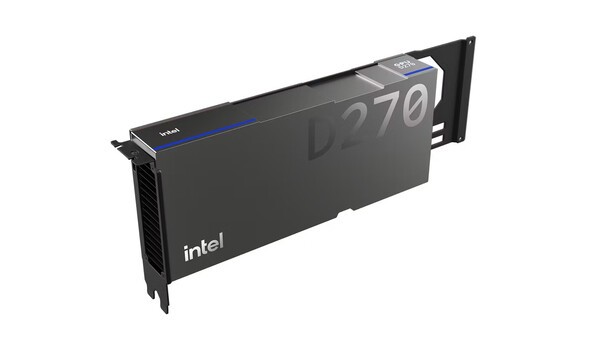
Intel also disclosed detailed specifications for the GPU D-series aimed at the large-scale AI inference market. The codename for the GPU D-series is Crescent Island, and its underlying architecture is Xe3P. The GPU D-series focuses on improving cost efficiency for memory-intensive inference workloads and offers up to 480GB LPDDR5X memory, 1.5TB per second of memory bandwidth, 1.3 PFLOPS of FP8 compute performance, and a 350W power range.
Intel said its strategy is to secure a balance among memory capacity, computational performance, and power efficiency. Through this, it aims to improve utilization in real inference environments.
The product's main applications are large language models(LLM), long-context processing workloads, and services handling concurrent inference requests, and its design goal is to address latency-sensitive workloads. Target uses include multi-tenant AI services and robotics, and a single card supports models with up to 300 billion parameters, while a system configured with 8 GPUs supports models with more than 1 trillion parameters.
The product uses a standard PCIe form factor and air-cooled design. As a result, it can reduce the burden of building dedicated racks and additional cooling infrastructure, and its key feature is improved ease of adoption in existing data centers.
The product is based on common Xe software and supports application portability across Intel GPU platforms. The goal is to maximize the use of existing software and existing development environments and support the transition to new GPU-based inference systems.
Anil Nanduri, who is responsible for AI products and GTM at Intel's Data Center Group, said AI inference has become a core workload, and accordingly enterprise infrastructure requires the right cost and the necessary performance. He said the goal is to achieve practical deployment of large-scale inference and cost-efficient expansion centered on the GPU D-series.
Intel is currently providing samples to customers and is working with OEM and ODM companies, neoclouds, ISV, appliance providers, and AI-focused companies. Intel plans to support customers' rapid transition from model evaluation to production environments through verified platform offerings, software integration, and ready-to-deploy solutions.
Kevork Kechichian, senior vice president at Intel's Data Center Group, said customer demands related to data centers are changing because of agentic AI.
Kechichian presented an open heterogeneous infrastructure that combines Xeon, purpose-built acceleration technologies, and interoperable software, rather than a single element, as the condition for success in responding to this shift. He said this foundation would help customers leverage existing investments and support the efficient scaling of new AI workloads while providing a flexible base.
Source: TECHWORLD · Park Gyu-chan
Original: https://www.epnc.co.kr/news/articleView.html?idxno=408089
References
This article was produced with the help of an automated content generation algorithm.
Source: TECHWORLD
View originalThis article was summarized and organized by BizCrush based on the original article from TECHWORLD. For exact quotations and full details, please refer to the original article.