AMD Unveils 'Helion' Agentic AI Rack-Scale Platform
IT DAILY ·
✦ AI Summary
Meta's tool downloads have recently reached several million in a short period, and as OpenAI and Anthropic put tens of thousands of agents into research and development, large-scale agent operations are entering full swing.
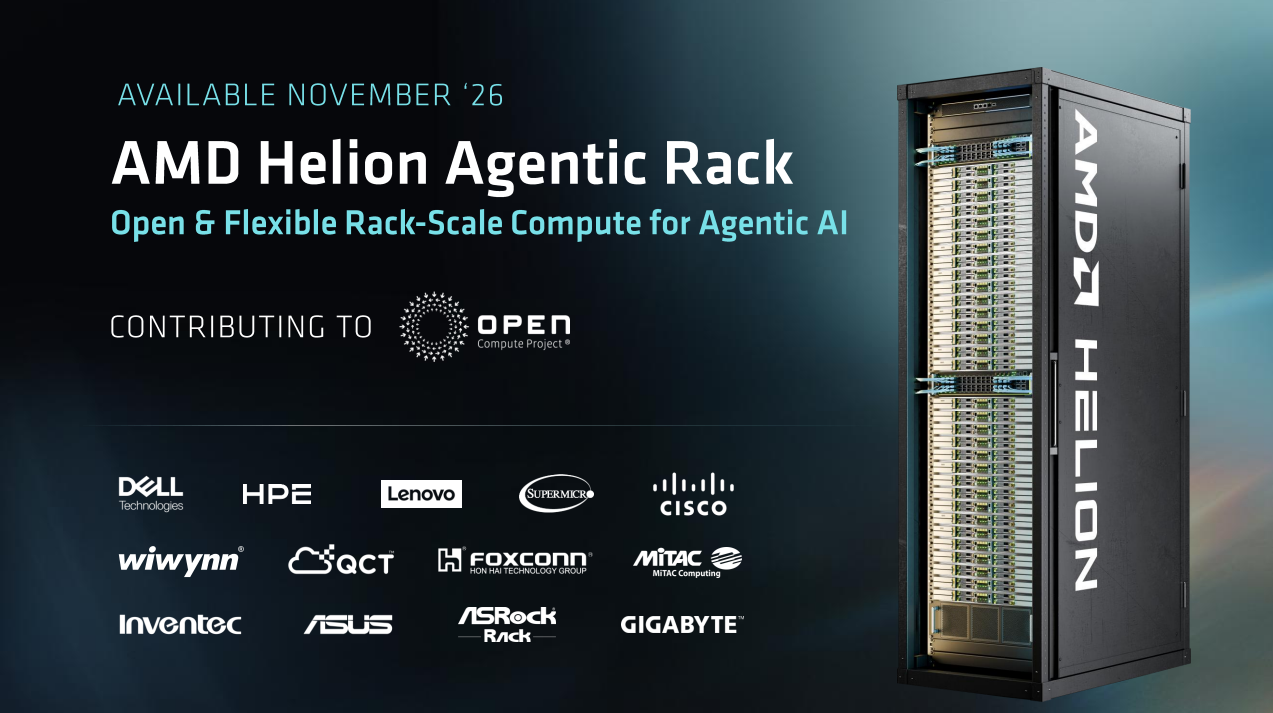
AMD unveiled 'AMD Helion,' an open agentic AI rack-scale infrastructure blueprint based on OCP specifications.
Helion proposes a disaggregated CPU-only rack for hyperscale use and an all-in-one (CPU+GPU) rack for enterprise use, while adopting the OCP ORv3 44U specification and a standard modular design.
Meta's tool downloads have recently reached several million in a short period, and as OpenAI and Anthropic put tens of thousands of agents into research and development, large-scale agent operations are entering full swing. Accordingly, the importance of CPU computing for supporting agents' complex control logic and orchestration is also rising sharply.
To meet this demand, AMD unveiled 'AMD Helion,' an open agentic AI rack-scale infrastructure blueprint based on OCP specifications. For hyperscale use, AMD proposed a 'disaggregated CPU-only rack,' and for enterprise use, an 'all-in-one (CPU+GPU) rack.'
Helion adopts the OCP ORv3 44U specification. It is also built on a standard modular design.
Helion supports both air cooling and liquid cooling. It is also designed to maximize data center power efficiency.
Helion will be equipped with the next-generation Zen 6-based 'Venice' processor. A single rack can be configured with up to 32,768 CPU cores.
The hyperscale rack is designed so that nodes can be flexibly combined by workload. The rack includes Node Type 1, which maximizes power efficiency density with 256 cores and 400W; Node Type 2, a balanced 600W option; and Node Type 3, which focuses on single-thread performance with 96 high-frequency cores.
The enterprise all-in-one rack includes 'CPU sandbox nodes.' The all-in-one rack integrates up to 16 'AMD Instinct MI350P' GPUs and general-purpose computing nodes for storage and DB in a single rack. Internal networking bandwidth within the rack reaches up to 102 Tbps.
With this configuration, companies can handle the entire pipeline within a single system without linking external infrastructure. The scope of processing ranges from agent execution to high-speed inference, allowing these tasks to be carried out efficiently.
The software stack comes with an intelligent 'Integrated Token Router' by default. The 'Integrated Token Router' analyzes an agent's model-call queries and then automatically distributes traffic between external commercial frontier models and on-premises open-source models based on task complexity and cost. This reduces computing costs and shortens response latency.
AMD said it plans to formally propose the Helion specifications to the OCP community. The goal is to move away from vendor lock-in and expand the open hardware ecosystem.
AMD is also developing systems with Dell, HPE, Lenovo, Supermicro, Cisco, Foxconn, and Asus, and the product is scheduled for official release in November. Dan McNamara, AMD senior vice president, said the workload requirements of agentic AI differ from one another. He added that the density of EPYC processors and flexible design make it possible to build the optimal custom system within a limited power budget.
Source: IT DAILY · Kwon Young-seok
Original: https://www.itdaily.kr/news/articleView.html?idxno=242128
References
This article was produced with the help of an automated content generation algorithm.
Source: IT DAILY
View originalThis article was summarized and organized by BizCrush based on the original article from IT DAILY. For exact quotations and full details, please refer to the original article.