[TECH in Review] CrowdWorks Turns Even Robot Behavior Into Data
TECHWORLD · · 1 views
✦ AI Summary
CrowdWorks was founded in 2017 and listed on the Kosdaq in 2023. It operates data collection and processing, enterprise AI products, and education through CrowdaAcademy.
Recently, it has been broadening its business into AI and robotics through corporate document processing, agent execution evaluation, robot training data, and regional base development.
Sales are up, but operating losses continue, leaving additional contract conversion for newly secured projects and customers, along with improved profitability, as key tasks.
Founded in 2017, CrowdWorks listed on the Kosdaq in 2023 and has built its growth on data collection and processing. The company has handled data labeling for object recognition in images, speech-to-text data labeling, and data construction for language model training. It has also added enterprise AI products to its business mix, while its subsidiary CrowdaAcademy runs an education business, broadening its support for companies adopting and using AI.
CrowdWorks is presenting enterprise agents and physical AI as the next areas to expand with its experience in building AI training data. It is carrying out a business that processes corporate documents into formats that can be used by AI, and it is also pursuing agent execution evaluation and the conversion of robot movements into training data. More recently, it has started supplying robot training data and has also set up a regional base for cooperation with manufacturing companies, expanding its business scope.
Sales have increased as the company has broadened its business, but operating losses continue. As a result, converting newly secured projects and customers into additional contracts, and improving profitability in product supply and operations, remain key tasks.
CrowdWorks organizes its main businesses into data, AI solutions, and education. In its data business, it builds materials for LLM development and AI training materials by industry. In its AI solutions business, it provides support for structuring corporate materials, agent development, and agent evaluation.
CrowdaAcademy runs the education business. Its offerings include data labeling training, AI-related training, government-funded courses, and corporate training. This business is responsible for training data workers and educating companies and institutions on AI use.
However, the share of education in the overall business has shrunk. According to an analysis by analyst Jeong Ho-yoon of Korea Investment & Securities in a report dated June 12, 2026, the education business, which accounted for 45% of sales in 2023, has contracted. At the same time, a shift in the business structure has emerged, with data and AI businesses replacing the reduced education share.
The report projected 2025 sales mix at 69.5% for the data business, 20.3% for the AI business, and 3.0% for the education business.
Recently, the scope of data construction projects has expanded from simple output-focused work to include the model's answer process and the execution process of agents. In July, the company won a project to build "complex document-based knowledge reasoning data" from the National Information Society Agency (NIA), which involved collecting and refining public documents that combine tables, graphs, drawings, and text. Workintelligence and Zendive participated jointly in the project, and the plan is to build more than 10,000 pieces of reasoning training data.
In September, the company joined a consortium led by Suhosofttech and won a project to support an "AI agent safety and reliability verification framework." In this project, CrowdWorks was tasked with designing multi-step call scenarios for external tools and APIs and building more than 7,000 Korea-specific verification datasets. The verification scope includes not only final answers but also evaluating the validity of the agent's planning and execution process.
The company is taking part in Kakao's consortium project, "Everyone's AI." It plans to handle the supply and processing of data for general-purpose chatbots and domain-specific agent development, and it will also support answer quality and safety verification.
At the center of the company's enterprise AI product lineup is Alpy. Launched last year, Alpy is a solution that supports the development, evaluation, and operation of workplace AI agents. It connects the data and models a company uses, helps structure work flows, and also supports performance and safety checks for agents.
Before that support begins, the company's documents are organized into a form that AI can read and search. This process uses Alpy Knowledge Compiler. Alpy Knowledge Compiler can analyze text, images, charts, and graphs in unstructured documents and structure them for use in RAG.
RAG is a method in which AI searches external materials and references them in its answers. For that reason, accurately reading the content and structure of documents is essential. The process of accurately reading and structuring document content and structure is presented as a key requirement.
The document processing system is operated in two parts: post-processing maintenance and management, and human correction of automated results. Alpy Data Portal handles the ongoing management role after document processing. Workstage is used for human correction work on automated results.
Alpy Data Portal handles linking data collection and storage, linking document segmentation, linking conversion for search, reflecting revised documents, setting department-specific access permissions, and providing original source text for answer references. Workstage provides data collection, processing, and inspection management functions, and also supports workplace staff in revising document analysis results and reflecting their specialized knowledge.
At the same time, the company is advancing enterprise AI deployment using its own small language model, SLM, WorksOne, as well as various LLMs. This deployment consists of linking document processing, data management, model application, and agent development and evaluation, with the goal of responding to each company's work needs and adoption environment. This year, the company also presented supply solutions for "Knowledge Compiler" and Workstage in the AI voucher program.
The company has expanded its data supply model from customer-specific build projects to a trading platform. On A1 Data Marketplace, launched last year, companies can purchase data for AI training.
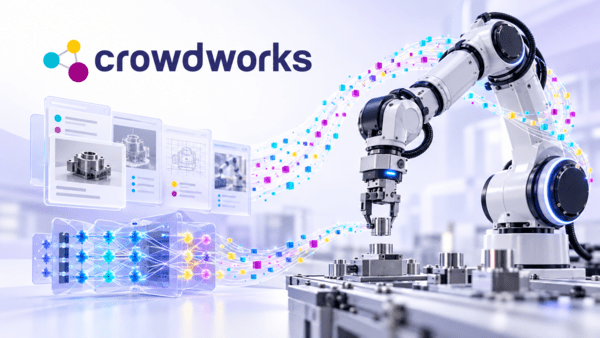
This year, the company began expanding the supply of robot behavior data in response to demand for physical AI development. The core data for the physical AI business is data that records, at the same time, the scenes the robot sees, its movements, and the force it applies.
In May, the company established an internal Physical AI Datalab. The team began research and proof-of-concept work using humanoid robots and teleoperation equipment. Its goal is to collect, process, and inspect robot joint trajectories, force, and visual information, and to advance its proprietary data platform.
In July, the company announced the supply of a robot precision manipulation dataset through A1 Data Marketplace. The dataset was collected by 145 operators worldwide remotely controlling robot arms and contains about 12,000 successful cases. Its scope covers 12 categories, from basic manipulation to advanced tasks. The delivery format is LeRobot for robot training, and it also includes quality information on completion, speed, path efficiency, and safety.
The company is carrying out a robot activity environment customized data processing business that processes the data needed for each robot-use setting, and it also operates the Physical AI Data Platform, a product that manages the data collection and processing process. The Physical AI Data Platform can manage remotely controlled and simulation-acquired behavior data, and it manages them by task, scenario, detailed task, and motion unit.
These capabilities were unveiled during the company's participation in "AI Festa 2026," held at COEX in Seoul from the 6th to the 8th. At the event, the company demonstrated remote robot control using VR devices and also disclosed the process of building training data.
In September, the company won the Mobirus agricultural autonomous driving data annotation project, where it is separating farmland, brush, farm roads, and dirt roads at the pixel level. This is intended to create training data for recognizing driving boundaries on farmland without lanes or road signs, as well as training data for judging obstacles in farmland. The company is also participating in related state-funded projects. In LG Electronics' project, "Development of World Foundation Model Technology for Physical AI Model Training," it is responsible for data collection and platform construction. In addition, in a project to develop a foundation model specialized for shipbuilding led by the Ulsan National Institute of Science and Technology consortium, it is refining industrial data and building training datasets.
The company continues to engage in cooperative activities with industry. It is a member of the Korea Physical AI Association and has also expressed its intention to join the second phase of the Ministry of Science and ICT-led "Physical AI Alliance." The company previously participated in the first phase of the Physical AI Alliance and says it plans to continue cooperation in the second phase, which began in June.
In particular, the second phase of the alliance focuses on linking specific cooperation tasks for technology development and industry applications. Through this, the company aims to expand contact points with manufacturing companies. It is a trend of broadening the scope of industrial cooperation by continuing participation in the association and the alliance.
In September, the company set up its Changwon office within the Gyeongnam AI Innovation Headquarters of the Gyeongnam Technopark. The Changwon office is its first regional base, tasked with identifying AI adoption demand among manufacturing companies and promoting proof-of-concept projects and industry-academia-research cooperation. The company has also announced plans to establish an Ulsan office as an additional base, expanding its business scope.
However, delays in improving profitability continue despite the broadening of its reach and rising sales. According to the semiannual report submitted to the Financial Supervisory Service's electronic disclosure system, consolidated sales in the first half of this year rose 33.5% year over year to about KRW 5.2 billion, but operating loss only narrowed 0.6% to KRW 5,746,250,000. Despite the increase in sales, losses continue, and the task of securing recurring revenue remains.
Analyst Jeong Ho-yoon said participation in major manufacturing and robot-related projects and the expansion of business areas were positive, but added that accumulated application results are needed. He also said recurring revenue must be secured and that an improvement in profits through securing recurring revenue is necessary.
CrowdWorks has expanded beyond corporate documents and language model training data to robot behavior and manufacturing-site work processes. Looking ahead, one of the key tasks is linking its experience in securing state-funded projects and regional bases with additional private-sector customer adoption. Another variable for the success of this expansion is whether the company can secure sustained profitability from data construction project sales and product supply and operations.
Source: TECHWORLD · Kim Seung-gi
Original: https://www.epnc.co.kr/news/articleView.html?idxno=407979
References
This article was produced with the help of an automated content generation algorithm.
Source: TECHWORLD
View originalThis article was summarized and organized by BizCrush based on the original article from TECHWORLD. For exact quotations and full details, please refer to the original article.