Platform User Protection Effectiveness Under Scrutiny in National Audit...Short-Form Content, Algorithms, and CI Reviewed
IT DAILY · · 4 views
✦ AI Summary
The effectiveness of platform user protection measures became a key issue in a National Assembly audit.
The omission of major overseas short-form drama operators from youth protection officer designation requirements, responsibility for recommendation algorithms, and youth protection measures for AI chatbots were discussed.
A case involving a CI leak victim's request to suspend processing and a membership withdrawal was raised, and the Broadcast Media Communications Commission said it would push ahead with legal revisions and consultations with relevant ministries.
At a National Assembly audit on the morning of the 12th targeting the Science, ICT, Broadcasting and Communications Committee and the Broadcast Media Communications Commission, the effectiveness of platform user protection measures emerged as a key issue. During the audit, lawmakers pointed out that a major overseas short-form drama operator had been excluded from the requirement to designate a youth protection officer, raising questions about whether platform protection rules are working properly in practice, and also called for clearer accountability over the agency responsible for responding to recommendation algorithms. In addition, a case was raised in which a victim of a data leak who had demanded that linked information (CI) no longer be used was instead processed as having withdrawn from membership.
The audit also raised calls for improvements to the system regarding identifying covered operators, internal safety measures within services, and responses after personal data leaks. As a result, lawmakers called for broader institutional fixes, from confirming the scope of covered operators to internal safeguards and post-incident responses, and the Broadcast Media Communications Commission said it would review how it investigates operators. The commission said it plans to consult with relevant ministries and also push ahead with legal revisions.
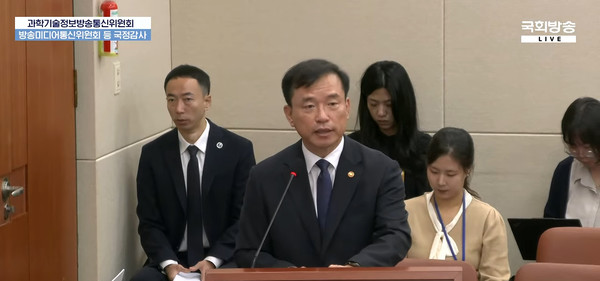
As the National Assembly audit of the Science, ICT, Broadcasting and Communications Committee, the Broadcast Media Communications Commission, and others was held at the National Assembly on the 12th, the possible failure to apply youth protection regulations to overseas short-form drama operators emerged as a key issue. Kim Jong-cheol, chair of the Broadcast Media Communications Commission, also made related remarks that day.
Rep. Lee Jeong-heon of the Democratic Party of Korea pointed out that major overseas short-form drama operators such as DramaBox and DramaWave were not included among those required to designate a youth protection officer. He argued that the method of relying on private panels centered on Android users and monthly active users was insufficient to reflect the actual scale of operators.
Lee raised the issue on the grounds that insufficient understanding of the domestic user scale of overseas operators could create gaps in the application of youth protection obligations. He also raised issues regarding the review of sexually suggestive short-form content and advertisements.
In response, Kim Jong-cheol, chair of the Broadcast Media Communications Commission, said the agency would review its investigation methods and consult with relevant organizations to reduce blind spots. Ko Gwang-heon, chair of the Broadcast Media Communications Review Commission, said it would set a period, conduct intensive monitoring and reviews, and then report the results.
In the area of recommendation algorithms, responsibility was a key issue, with debate over which agency should take charge and respond when side effects occur.
Rep. Kim Woo-young of the Democratic Party of Korea pointed out that the Broadcast Media Communications Commission, the Broadcast Media Communications Review Commission, and the Ministry of Science and ICT had cited a lack of legal basis, job scope, and jurisdiction belonging to other ministries as reasons.
Kim Woo-young called on the Broadcast Media Communications Commission to form a response organization with relevant ministries and take the lead in assuming responsibility. Kim Jong-cheol said it could not be denied that the commission has a duty to establish and implement policies to reduce the harms of algorithms.
Kim Jong-cheol said, however, that specific implementation requires a legal basis. He also said he would support legal revisions to secure users' freedom of choice and algorithm transparency.
On the AI chatbot side, procedures for verifying teenage users and responding to risky conversations were discussed as key issues. Rep. Lee Joo-hee of the Democratic Party of Korea cited the AI character conversation service 'Zeta' and raised concerns about overdependence and harmful conversations.
Lee called for institutionalizing age verification for users of AI services, institutionalizing guardian consent, institutionalizing time limits on use, and institutionalizing response systems for risky conversations to protect users. In response, the chair said he generally agreed with the concerns and proposed measures.
The chair said he would consult with relevant ministries to revise and supplement the relevant laws. In response to Lee's demands, he indicated that discussions on improving the system would continue.
At the same time, another issue raised was whether users can stop the use of that information or change it after a leak. Here, CI refers to user identification information online.
CI is used to link different services and has the characteristic that the same value is used across multiple services. For that reason, if CI is leaked, it could be abused to connect fragmented personal data into one person's information.
According to materials from Rep. Kim Seon-min's office of the Rebuilding Korea Party, victims of a CI leak requested suspension of CI processing from six operators. The targets of the suspension requests included distribution platforms, integrated memberships, online malls, and video platforms, and the responses by operator differed.
The way members were handled after receiving requests to suspend information processing differed from operator to operator. Some operators handled the cases as membership withdrawals, while others reset identity verification information and kept the accounts active.
In response, Rep. Kim pointed out that requests to suspend information processing should be distinguished from intentions to withdraw membership. He also said operators that run simple membership types without collecting CI need to consider alternative procedures for maintaining existing member accounts.
The nature of this case was discussed not only as a matter of preventing leaks but also as a problem with membership management procedures after an incident. The issue focused on whether victims who requested that their information no longer be used can continue using the service, and whether operators can provide alternative means for that purpose.
Kim Jong-cheol said he would consider ways to assign a validity period to CI. He also said that legal improvements related to linked information are being prepared and that related measures will be reviewed as well. Kim asked the commission to submit answers, including on CI renewal rights, before the plenary audit of the Broadcast Media Communications Commission, and Kim said he would submit a response.
Source: IT DAILY · Kim Byung-joo
Original: https://www.itdaily.kr/news/articleView.html?idxno=242124
References
This article was produced with the help of an automated content generation algorithm.
Source: IT DAILY
View originalThis article was summarized and organized by BizCrush based on the original article from IT DAILY. For exact quotations and full details, please refer to the original article.