AI Festa, SmartLifeWeek Put ‘AI for Real-World Use’ Center Stage
TECHWORLD ·
✦ AI Summary
AI use is expanding into document information extraction, facility condition checks, and support for city administration and everyday services.
AI Festa 2026 and SmartLifeWeek (SLW) 2026 at COEX in Seoul showed both AI application directions and the data and operating environments that support them.
At both events, companies demonstrated product functions and also introduced data-building and operating processes, as well as technologies that support robot learning and operation.
The use of artificial intelligence (AI) is expanding into document information extraction, facility condition checks, and support for city administration and everyday services. As the scope of use broadens, technologies that connect AI with internal corporate data and support robot learning and operation are also gaining attention.
That trend was on display at AI Festa 2026 and SmartLifeWeek (SLW) 2026, held at COEX in Seoul from the 6th to the 8th. The exhibitions included products and services that show these application directions. AI Festa 2026 organized its exhibits by technical areas such as models, data, infrastructure and robots, while SmartLifeWeek (SLW) 2026 focused on city and daily-life spaces such as administration, transportation and housing.
Both events highlighted the work AI is expected to perform and the data and operating environments that support it. Companies demonstrated product functions and introduced how they are being applied to existing work and facilities.
AI Festa 2026 was held in Hall C at COEX. The event was organized into special sections by field, including proprietary AI foundation models, agentic AI, physical AI and robots, AI semiconductors and infrastructure, and defense AI. The exhibition covered everything from models to industry-specific services, bringing together technologies needed for AI development and use.
The special section on proprietary AI foundation models featured LG AI Research, SK Telecom (SKT), and Upstage. Each organization presented a different use case in this section. LG AI Research set up an experience zone for building a natural-language-based website.
SKT demonstrated CSV data analysis and dashboard generation. Upstage unveiled a document AI that can extract information from insurance claim forms and contracts and link it to follow-up tasks.
Technologies for connecting corporate data with AI were also on display. Graphy introduced 'AkashicDB' and 'Enterprise Memory' in the AI infrastructure section. 'AkashicDB' is a product that integrates relational, vector and graph databases with advanced search functions. 'Enterprise Memory' was presented as a tool for linking corporate knowledge and information.
Approaches to how companies prepare and organize data for AI use were also presented one after another. First, Graphy showcased a method that uses document content and relational data in parallel, along with a way to organize the information needed for responses. Aimed at companies that find it difficult to take internal data outside, Graphy focused on establishing a data foundation that would allow AI use in on-premises environments.
NeuinAI unveiled 'Quetta AI,' an analysis tool that structures unstructured data and uses knowledge graphs and causal inference. 'Quetta AI' is a platform for brand diagnosis, customer experience (CX), and market analysis, combined with industry-specific services. NeuinAI also made 'Quetta AI MCP' public ahead of its official launch.
'Quetta AI MCP' is a tool that enables AI agents and the company's own language models to search and analyze NeuinAI's social big data. The company said it plans to officially release 'Quetta AI MCP' in the second half of this year after reflecting feedback from the event site.
In the physical AI sector, the process of turning robot work experience into training data was introduced. Crowdworks set up a program showing how it is building data through VR-based remote-control work under a state project, and also introduced its 'Physical AI Data Platform.' The platform collects, processes and verifies behavioral data obtained from teleoperation and simulation environments, and structures it by task and detailed motion unit.
Exhibits of on-site robot operation technologies also continued. KT unveiled an autonomous monitoring robot for checking data center equipment conditions, and Samsung SDS unveiled technology for managing multiple robots from different manufacturers on a single platform. NHN Cloud introduced GPU infrastructure and resource management, as well as AI agent development and operations services, through 'NHN FactoryX.'
A defense AI special section was also operated. Conan Technology introduced a platform for integrated analysis of outgoing-source information and its business for automatically collecting and analyzing open-source intelligence (OSINT). The targets of OSINT collection were North Korea and overseas defense and security fields, and the processing scope covered collection, processing and translation. AI analysis was used to support intelligence analysis work.
Following these industrial and defense-sector examples, SmartLifeWeek 2026 was also held. Under the themes of administration, housing and daily life, SmartLifeWeek presented AI applications in urban and civic life through experiential exhibits.
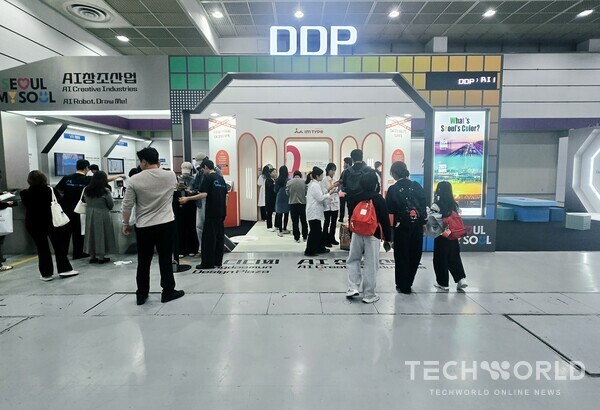
Hall A was organized into showrooms themed around eight representative Seoul locations. The eight were Sejong-daero, Yangjae and Suseo, DDP, Bukchon Hanok Village, Seoul Station, the Seoul Library, the Han River and Gwanghwamun.
The exhibition arranged and introduced different AI and advanced-technology examples by zone. In the Yangjae and Suseo zone, it displayed a mockup of Hyundai Motor and Boston Dynamics humanoid 'Atlas' and ILL Robotics' 'H2.' In the Gwanghwamun zone, it introduced Google Cloud and AI agent-based administrative services. In the Han River zone, it introduced Re:Bio AI water quality analysis and Viewrun Technology lidar technology.
It also featured products that help companies and institutions use data and directly build AI services. PCN exhibited three products from its in-house solution 'OZAI': chatbot, vibecoding and MCP. OZAI Chatbot has functions that let users choose which data and work tools to connect for each question, execute them, and receive source-based answers. The chatbot combines vector search and graph search, and also supports linkage with small language models in closed-network environments.
According to the company, OZAI Chatbot has been applied to a Seoul city testbed verification support project for Jung-gu Office.
In a separate exhibition, a display was held that presented urban development concepts alongside daily-life services. Seoul Housing & Communities Corporation (SH Corporation) unveiled its vision for a future city at the Seoul Digital Bio City (S-DBC) exhibition experience hall. At the SH Corporation booth, an AI skin and scalp analysis experience using ChoiceDx from ChoiceTech Korea was also offered.
At Hall B, where the Seoul AI Robot Show was held, LG CNS's smart home, Hyundai Motor and Kia Robotics Lab's mobility platform 'MobED,' Hyundai Motor and Kia Robotics Lab's wearable robot 'X-ble Shoulder,' and Doosan Robotics' collaborative robots for food and beverage applications were on display. The exhibition showed ways of applying different robot forms for uses such as housing, mobility and industrial work.
Across both events, AI functions were explained through concrete work and daily-life scenarios. Demonstrations included document information extraction, facility inspection and skin condition analysis.
This setup helped visitors understand the technology's uses and target applications. The two events also went beyond technical explanations to present data-building and operating processes as important elements as well.
The events introduced procedures for generating robot training data, technologies for managing multiple robots, and products that connect internal information to AI. This made it possible to examine the work needed for on-site deployment.
This year, AI touchpoints also continued in private exhibitions and public fairs. From May 6 to 8 at COEX, the International AI Expo Korea 2026 (AI EXPO KOREA 2026) was held, and from August 19 to 21, AI Summit Seoul & Expo 2026 (AISE 2026) was held. AISE combined a conference, exhibition and technology demonstrations, and introduced AI agents and industry-specific use cases.
On June 23 to 24 at KINTEX in Ilsan, the 2026 Public AI Expo was held. Samsung SDS, LG CNS, Naver Cloud and Kakao participated in the 2026 Public AI Expo, and the companies unveiled AI technologies for public-sector work and services. Through these events, face-to-face opportunities between technology suppliers and users expanded across fields such as industry, the public sector and urban life.
However, apart from the expansion of events, some areas of the exhibition floor appeared relatively quiet on site. One booth representative raised the possibility that the timing between holidays may have had an impact. The representative also suggested that repeated similar exhibitions may have made it difficult to draw visitor interest.
Although each event has a different purpose and audience, many of the AI-related topics covered overlap substantially. Common themes included AI models, agents and workflow automation, and the two events showed a trend of expanding AI use into corporate work and urban life. This also aligns with the continued staging of similar field-specific exhibitions.
In this situation, it is necessary to present industry-specific use cases in concrete terms, and newly added functions also need to be presented concretely, as do customer use experiences. Conveying industry-specific use cases, new features and real operating experience in concrete terms expands the information visitors can gain and becomes a factor that enhances event differentiation among similarly themed exhibitions.
Source: TECHWORLD · Kim Seung-gi
Original: https://www.epnc.co.kr/news/articleView.html?idxno=407989
References
This article was produced with the help of an automated content generation algorithm.
Source: TECHWORLD
View originalThis article was summarized and organized by BizCrush based on the original article from TECHWORLD. For exact quotations and full details, please refer to the original article.