A Guide to Choosing DC-DC Converters Using Input Voltage Range Ratio
TECHWORLD · · 2 views
✦ AI Summary
The input voltage range ratio is calculated as V_in_max÷V_in_min, and the same value can appear even across different input voltage ranges.
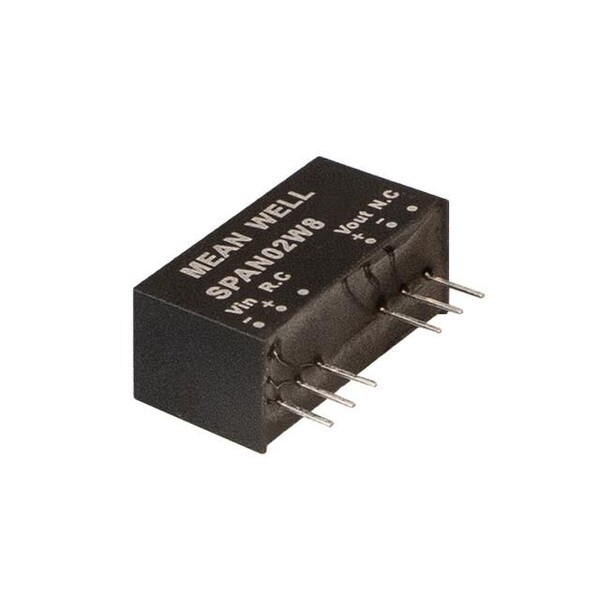
MEAN WELL's MDS02M-03N and SPAN02W8-03 both have a rated output of 2W and an output voltage of 3.3VDC, but their input voltage range ratios are 1.22:1 and 8.33:1, respectively.
The input voltage range ratio reflects only input voltage characteristics and should not be viewed as a benchmark for output voltage, rated power, efficiency, or voltage regulation performance; the application environment changes according to the expected input voltage range.
The input voltage range ratio specification for DC-DC converters is a single-number expression of the allowable input voltage range. It generally applies to all DC-DC converters. This article focuses on small PCB-mounted converters.
The formula for calculating the input voltage range ratio is V_in_max÷V_in_min. In the example calculation, 75/9=8.33. The example is written as about 8:1.
This figure can be the same even across different input voltage ranges. For comparison, a 9-72V converter and a 15-120VDC converter are cited.
The range ratio for both examples is 8:1. This shows that the input voltage range ratio expresses the allowable input voltage range as a single number.
One caution is that the input voltage range ratio should not be used as a quality metric. It indicates only input voltage characteristics.
Conversely, it does not indicate output voltage, rated power, efficiency, or voltage regulation performance. Therefore, this figure should not be mistaken as a benchmark for quality or other performance items.
When using a front-end power source that maintains a stable voltage, a converter with a narrow input voltage range ratio is appropriate.
On the other hand, a converter that supports a wide input voltage range ratio is advantageous for reducing logistics management burdens.
It also allows a single PCB to support a variety of voltages in battery and solar applications.
To help understand this input voltage range ratio specification, two MEAN WELL converters were presented as comparison examples.
The comparison models are "MDS02M-03N" and "SPAN02W8-03."
Both products have the same rated output of 2W, and both also have the same output voltage of 3.3VDC.
The table title is the calculated input voltage range ratio for MEAN WELL converters.
Looking at the input voltage items in the table, the minimum input voltage is 0.8VDC for MDS02M-03N and 19VDC for SPAN02W8-03.
[Table] shows that the input voltage range ratios of the two power supplies differ significantly.
The maximum input voltage is compared as 13.2VDC versus 75VDC, and the nominal input is also presented as 12VDC versus a wide input range.
In the input voltage range ratio comparison, they are shown as 1.22:1 versus 8.33:1.
Specifically, the input voltage range ratio of the MDS02 converter is about 1.22:1, while the SPAN02 converter has an input voltage range ratio of 8.33:1, commonly written as 8:1.
Because the difference in input voltage range ratio is so large, the operating environments for the two power supplies also differ.
The selection criterion for design optimization is the design requirements, and the most important factor is the expected input voltage range.
Because the MDS02 has a very narrow input voltage range, it is suitable for environments with relatively constant input conditions, assuming that the upstream 12VDC supply voltage remains stable.
Even if the nominal voltage of the converter and the battery are both 12VDC, the typical float charge voltage of a lead-acid battery is about 13.8VDC, and since about 13.8VDC exceeds the MDS02 input specification range, the battery float charge voltage exceeds the converter's maximum input voltage.
The SPAN02 can be used in environments with large input voltage fluctuations, and it is described as a product with the characteristics of a general-purpose power supply that has a 9-75VDC operating range. This is in the same context as a power supply that supports 85-264VAC input being understood as a general-purpose product category. Accordingly, a single converter can be used in a variety of applications.
That said, when comparing power supply specifications, each item must be examined carefully. System efficiency varies depending on the actual input voltage, and when supplying the same power, the input current increases as the input voltage drops.
For this reason, it is inappropriate to judge based only on the efficiency value at nominal input voltage as a fixed benchmark. When evaluating efficiency, input voltage and output current need to be considered together.
In addition, a wider input voltage range ratio may increase cost. As of the time of writing, the unit price for a quantity of 10 on DigiKey was $5.99 for the MDS02 and $8.32 for the SPAN02.
Voltage sources can also theoretically be assigned a voltage range ratio. The range ratio of a 12VDC flooded lead-acid battery is about 1.5.
The reference voltages for this calculation are the 15.8VDC equalization charge voltage and the 10.5VDC deep discharge voltage. Based on these values, the voltage range ratio of a 12VDC flooded lead-acid battery can be calculated.
The nominal voltage of the MDS02 and the battery are both 12VDC. However, the MDS02 input voltage range ratio is smaller than that of the lead-acid battery.
For this reason, the MDS02 is not suitable for direct connection to a lead-acid battery. In contrast, the SPAN02 can be used with that battery according to the input voltage range ratio and input voltage range criteria in the [Table].
A DC-DC converter with an 8:1 input voltage range ratio is useful when the exact input voltage is unknown but fluctuates within the operating range. A wider input voltage range allows a single assembly to be used in multiple applications.
If it can be shared across multiple applications, it helps reduce inventory. Examples of applications with wide input voltage ranges follow.
In an external battery connection scenario, the converter receives power directly from the battery, and the allowable battery nominal voltage range is assumed to be 12-48VDC. This configuration corresponds to one to four 12VDC batteries connected in series. For the range calculation, the 15.8VDC equalization charge voltage and the 10.5VDC discharge voltage of lead-acid batteries are considered, and voltage values may differ by battery type.
When using solar power, the converter also operates across a wide input voltage range. However, care must be taken because the nominal solar voltage and the actual voltage may not match. In particular, the voltage of a solar panel may rise on cold, sunny days when the load is light.
In field-configured assemblies, a small DC-DC converter and a larger converter can be used together, as in a stepper motor drive system. In such cases, the DC input voltage is set in the field to match the motor being used. The small PCB-mounted DC-DC converter supports a wide input voltage range and is responsible for supplying power to the logic circuitry.
The conclusion notes that caution is needed when trying to use the remaining energy of batteries and capacitors to the very end.
The reason given is that physical limitations exist.
It explains that battery life shortens with excessive discharge.
It adds that the stored energy in a capacitor is proportional to the square of the voltage, and that as voltage drops, the remaining energy in the capacitor decreases sharply.
For the original source, refer to DigiKey's TechForum/Article.
Source: TECHWORLD · Lee Gwang-jae
Original: https://www.epnc.co.kr/news/articleView.html?idxno=407988
References
This article was produced with the help of an automated content generation algorithm.
Source: TECHWORLD
View originalThis article was summarized and organized by BizCrush based on the original article from TECHWORLD. For exact quotations and full details, please refer to the original article.