DeepBrain AI Develops 'AI Guard' to Block Misuse of Generative AI
TECHWORLD ·
✦ AI Summary
DeepBrain AI announced on the 12th that it has developed an integrated safety engine, "AI Guard," to prevent misuse of generative AI.
AI Guard checks for identity theft, harmful inputs, and deepfakes, inspecting prompts and reference images before generation and analyzing images and videos after generation.
In testing by Wisestone, a KOLAS-accredited laboratory, in October 2025, three items met the standard, and the accuracy of determining whether content was synthesized was presented as 96%.
DeepBrain AI announced on the 12th that it has developed "AI Guard," an integrated safety engine designed to prevent malicious use of generative AI. "AI Guard" is a technology that checks for identity theft, harmful inputs, and deepfakes in generative AI content, with the goal of identifying risk factors before and after content generation.
"AI Guard" consists of three functions. The first is "Face ID verification," which checks whether a person in an image or video is registered as a protected subject. The second is a "malicious input filter," which blocks text and images that induce the creation of harmful content. The third is "deepfake verification," which analyzes whether an image or video has been synthesized.
The engine is provided in a form that applies the same authentication system and response specifications. Ten types of API have been prepared.
Companies and institutions can select and integrate the functions they need according to their service environment and purpose. Based on a common authentication system and response specifications, DeepBrain AI provides "AI Guard" so users can choose and apply only the functions they need.
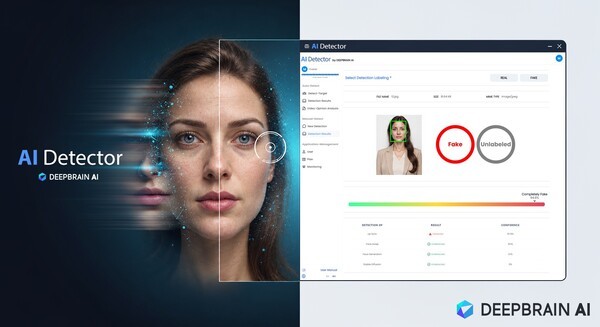
While the existing "AI Detector" focused on identifying image and video deepfakes, AI Guard expands the scope of inspection across the entire content generation process. Before generation, it checks user prompts and reference images to block violations, and after generation, it analyzes images and videos again.
This structure performs a second check for unidentified elements at the input stage and problems that arise during the generation process. It also blocks a request if a model response error occurs, and blocks the request even when processing time is exceeded.
This prevents content that failed verification from being delivered as is. AI Guard also conducted performance verification based on this structure.
AI Guard underwent testing in October 2025 at Wisestone, a KOLAS-accredited testing laboratory, in accordance with the international software quality standard KS X ISO/IEC 25023. As a result, three items, including accuracy in determining whether content was synthesized, error rate in blocking malicious prompts that induce generation, and accuracy in recognizing a specific person, met the standard, and the accuracy of determining whether content was synthesized was presented as 96%.
AI Guard was designed to operate in companies' and institutions' internal infrastructure, taking their security environments into account. The language model for verification and the safety classification model run on the company's own GPU without calling external commercial APIs, and the prompts and images being inspected can be processed without external transmission. This setup operates on internal infrastructure and the company's own GPU without external APIs or external transmission, meeting the security requirements of companies and institutions.
Based on this, DeepBrain AI has begun supplying AI Guard to content generation platform operators and public institutions. Going forward, it plans to expand the scope of application to generative AI services operated by companies and institutions.
Jang Se-young, CEO of DeepBrain AI, said that safety safeguards for generative AI services are not an add-on feature but a basic requirement for stable operations. He added that the company plans to continue expanding the scope of technology deployment so that companies and institutions can systematically manage the risk of misuse of generative AI within their own infrastructure.
Source: TECHWORLD · Kim Seung-ki
Original: https://www.epnc.co.kr/news/articleView.html?idxno=408046
References
This article was produced with the help of an automated content generation algorithm.
Source: TECHWORLD
View originalThis article was summarized and organized by BizCrush based on the original article from TECHWORLD. For exact quotations and full details, please refer to the original article.