Tilion Registers Entire Dstation X Lineup on Public Procurement Platform
IT DAILY · · 2 views
✦ AI Summary
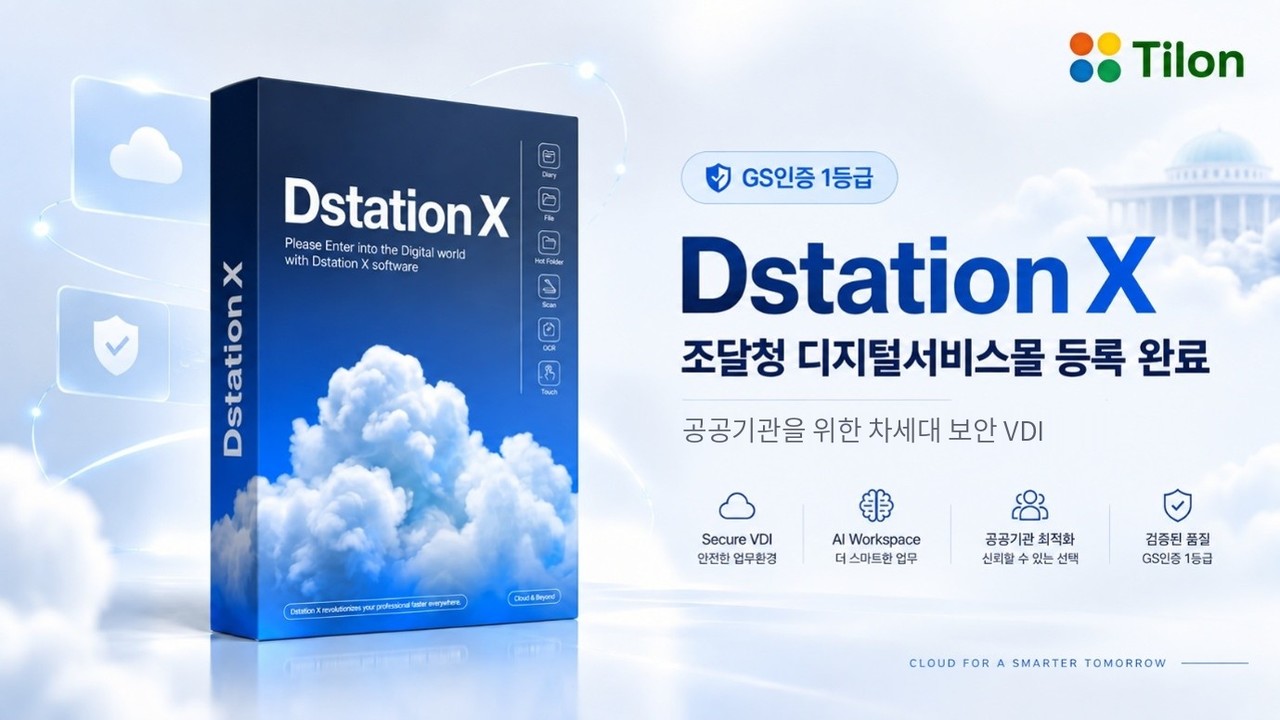
Tilion announced on the 8th that it had registered five products in its next-generation VDI platform, Dstation X, on the Public Procurement Service’s Digital Service Mall.
The registered products are Dstation X, Dstation XE, Dstation XT, Dstation XI, and Dstation XABT, for a total of 10 items consisting of perpetual and annual licenses.
Tilion said it completed procurement registration after obtaining Grade 1 GS certification and has established a public procurement route.
Tilion announced on the 8th that it had registered five products in its next-generation VDI platform, Dstation X, on the Public Procurement Service’s Digital Service Mall. The lineup consists of one basic model and four purpose-specific models.
Each product comes with a perpetual license and an annual license, and the total number of registered items is 10. The registered product names are Dstation X, Dstation XE, Dstation XT, Dstation XI, and Dstation XABT.
Tilion said earlier this month that it had obtained Grade 1 certification for GS, and it has now completed procurement registration after receiving that certification. As a result, it has established a public procurement route for the entire Dstation X lineup.
By product, Dstation X is the basic model, while Dstation XE is for engineering. Dstation XT is for development environments, Dstation XI is for AI platforms, and Dstation XABT is for AI-based computer-based testing (CBT).
With the procurement channel unified, customers can now purchase virtual desktops for general office use, 3D design, software development, internal AI use, and test operation environments. All five products offer both perpetual and annual licenses, allowing institutions to choose a license type depending on their budgeting approach.
The contract format is a third-party unit-price contract for commercial software. This structure operates on a pre-agreed price between the Public Procurement Service and the supplier. As a result, national agencies, local governments, and public institutions do not need a separate bidding process and can select and purchase directly from the Digital Service Mall.
Dstation X is an enterprise VDI platform for public sector, financial, and corporate environments. Security and large-scale operations are key priorities for the platform. Users can access a centralized virtual PC from a variety of devices, including PCs, laptops, and tablets. Administrators can centrally manage multiple users’ virtual PCs, security policies, and system status. It is also designed to work with existing servers and virtualization infrastructure, helping reduce system migration costs and operational burdens.
Compared with previous versions, Dstation X has strengthened security and operational features. With role-based access control (RBAC) and attribute-based access control (ABAC), it fine-tunes permissions by user and administrator duties as well as by access environment. In addition, it can directly control process and network access at the virtual machine kernel level.
On the security side, Dstation X provides screen and document watermarks, screen capture blocking, access control for the administrator portal, and default policies that distinguish between internal and external access. It also manages major security events and user activities through a centralized audit log that includes time information.
This centralized audit log is used for real-time security monitoring and for post-incident root-cause tracing and audit response. Through this, security events and user activity histories can be reviewed in one place.
On the operations side, Dstation X enhances convenience and supports a multi-tenant structure that separates data and policies by organization and client. As a result, it can be applied to public institutions and DaaS providers that deliver virtual desktops to multiple organizations. It also supports HTML5-based web access and remote access for Windows, Mac, and Linux, and provides self-device redirection technology that reduces network usage for peripherals such as webcams and printers.
On the product integration side, it is configured together with CenterPost, an integrated management dashboard, Linker, which supports virtual PC access across various operating systems, and Station, a dedicated messenger. Station provides chat, file sharing, video conferencing, and AI chatbot functions within a VDI environment, enabling the product family to cover virtual desktop management, access, and collaboration in a single lineup.
Dstation X serves as a secure access gateway to Internal AI inside an organization, with access to Internal AI unified through VDI. It also controls copy, download, screen capture, and external storage device connections through security policies. In this way, it is designed to implement data protection, user control, and an audit system in the course of an organization’s AI use.
Dstation X can centrally record who used which AI and what data, and when. In this way, it is designed to meet an organization’s security, control, and audit requirements, along with centralized records of AI usage history.
Tilion links Dstation X with iStation, its enterprise AI platform based on multi-LLM and RAG. iStation is an enterprise AI platform based on multi-LLM and RAG. It also links Dstation X with TStation, which provides GPU resource partitioning and AI development and training environments. TStation has functions for GPU resource partitioning, AI development environments, and AI training environments.
Tilion plans to expand beyond virtual desktops into an AI Native workspace that uses work and AI resources in a single secure environment. Based on this procurement registration, it plans to target new VDI and DaaS projects at central government ministries, local governments, public institutions, and educational institutions, while also supporting the transition of existing Dstation customers to the next-generation version.
Tilion plans to expand its business in the public AX market through product lines specialized for industry and work purposes. To that end, it is pushing the Dstation lineup, which is segmented by work purpose. The product for engineering work is Dstation XE, the product for development and training environments is Dstation XT, and the product for AI work environments is Dstation XI. The product for AI-based computer test environments is Dstation XABT.
Choi Baek-joon, CEO of Tilion, said GS certification is a procedure for verifying product quality, while procurement registration is a procedure that enables actual purchasing by institutions. He also said that the work environments required by each institution differ, ranging from office work and design to development, AI, and testing.
In line with that, Choi said the company registered the five products with both perpetual and annual licenses. He also said the company plans to support institutions preparing for network separation improvements and AI adoption at the same time, while enabling immediate deployment in line with budgets and schedules.
Tilion said in September that it obtained Grade 1 certification from GS (Good Software) for Dstation X. GS (Good Software) Grade 1 certification is the highest level of software quality certification. Based on this, Tilion is expanding the supply of next-generation VDI in the public sector, financial sector, and corporate market.
Source: IT DAILY · Kwon Young-seok
Original: https://www.itdaily.kr/news/articleView.html?idxno=242116
References
This article was produced with the help of an automated content generation algorithm.
Source: IT DAILY
View originalThis article was summarized and organized by BizCrush based on the original article from IT DAILY. For exact quotations and full details, please refer to the original article.