S.K. Chairman Chey Tae-won Says Market Rules Needed to Make Social Value Work Economically
TECHWORLD ·
✦ AI Summary
Chey Tae-won, chairman of SK Group, said that market rules and mechanisms are needed to recognize and reward social value if it is to work economically.
The Social Enterprise World Forum (SEWF) and the Center for Social Value Enhancement Studies (CSES) will hold the first Ecosystem Leadership Exchange (ELE) in Seoul from the 12th to the 15th, reviewing Korea's social economy ecosystem with social innovation leaders from around the world.
The Schwab Foundation for Social Entrepreneurship under the World Economic Forum (WEF) and the Center for Social Value Enhancement Studies released an Impact Economy report, saying that measurement and disclosure of social value alone are not enough to create demand and proposing the need for regulatory systems, investment systems and financial linkages.
Chey Tae-won, chairman of SK Group, says the social value creation experiment he has been pursuing over the past 10 years is expanding beyond support for social enterprises into an agenda for changing the global economic system. Chey said that market rules are needed to make social value work economically.
Against this backdrop, the Social Enterprise World Forum (SEWF) and the Center for Social Value Enhancement Studies (CSES) will hold the first Ecosystem Leadership Exchange (ELE) in Seoul from the 12th to the 15th. Social innovation leaders from around the world will attend the event, which will review Korea's social economy ecosystem.
Participants will discuss ways to apply their experience in creating social value to policies and markets in their respective countries. Ahead of that, on the 8th, the Schwab Foundation for Social Entrepreneurship under the World Economic Forum (WEF) and the Center for Social Value Enhancement Studies jointly released a report titled “The Impact Economy: Turning Disclosure into Demand.”
SEWF is a global network in the social enterprise sector launched in 2008 in Scotland, U.K. SEWF connects social entrepreneurs, governments, companies, investors and support organizations, and shares experience in the policy, finance and market development of social enterprise ecosystems. More than 1,000 people from more than 65 countries took part in its annual forum held last year in Taipei, Taiwan.
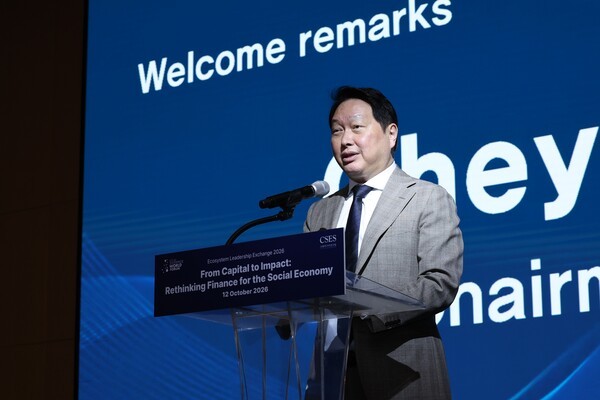
This ELE is a global leadership program designed to exchange experiences among countries and provide on-site learning about a single country's social economy ecosystem. SEWF selected Korea as the first host country and learning destination. In a joint opening address, Chey said that market rules and mechanisms that recognize and reward social value are needed as a prerequisite for linking it to real economic value and resource allocation.
The program runs for four days, from the 12th to the 15th. Its main themes are social value compensation systems, social economy-related policy and legislation, private-sector participation and investment, and building ecosystems at the national level.
Participants are scheduled to visit the National Assembly, public institutions, companies and foundations. They will examine Korea's policy, institutional, financial and market structures that have supported social innovation through government, companies and civil society.
The event involves 19 organizations from 15 countries. Attendees include the Scottish Minister for Business, an expert on outcome-based compensation policy in the U.K., government ministries related to social enterprises in Malaysia, the Temasek Foundation in Singapore, major nonprofit foundations in Australia, Canada and the U.S.
In Korea, the Social and Solidarity Economy Bureau of the Ministry of the Interior and Safety, the National Assembly Social Innovation Forum, the Korea International Cooperation Agency (KOICA), the Hyundai Motor Chung Mong-Koo Foundation, MYSC, the Council of Local Governments for the Social and Solidarity Economy nationwide, AIWorks and Dot are participating as co-host organizations.
Along with this, SEWF and the Center for Social Value Enhancement Studies jointly published “Building Hybrid Ecosystems: Korea's Experience and Global Lessons.” The report aims to shed light on the development of Korea's social enterprise ecosystem over the past 20 years and to present the development process and implications of Korea's social economy ecosystem. The report introduced Korea not as a finished success model, but as a “Living Laboratory” that continues to experiment with new policy and market mechanisms.
Chey Tae-won attended the first session of ELE on the morning of the 12th and shared his experience in promoting social value and his future plans.
Chey said existing CSR has been operated around budget spending and promotion. He noted that existing CSR has relatively lacked a system for measuring substantive social outcomes, and emphasized the importance of accurate measurement.
Chey then introduced the journey of building ecosystem support platforms such as Happiness Delivery, Happiness Narae, the Social Enterprise MBA and the Center for Social Value Enhancement Studies.
Chey said precise value measurement comes with high transaction costs. He added, however, that recent advances in AI technology could solve the cost issue.
He also pointed out that altruism alone has limits in securing the scale needed to address growing social problems. He argued that a sophisticated performance-based incentive system that generates voluntary motivation is essential.
Chey described the Social Progress Credit (SPC), which he has been pursuing for the past 10 years, as a new way to reduce national and social costs. He proposed accelerating a shift to “New Capitalism,” in which social value creation is rewarded beyond profit seeking. He also raised the issue that, just as capitalism and democracy operate together, there is a need to move to an economic system in which compensation for social value functions.
Chey's SPC concept was embodied in a domestic support program for social enterprises, but its starting point was global discussion on the market economy. He proposed the SPC concept at the World Economic Forum (WEF) in Davos in 2013. The concept measures the results of solving social problems and provides compensation corresponding to those results.
This line of thinking starts from the idea that linking measurement of social value with economic incentives can encourage more companies to participate in solving social problems. It also includes the vision of developing such participation into sustainable economic activity. The key is to measure social performance and connect it to economic rewards so that company participation increases and leads to sustainable activity.
SK has been carrying out the SPC project since 2015. The project operates by measuring the monetary value of social performance created by social enterprises and paying cash incentives in proportion to the results. It also aims to enhance the sustainability of social enterprises by turning social outcomes into measurable indicators and linking them to monetary rewards.
The discussion on social value is moving beyond compensation for individual social enterprises to the way the market as a whole works. At the Schwab Foundation's annual meeting last year, a proposal was made to trade measured social value within the market system.
Against this backdrop, the Schwab Foundation for Social Entrepreneurship and the Center for Social Value Enhancement Studies released a joint report on the 8th. The report is the third joint publication by the two organizations. It analyzed the structural reasons why, despite progress in measuring and disclosing social value, actual investment and purchasing demand has not formed, and also suggested solutions.
Chey said SK and the Center for Social Value Enhancement Studies have proven through experiments that social value can be measured and linked to financial incentives. He then explained that rules and mechanisms are needed to support social value if it is to work economically.
Chey emphasized that the system for determining economic value needs to change. He said the system should recognize and reward social value and make it possible to scale it up. He also argued that the response should not stop at dealing with market failure after the fact, and that the rules of the market need to change. He further set out the goal of making social value not a peripheral part of the existing economic system, but the foundation for growth.
The report focused on the “Impact Economy,” in which social value is rewarded in the market. It said awareness of the importance of social value is increasing and measurement and disclosure of related results are also advancing. Still, it noted that the flow of actual capital into solving social problems remains insufficient.
The report identified a structural issue called the “Impact Paradox” as the cause. One aspect of this structural problem is that the benefits of solving social problems accrue to many people, while the costs are borne by specific actors. It also explained that although long-term economic effects from solving social problems exist, it is unclear how that value is reflected in financial statements and investment decisions.
It also noted that while social outcomes unfold over a long period, corporate decision-making is influenced by short-term performance. It added that creating social value often involves multiple actors working together, making it difficult to distinguish and assess each actor's contribution.
The report explained that under this structure, even if the need to solve social problems is recognized, companies and investors may still lack the actual incentive to put in money. It then said that measuring and disclosing social value alone makes it difficult to create market demand and capital flows.
The report proposed the need for regulatory and investment systems to stimulate demand for purchasing and investing in social value. It also proposed financial linkage and multilateral cooperation structures. The “Impact Economy” described in the report means an economy in which positive social and environmental outcomes are recognized, measured and rewarded within the market and financial system.
This concept aims not to leave social value only to companies' voluntary donations and philanthropy, but to reflect it in companies' investment, procurement and financial decisions in order to change how the market works. SK's SPC was also introduced as an example of linking social outcomes to economic rewards.
In this report, the Impact Economy and cases of creating demand for social outcomes are expected to be discussed at the annual meetings of the IMF and the World Bank in Bangkok, Thailand. The discussion period runs from the 12th to the 18th.
The SEWF Seoul event and the WEF report are international platforms with different starting points. But both are centered on the common question of what conditions are needed to bring in more resources for solving social problems.
SEWF's focus in Korea is the social enterprise ecosystem capable of continuously creating social value. On the ground, the aim is to examine how governments, companies, social enterprises, civil society and investors are creating policy, finance and market environments to support the growth of the social economy ecosystem.
The Schwab Foundation report expands this discussion to the broader economic system. The report calls for a structure that goes beyond merely measuring social outcomes, and says a mechanism is needed in which social outcomes are reflected in real economic decisions such as corporate strategy, investment and procurement.
At the center of the connection between the two streams is the past 10 years of SK and the Center for Social Value Enhancement Studies' “measurement→reward→market” experiment. The experiment is described as quantifying social outcomes, linking them to a reward system and aiming to expand them into market demand and resource allocation.
Gerry Higgins, chairman of SEWF, said the starting point of Korea's social economy ecosystem was the government. He explained that Korea's social economy later developed into a hybrid form in which government, the private sector and nonprofit organizations each contribute policy, technology and methodology.
Gerry Higgins said this development model can serve as an excellent textbook for both developing and advanced countries. He cited the fact that Korea's social economy model has developed through the combination of multiple actors as an example that can also be used internationally.
Na Seok-kwon, chief executive of the Center for Social Value Enhancement Studies, said putting capital into solving social problems does not mean consuming economic resources. He described it as reducing the negative factor of social costs in growth to create a larger base for growth, and pointed out that there are limits to a resource-moving approach that relies on goodwill. He then stressed that it is time for a new solution linking social outcomes and economic performance.
Source: TECHWORLD · Park Kyu-chan
Original: https://www.epnc.co.kr/news/articleView.html?idxno=408033
References
This article was produced with the help of an automated content generation algorithm.
Source: TECHWORLD
View originalThis article was summarized and organized by BizCrush based on the original article from TECHWORLD. For exact quotations and full details, please refer to the original article.