JiSun Emerges as a Beneficiary of AI Security Amid Repeated Financial Breaches; Wireless Backdoor Detection Technology Draws Attention
TECHWORLD ·
✦ AI Summary
As hacking incidents have continued to hit the financial sector, the need to strengthen security has grown, and JiSun, which has a wireless backdoor detection system, has emerged as a security beneficiary.
JiSun's stock price rose from KRW 3,010 on September 7 to KRW 3,555 on October 7, gaining about 18.1% over one month.
JiSun has supplied wireless backdoor detection systems to 16 financial institutions, including South Korea's five major banks, as well as global semiconductor conglomerates, and related revenue in the first half of this year increased roughly sevenfold from a year earlier.
As hacking incidents have continued to hit the financial sector, underscoring the need to strengthen security, JiSun, which has a wireless backdoor detection system, is emerging as a security beneficiary. At the same time, market attention is also turning to technologies that detect wireless backdoors.
JiSun's stock price rose from KRW 3,010 at the close on September 7 to KRW 3,555 on October 7. That represents an increase of about 18.1% over one month.
On the 12th, JiSun said that the importance of strengthening security has increased after the financial incidents, and that interest in its wireless backdoor detection system is also expanding. It added that business expectations have risen on the back of this trend, and that those expectations appear to have affected the stock price as well.
Wireless backdoors are an attack method that can bypass even reinforced network separation environments and penetrate them. In 2022, active-duty officers who had received orders from North Korean operatives were caught preparing PoisonTap, a USB-type hacking device, to target a military command and control system. In a 2024 U.S. House investigation, a case was also cited in which an unauthorized communications device was found on a Chinese-made crane installed at a U.S. port.
In June this year, the Financial Supervisory Service warned the financial sector about the risk of hidden wireless spy chips inside servers and IT equipment. It urged companies to check equipment when introducing it and to regularly inspect for unauthorized wireless communications. Similar warnings were also raised during the parliamentary audit. It was also pointed out that one-time inspections have limitations in detecting communications that emerge after installation, highlighting the need for continuous monitoring.
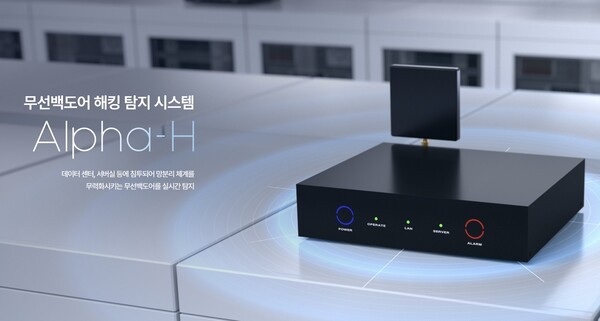
Against this backdrop, JiSun has supplied its wireless backdoor detection system to all of South Korea's five major banks. A securities firm report described JiSun as the country's sole supplier. JiSun's detection system continuously monitors radio signals inside buildings 24 hours a day, triggers an alarm when suspicious signals are detected, and has the ability to estimate and report the signal's location.
The solution has been supplied to 16 financial institutions, including KB Kookmin Bank, Shinhan Bank, Hana Bank, Woori Bank, and NH NongHyup Bank. It has also been delivered to global semiconductor conglomerates and others. Revenue from the wireless backdoor security business in the first half of this year increased roughly sevenfold from a year earlier. The overseas supply countries include the U.S., the U.K., Singapore, and Malaysia, among five countries, and the company is working to expand business opportunities through overseas supply.
A JiSun official said the company has accumulated experience deploying its systems at major financial institutions and, based on its wireless core technology, outlined its future business expansion direction. On that basis, the company plans to strengthen domestic expansion deployments and step up its push into overseas markets to lead the security market.
Source: TECHWORLD · Kim Hye-jin
Original: https://www.epnc.co.kr/news/articleView.html?idxno=408011
References
This article was produced with the help of an automated content generation algorithm.
Source: TECHWORLD
View originalThis article was summarized and organized by BizCrush based on the original article from TECHWORLD. For exact quotations and full details, please refer to the original article.