Eight in 10 AI Citations Come From Channels Cited Every Month
TECHWORLD ·
✦ AI Summary
The September issue of the 'AIBA AI Citation Index Report,' published by the AI research institute under Hamshout Global, was released.
This September issue is a quarterly cumulative report integrating data from July through September, analyzing 10,800 responses, 100,783 citations, and 12,228 citation channels.
The analysis found that AI citations were concentrated in repeated citations from a small number of channels, SNS was the most cited type throughout the 3 months, and media citations increased for 3 straight months.
The September issue of the
This survey is conducted monthly by entering the same question across 30 industry sectors. The tally includes channels linked as sources in generative AI responses.
The September issue is the third installment, following the inaugural July issue and the August issue. This September issue is a quarterly cumulative report that integrates data from July through September. It analyzed 10,800 responses to brand-free information-search queries, 100,783 citations in responses, and 12,228 citation channels, excluding duplicates.
The combined results from the third round confirmed a structure that was not visible in a single month of data. AI repeatedly cited a small number of channels, and more than half of newly cited channels were not cited again the following month. As the headline suggests, 8 out of 10 AI citations came from channels cited every month.
This survey compared both the persistence of citations by channel and their distribution by industry. Among channel types, SNS remained the top source each month, while media citations increased for 3 straight months. There were also channels cited across all industries, as well as channels cited in only one specific industry.
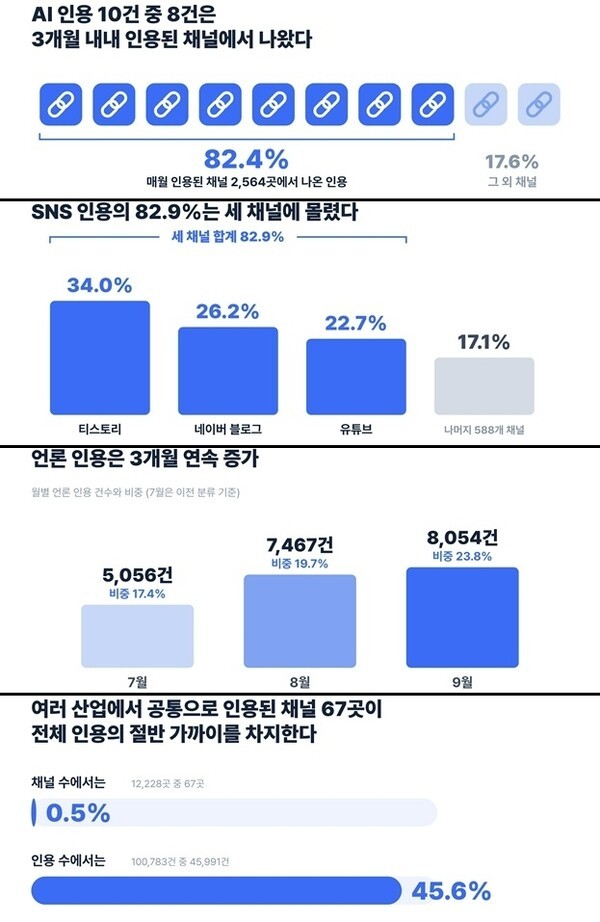
Over the 3-month survey period, 12,228 channels were cited at least once. Of these, 2,564 were cited in all 3 months, July, August, and September, accounting for 21.0%. Total citations reached 100,783, and citations from channels cited in all 3 months totaled 83,093, or 82.4%.
By contrast, 6,715 channels were cited in only 1 month. The share of citations from these channels was just 8.0%. The analysis found that most of the sources behind AI responses were channels cited repeatedly every month, while newly appearing channels accounted for only a small share.
This pattern centered on repeatedly cited channels appeared across industries. However, the share of monthly citations by industry varied, with telecommunications the highest at 75.8% and IT platforms/services the lowest at 63.8%.
The rate at which newly cited channels were cited again the following month was below 50%. Channels first cited in August numbered 4,083, of which 1,881 were cited again in September. The September continuation rate for newly cited August channels was 46.1%.
By contrast, 3,242 channels were cited in both July and August, and 2,564 of them were also cited in September. The September continuation rate for channels cited in both July and August was 79.1%. The share of citations from newly cited channels fell from 14.7% of all August citations to 7.5% of all September citations. This showed that a single citation alone is not enough to determine whether a channel will continue to be used as a source the following month.
Among channel types, SNS ranked first in citations in all 3 months. SNS accounted for 28.2% in July, 34.6% in August, and 31.2% in September. The cumulative share of SNS over the 3 months was 31.6%, and cumulative SNS citations totaled 31,848. By type, media ranked second at 20.4%, corporate channels third at 16.4%, other web fourth at 12.5%, government/public institutions fifth at 9.8%, and information platforms sixth at 9.4%.
Over the 3 months, 591 SNS channels were cited. However, SNS citations were not widely dispersed but heavily concentrated in 3 channels: Tistory, Naver Blog, and YouTube. Those 3 channels accounted for 82.9% of SNS citations, with shares of 34.0% for Tistory, 26.2% for Naver Blog, and 22.7% for YouTube. Citations from those 3 channels made up 1 out of every 4 citations overall. The scope of those 3 channels also included official blogs and YouTube channels operated by companies.
By period, the share of blogs within SNS citations kept rising, from 58.0% in July to 62.3% in August and 81.2% in September. By contrast, YouTube citations rose from 2,504 in July to 3,738 in August before falling to 999 in September.
On YouTube, broadcasters and economic news accounts had a high share. The most-cited YouTube accounts were official broadcaster accounts such as KBS News, YTN, and SBS News. Seven of the top 10 YouTube accounts by citations were broadcaster or economic news accounts.
In this context, it was suggested that trust in AI models may have accumulated around news channels with a large amount of refined information.
Media citations increased in both count and share from July through September. Media citations rose for 3 straight months, from 5,056 in July to 7,467 in August and 8,054 in September. Their share of total citations also climbed from 17.4% in July to 19.7% in August and 23.8% in September.
In particular, even though total citations fell from August to September, media citations increased. Total citations declined from 37,923 in August to 33,775 in September, but media citations in September rose compared with August. Hamshout Global said this shows a trend of increasing use of media as a basis for generative AI responses, describing it as evidence that media reports are being used more widely as source material for generative AI answers.
There were 14 channels for which citations increased for 3 consecutive months, and 9 of them were media outlets. These figures show that the rise in media citations stood out among many channels.
However, citations were spread broadly across many media outlets rather than concentrated in a few specific outlets. There were 1,302 media outlets cited over the 3 months. The top 3 outlets accounted for 12.7% of all media citations, and the top 20 outlets together accounted for 35.9%.
In the ranking of media outlets across all industries, Maeil Business Newspaper and The Korea Economic Daily held first and second place throughout the 3 months. Overall, media citations showed an increasing trend while also becoming more dispersed.
Industry-level tallies showed that, in addition to general-interest outlets, many industry-specific publications also ranked near the top, including sector-specific trade papers. In steel, shipbuilding, and heavy industry, Steel & Metal News ranked among the top outlets, and in fashion, Fashion Insight ranked among the top outlets.
Based on these results, both general economic dailies and industry-specific coverage from companies’ own sectors were identified as items that corporate communications staff should review in connection with company statements. The summary was that corporate PR teams need to examine not only general media outlets but also industry-specific publications in their own sectors.
External research also exists, suggesting that AI citations may lead to actual visits to article pages. According to the Reuters Institute Digital News Report 2026, 56% of Korean respondents who said they encountered news through AI chatbots said they visited the cited article page directly.
Korea recorded the highest share among the 48 countries surveyed, while the average across the 48 countries was 42%. Denmark had the lowest share at 26%. The figures were presented as evidence of diversification in news-consumption channels, a pullback from major search portals, and the spread of AI platforms.
In addition, channels cited in common across 20 or more of the 30 industries numbered 67. That represented 0.5% of all citation channels, and those 67 channels accounted for 45.6% of total citations.
Citation channels were divided into several types. The platforms included among the 67 were Tistory, Naver Blog, and YouTube. By type, the 67 channels consisted of 38 media outlets, 9 SNS channels, 8 corporate channels, 6 government/public institutions, 5 information platforms, and 1 other web channel. Among them, 15 were cited across all 30 industries.
By contrast, the number of channels cited in only 1 industry was tallied at 9,651. However, those channels accounted for 19.6% of total citations.
There were also differences in citation structure by industry. Based on the 3-month cumulative total, the industry with the highest share of media citations was steel, shipbuilding, and heavy industry at 42.6%, while the lowest was parenting at 11.2%. The industry with the highest share of SNS citations was camping and outdoor at 50.1%, while the lowest was chemicals and materials at 12.7%.
The AI research institute classified the share of media and SNS citations in each industry into 4 types by comparing them with the median across the 30 industries.
Looking at the distribution of channel types by industry, the number of industries in each type was 7 media-led, 8 media-SNS parallel, 7 SNS-led, and 8 channel-diversified. In addition, 14 of the 30 industries maintained the same type in July, August, and September.
An analysis of 7,818 responses that displayed citation links showed that a single AI response tended to use multiple channels as sources at the same time. The average number of citation links per response was 12.9, and the average number of sources grouped by channel was 9.3. Of those responses, 59% cited 4 or more of the 6 channel types at the same time. The average number of citations per response was 10.8 in July, 13.4 in August, and 14.7 in September.
Regarding the integrated analysis of the 3 rounds of citation data, Kwon In-hee, head of the Hamshout Global AI Research Institute, said that the basis of AI responses did not change much from month to month and was concentrated in a small number of channels that were cited repeatedly. She then stressed to corporate marketing staff that rather than reacting to month-to-month ranking changes, the priority should be checking the exact brand information of channels that are repeatedly cited in their own industry.
The speaker suggested that, as a response strategy in the AI environment, citation sources should be continuously accumulated across media, SNS, and official corporate channels. He explained that the reason was that Korean users of AI chatbot news had the highest rate of moving to the original article among the countries surveyed, and proposed that when evaluating AI citations, it is necessary to review not only exposure but also visits.
Source: TECHWORLD · Lee Gwang-jae
Original: https://www.epnc.co.kr/news/articleView.html?idxno=408012
References
This article was produced with the help of an automated content generation algorithm.
Source: TECHWORLD
View originalThis article was summarized and organized by BizCrush based on the original article from TECHWORLD. For exact quotations and full details, please refer to the original article.