Korea Technology Institute Pushes Space Branding for 2026 Gyeongbuk Science Festival with Media Tower
TECHWORLD ·
✦ AI Summary
Korea Technology Institute unveiled a central media tower at the center of the 2026 Gyeongbuk Science Festival venue.
The tower is a vertical structure in the shape of a triangular prism that combines guidance, information delivery, and rest.
Korea Technology Institute designed it as a visual focal point at the center of the venue and as a reference point for traffic flow guidance.
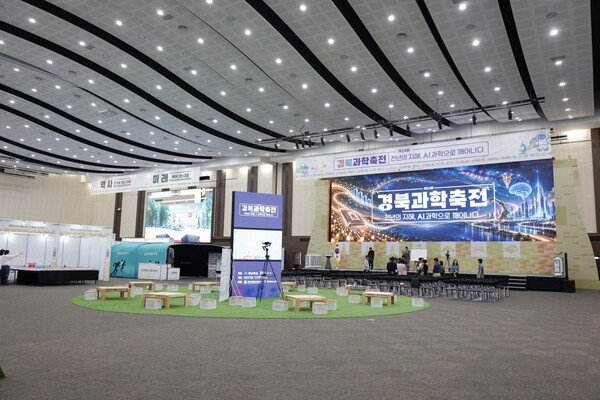
Korea Technology Institute, an event agency, unveiled a central media tower at the center of the 2026 Gyeongbuk Science Festival venue. The central media tower was designed as a facility that combines guidance, information delivery, and rest. The new media tower was planned as a vertical structure in the shape of a triangular prism, with the design intent of creating a visual focal point in the middle of the venue. Korea Technology Institute placed the facility in the relatively open central area of the venue and configured it as a three-dimensional installation, while also creating a rest area around it for visitors to stay.
The setup focused on improving spatial use beyond the installation of decorative pieces and sculptures. Korea Technology Institute said it considered both visitor movement and dwell time in shaping the layout. The central media tower’s main functions are to guide visitors and provide event information. It was designed to serve as a reference point for finding one’s location and direction within the venue, while the installed media screens were configured to deliver event-related information. The approach combines the concept of Wayfinding with digital information delivery functions.
Korea Technology Institute said that as event venues grow larger, it becomes more important for visitors to understand traffic flow and access information. Accordingly, it said the guidance function was reflected from the space-design stage. The company plans to apply this approach uniformly to future event spaces it manages. The goal of the uniform application is to develop it into a spatial branding element that expresses the company’s identity.
In the center of the venue, a layout linking the tower with guidance facilities and rest areas was applied. Around the tower, green flooring, tables, and seats were arranged, and a separate lounge area was set up. This was intended to allow visitors who were viewing exhibitions and experience programs to take a short break and check event information, giving the center of the venue a purpose for both information access and rest.
The vertically installed tower serves as a reference point that draws the eye, while the surrounding lounge area supports visitors’ dwell time. As a result, movement, guidance, and rest functions were placed in one zone, creating a multiuse space at the center of the venue and an environment where visitors can stay naturally. This spatial design links the form of the facility with the visitor experience, and it can be seen as a space-planning approach that considers not only the function of each individual installation but also the visitor’s overall experience of the venue.
Korea Technology Institute said it will apply the new media tower to future event agency projects and plans to use common spatial branding elements in the tower. The tower is designed as a combination of a triangular-prism structure and information-delivery functions, and the design is intended to be applied to various venues. The company aims to convey its distinctive spatial composition method consistently while preserving the characteristics of each event, and it said the detailed layout can be adjusted according to event scale and operational purpose. Still, the focus is on establishing the company’s visual identity based on a common form and function.
This effort goes beyond limiting corporate identity to logos and promotional slogans, extending it to the facilities and spatial experience used by visitors. Korea Technology Institute places meaning on prompting visitors to repeatedly encounter a specific spatial structure while receiving guidance, checking information, and resting, thereby creating touchpoints for brand recognition. This combines the practical functions of event operations with brand elements and is differentiated from conventional space configurations centered on visual promotion.
Korea Technology Institute plans to pursue future space planning centered on the media tower, with that planning aimed at balancing event-operation efficiency with visitor convenience and responding to each event’s operating environment. The company also intends to establish a spatial branding system, through which it plans to consistently convey its planning direction and visual identity.
Source: TECHWORLD · Kim Gyeong-ju
Original: https://www.epnc.co.kr/news/articleView.html?idxno=408008
References
This article was produced with the help of an automated content generation algorithm.
Source: TECHWORLD
View originalThis article was summarized and organized by BizCrush based on the original article from TECHWORLD. For exact quotations and full details, please refer to the original article.