[Review] iPhone 18 Pro Broadens Photo Options and Takes AI a Step Further
IT DAILY ·
✦ AI Summary
IT Daily reported on Apple’s iPhone 18 Pro review.
Over several days of use, the reporter confirmed changes in the camera and AI features through low-light indoor shooting, distant-subject photography, and conversations with Siri.
The main camera gained a variable aperture and shooting controls, while Siri AI handled information searches and app-related requests in an English environment.
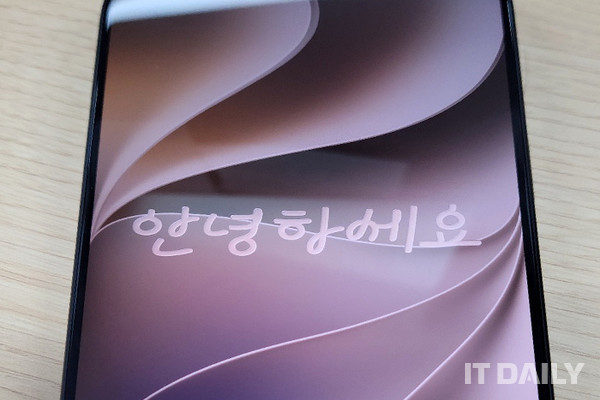
IT Daily reported on Apple’s "iPhone 18 Pro" review. When the device was first powered on, greetings in languages from around the world appeared. The photos were taken by reporter Kim Byeong-ju. Over several days of using the iPhone 18 Pro, the reporter tested photography and Siri conversations, focusing on changes in the camera and Siri AI.
In terms of shooting experience, the review checked low-light indoor photography and zooming in on distant subjects. The main camera was equipped with a variable aperture, and the default camera app allowed users to adjust shooting settings directly. Through this, the product showed an expanded range of camera expression.
The AI features were tested in an English environment. The reporter examined Siri’s performance by asking it to search for information and handle app-related requests. Siri AI tracked detailed context in instructions in English and suggested the potential for voice-based smartphone use. Through this, the product showed expanded touchpoints for AI use.
The most intriguing feature on the iPhone 18 Pro was the variable aperture. The main camera aperture can be adjusted in 4 steps: f/1.48, f/1.8, f/2.8 and f/4.0. Opening the aperture increases the amount of incoming light, while narrowing it expands the range that appears to be in focus. Apple said the variable aperture improves low-light shooting and depth of field.
However, it was difficult to isolate the effect of the variable aperture from everyday photos alone. That was because no side-by-side test was conducted with only the aperture changed in the same scene.
Even so, the significance of the variable aperture lies in the greater room it gives photographers to reflect their shooting intent. The settings needed differ when capturing nearby food or flowers apart from the background, versus photographing several people clearly together. The variable aperture feature is a tool for adjusting expression to match the subject and situation.
Another feature is that even while using automatic shooting, users can intervene directly in the settings if needed.
Pro-level controls have been added to the default camera app. The changes were supported by additional features. Users can adjust aperture, shutter speed and white balance, and check exposure with a histogram.
This setup can also be useful for users who become interested in photography itself while shooting on a smartphone. It now allows direct control of shooting settings within the default camera app.
The reporter shot in a dark indoor setting and also captured distant subjects. In the process of shooting different scenes, the division of roles between the main camera and the telephoto camera was observed.
The variable aperture is applied to the main camera. The telephoto camera has a 4x-equivalent focal length and a fixed f/2.8 aperture, and Apple says it supports 8x "optical quality" zoom.
The iPhone 18 Pro offers both shooting with the main camera’s aperture and shooting that pulls in distant subjects, providing both areas at once. As a result, users have more options depending on the shooting situation, and it can respond to both near-subject expression and distant-scene photography. Understanding each camera’s characteristics could broaden the range of use.
The photo shows an example of asking Siri AI in English to generate an image of a dog drinking coffee, and was taken by reporter Kim Byeong-ju.
After trying Siri AI in several ways, the reporter found that in an English environment, results improved as instructions became more specific while testing multiple requests. Siri AI showed stronger ability to follow detailed context in instructions, and there were many cases where it responded more closely to the desired outcome.
The most impressive feature alongside the camera was Siri AI. During information-search requests and app-related tasks, the potential for voice-based smartphone use was confirmed, and Siri AI connected user requests to the necessary functions after understanding them. This experience pointed to a role for AI inside the smartphone.
The process of calling up health, mail and note information felt more natural than with previous Siri versions, and convenience also improved when continuing tasks after linking apps.
However, its image-generation capability was relatively less notable, and its ability as an independent large language model (LLM) was also relatively less notable. Siri AI appeared to focus on using personal context understanding and on-screen awareness to find the needed information and complete tasks.
In a Korean-language environment, there were cases where it lacked understanding of requests, and there were also cases where responses fell short of expectations. However, this comparison was not a side-by-side test under identical commands and conditions.
Apple is offering Siri AI in English first, and Korean support is scheduled for later this month. Its usefulness in an English environment has already been experienced.
As a result, once Korean support expands, the range of everyday use for domestic users is also expected to widen. The way users give requests to smartphones could also expand from direct on-screen operations to natural conversation.
Apple also provided photos of the iPhone 18 Pro and iPhone 18 Pro Max. The photos were taken by reporter Kim Byeong-ju.
To support this kind of use, performance for photography and AI support was also strengthened. The iPhone 18 Pro is powered by the A20 Pro chip and also uses a next-generation vapor chamber. Apple said graphics performance is up to 40% better than the iPhone 17 Pro, and sustained performance is also up to 40% better.
In this review, no measurements were taken of performance improvements based on long gaming sessions or video rendering. Still, the stronger processing performance and cooling structure were worth noting as a foundation for high-spec work and AI features. Charging performance was also improved, and Apple said that with a 60W or higher adapter supporting AVS, it can charge to up to 50% in about 15 minutes. However, an adapter that meets those conditions must be prepared separately.
After several days of review, the iPhone 18 Pro was a product that expanded both the way photos are taken and the way AI is used. The variable aperture and shooting controls widened the room for reflecting intent in photos.
Siri AI in English showed the possibility of using a smartphone based on voice. Once users learn the camera settings and Korean AI support expands, there is expected to be even more practical use in daily life.
Source: IT DAILY · Kim Byeong-ju
Original: https://www.itdaily.kr/news/articleView.html?idxno=242105
References
This article was produced with the help of an automated content generation algorithm.
Source: IT DAILY
View originalThis article was summarized and organized by BizCrush based on the original article from IT DAILY. For exact quotations and full details, please refer to the original article.