Seoul AI Hub Connects Citizen-Made AI Solutions to Policy
TECHWORLD ·
✦ AI Summary
Seoul AI Hub held the "AI Impact" hackathon and policy discussion, allowing citizens, developers, and students to define everyday social problems and create AI prototypes and policy proposals.
At the event, 13 AI prototypes and policy proposals were identified around education gaps, care, housing, digital exclusion, accessibility for people with disabilities, and immigrant daily administration.
Seoul AI Hub said it plans to prepare a results report combining the hackathon outcomes, 59 citizen policy opinions, and panel discussion content, share it with related institutions, and review follow-up project links.
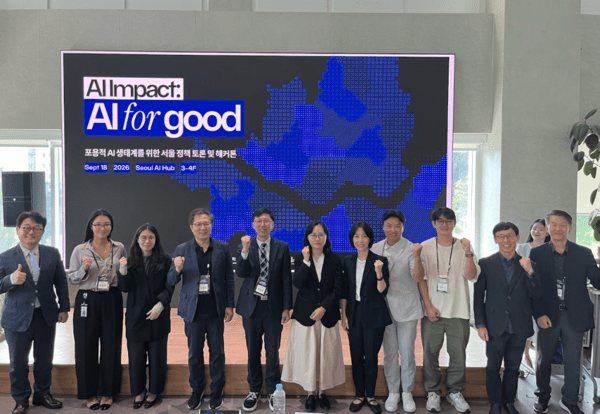
Seoul AI Hub has completed an AI experiment focused on solving social problems. The experiment was carried out in a way that had citizens and developers directly define everyday social problems and implement solutions using AI. Citizens, developers, and students took part, and they built workable AI prototypes.
The event was held under the title "AI IMPACT: AI for Good - Seoul Policy Forum and Hackathon for an Inclusive AI Ecosystem." The agenda covered education gaps, care, housing, digital exclusion, accessibility for people with disabilities, and immigrant daily administration. The event produced 13 AI prototypes and policy proposals.
Through the event, Seoul AI Hub ran technology development and policy discussion in tandem. This set it apart from existing hackathons and policy forums. The experimental results and outputs were linked to policy discussions, and the follow-up step was to turn them into policy forum agenda items.
Participants in the policy discussions included Seoul Metropolitan Government, the Seoul Metropolitan Office of Education, Seoul National University, Google, industry experts, and investment experts. Seoul AI Hub operated a flow in which citizens and developers directly defined social problems, built AI-based solutions, and then connected those outputs to policy discussion agenda items involving the public sector, academia, companies, and experts.
Of the 115 applicants for the hackathon, 60 were selected, and 59 actually participated. Among the participants, 91.4% were in their 20s and 30s, and 4 were foreign participants. The participant makeup also included 28 working developers and engineers, as well as 17 university and graduate students.
In responses about motivation for applying, 47 people said they wanted to "turn my idea into a policy proposal," which was more than the 37 who said they wanted to "actually build something with AI tools." These responses clearly showed the character of the event in the applicants' motivations.
The hackathon was operated by the AI builder community Team Human. Team Human handled participant recruitment and selection, on-site team formation, credit operations, and the entire judging and presentation process.
Participants worked during about 3 hours and 30 minutes of actual build time within an approximately 4-hour morning program. They did not stop at defining problems, but built working prototypes and also proposed policies and support measures for the social implementation of the technology.
On-site, participants freely formed and reformed teams, and in the end, 13 final teams completed prototypes and policy proposals. Of those 13 teams, 12 presented the results of the afternoon policy forum.
The 13 projects began from different problems in education, housing, care, accessibility for people with disabilities, immigrant daily administration, local communities, and jobs. The winning entries shared a common recognition that AI could offer new accessibility to groups left out of existing services and systems.
First place went to Suojeogyo. Suojeogyo proposed a "sign language Wikipedia," a user-driven way to collectively build up the shortage and fragmentation of sign language data, and also presented an AI sign language generation service using it.
Second place went to Maro. Maro implemented an AI daily administration copilot for foreign residents, with support covering housing, finance, medical care, welfare, and other everyday administrative information. It also highlighted that it goes beyond simple translation by supporting the actual completion of needed procedures.
At the event, Baek Daero took third place. Baek Daero proposed an audit layer to recheck whether the basis for point deductions in AI essay and short-answer grading falls within a student's learning scope. It also raised the need for explainability and accountability frameworks to be established as AI use expands in educational settings.
Several AI service ideas were also actually implemented at the event. A service was built that lets AI learn seniors' lifelong experience and tacit knowledge and connect it to social tasks, and a public housing support service was built to guide eligibility and application procedures. In addition, a physical AI and local community development and job linkage on-site data platform was built, along with an educational service that analyzes student understanding and questions during class.
After that, policy presentations expanded the issues raised earlier from the perspectives of urban policy, education, AI literacy, and commercialization. A panel discussion was also held.
The event also introduced the direction of Seoul's AI policy. Park Ji-eun, team leader at the AI Strategy Industry Division of the Seoul Metropolitan Government, explained Seoul's AI policy from the perspectives of expanding opportunities for citizens to use it, driving changes in daily life, and building a foundation for industrial growth.
As AI use expands in education and in efforts to solve social problems, the risks that need to be checked on site, the capabilities required, and the conditions for commercialization were presented. Kim Young-il, director of the Creative Future Education Division at the Seoul Metropolitan Office of Education, laid out tasks related to the rapid spread of AI in education, including checking education gaps, checking overdependence on AI, checking the outsourcing of thinking, and checking teachers' AI use capabilities.
Kim Min-jung, Google APAC lead, emphasized inclusive AI and AI literacy, along with the importance of the ability to cross-check AI results and the importance of safe AI use capabilities. Lee Jong-ik, chairman of Quenesty, explained the conditions for sustainable commercialization of AI for solving social problems, listing verification of social value, customer validation, marketability validation, and scalability validation.
A panel discussion moderated by attorney Koo Tae-eon of Yulchon LLC followed. The panel included Kim Young-il, director at the Seoul Metropolitan Office of Education; Lee Jong-ik, chairman of Quenesty; Ham Jong-min, professor at the AI IMPACT Promotion Committee of Seoul National University College of Engineering; and Byun Woo-seok, head of Seoul AI Hub, who discussed related issues.
During the panel discussion, the main topics were measuring the results of AI for solving social problems, innovation and accountability in education, the usability of public data, and verification and commercialization after prototypes. The panel discussed together what should count as results and what kind of foundation is needed in the process of expanding the social use of AI. In that process, the need to review the evaluation criteria for AI support projects was raised.
In performance evaluation, there was an opinion that beyond simple distribution numbers and user counts, the assessment should include whether the technology reached people who actually needed it. There was also a discussion that continued use and whether it leads to improvements in everyday problems should be included in performance evaluation.
In the education field, an opinion was presented that if AI's involvement in evaluation and decision-making expands, a structure for explaining the results is needed. At the same time, there was also an opinion that if AI's involvement in evaluation and decision-making expands, a structure that allows people to review the results is also needed.
In the public data discussion, it was raised that data quality is more important than the number of items opened, and factors for data quality were listed as recency, standardization, and missing-value management. The practical usability of AI was presented as the standard for public data. It was also raised that a follow-up verification environment is needed for ideas to develop into actual services, and there was discussion that this environment should include links with users, on-site data, and verification spaces.
Before the policy discussion, Seoul AI Hub asked participants a question. The question was, "What policies or support do you think are needed for AI to make society better?" The two channels for collecting opinions were Team Human participant pre-checks and applications to the Seoul AI Hub policy discussion.
Out of a total of 100 people, 59 submitted free-form opinions. In the distribution of opinions, "AI for everyone" was the most common with 17 cases. It was followed by AI sovereignty and infrastructure with 13, social integration and governance with 10, and practical education with 8.
In addition, care and inclusion came to 4 cases, trust and safety to 3, and immigrant and multicultural daily administration to 2. Seoul AI Hub collected these opinions ahead of the policy discussion.
Among the detailed opinions, there was a call to strengthen AI accessibility so that older adults, people with disabilities, and immigrants can carry out public and administrative service procedures, not just receive information or translation.
Another opinion said that rather than expanding the volume of public data opened, what is needed is improved quality and usability for the actual applicability of AI services.
Seoul AI Hub said it compiled policy tasks to review later by bringing together the hackathon results and policy discussion content from the event. The hub organized the direction for expanding AI support outcomes as a shift from simple distribution to actual use and continued use, and organized the direction for expanding support scope as accessibility that goes beyond information provision to support procedural execution. It also included improving public data quality, trust and accountability in AI decisions, expanding opportunities for on-site verification, and strengthening practical work and social skills in educational AI as policy tasks that can be reviewed in the future.
Byun Woo-seok, head of Seoul AI Hub, said the significance of the event lay in the fact that citizens and developers directly defined everyday problems, created AI solutions, and then connected the results to discussions in policy, education, and industry settings. He added that he would continue looking at ways to link Seoul AI Hub's verification and company support programs so that good ideas do not remain just prototypes but can move on to real-world validation and citizen-facing services.
Seoul AI Hub said it plans to compile a results report that brings together the 13 AI projects identified at the event, the 59 citizen policy opinions collected, and the topic presentations and policy panel discussions, share it with related institutions, and review possible links to future related projects.
Source: TECHWORLD · Lee Gwang-jae
Original: https://www.epnc.co.kr/news/articleView.html?idxno=407987
References
This article was produced with the help of an automated content generation algorithm.
Source: TECHWORLD
View originalThis article was summarized and organized by BizCrush based on the original article from TECHWORLD. For exact quotations and full details, please refer to the original article.