SK Chairman: “Yongin Alone Is Not Enough... We Will Build the Gwangju Plant as Quickly as Possible”
TECHWORLD · · 4 views
✦ AI Summary
SK Group Chairman Chey Tae-won visited the area around the former Gwangju military airport site and munitions depot with CEO Kwak Noh-jung of SK hynix and others on the 9th to inspect the industrial complex development plan and preparations for infrastructure.
Chey said expanding production facilities is urgent to respond to rising AI memory demand and instructed that the semiconductor cluster in the southwestern region be pushed ahead with speed in cooperation with the government and local governments.
He reaffirmed his determination to establish the Gwangju semiconductor cluster in South Jeolla Province at an early date and said its scale could expand depending on demand and land acquisition conditions.
SK Group Chairman Chey Tae-won visited the planned site for a semiconductor-specialized complex in the integrated special city of Gwangju, South Jeolla Province, in person. He conducted an on-site inspection after determining that production capacity must be expanded urgently in response to rising demand for AI semiconductors, and concluded that expansion of manufacturing facilities was necessary. Through the visit, he called for accelerating the building of the semiconductor cluster in the Honam region and reaffirmed his willingness to push ahead with the project.
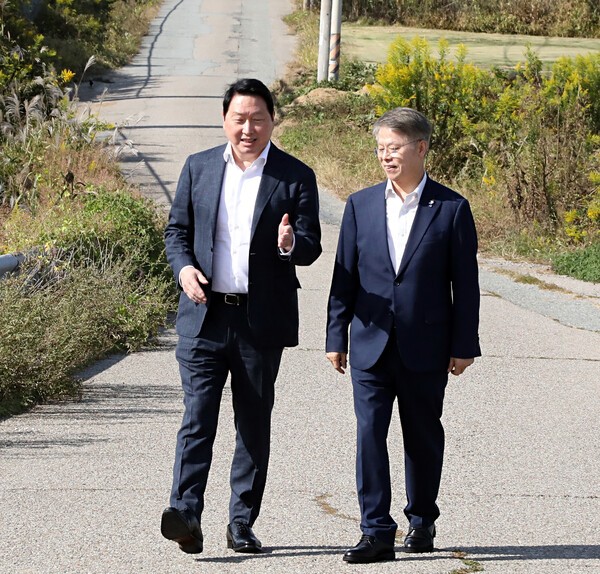
On the 9th, Chairman Chey visited the former Gwangju military airport site and the munitions depot area together with key executives, including Kwak Noh-jung, CEO of SK hynix. The munitions depot area is a key candidate for redevelopment. Chey met with officials, including MIn Hyung-bae, mayor of the integrated special city of Gwangju, South Jeolla Province, and inspected the industrial complex development plan, the status of land acquisition, and preparations for infrastructure such as power, water and transportation.
After the site inspection, Chey instructed executives to work closely with the government and local governments. He also directed them, in effect, to push ahead with building the semiconductor cluster in the southwestern region as quickly as possible.
As demand for AI memory surges, Chey has stressed the urgency of expanding semiconductor production capacity. He said semiconductor demand is rising faster than expected and stated that manufacturing facility expansion must be accelerated.
In recent meetings and other forums, Chey has repeatedly emphasized that, in order to lead the AI era, memory semiconductor production capacity must be expanded by more than 2 times within the next 5 years. This is seen as a renewed expression of his view that capacity expansion can no longer be delayed.
He said that even though the overall construction schedule for the Yongin semiconductor cluster had been shortened by 12 years, production capacity would still be insufficient even with that adjustment. Accordingly, he also noted that the pace of expanding manufacturing facilities must be raised even further.
Chey also mentioned the need to promote the Gwangju semiconductor cluster in South Jeolla Province at an early date. He also raised the possibility of building the Yongin and South Jeolla Province Gwangju plants in parallel and suggested that additional production bases could be secured.
He said the purpose of this visit was to directly check the pace of construction of the South Jeolla Province Gwangju plant. At the same time, he expressed his determination to build the plant as quickly as possible.
This site visit is being interpreted as an extension of the strategy to expand production bases in response to AI memory demand. Analysts say the move is part of an effort to flesh out plans to expand production hubs while checking progress on construction in South Jeolla Province Gwangju.
The integrated special city of Gwangju, South Jeolla Province, is preparing land acquisition and infrastructure, talent development, and residential conditions together as it pushes ahead with a plan to build a semiconductor cluster. Stable site conditions for large-scale semiconductor manufacturing facilities require industrial land, as well as timely securing of power, water and transportation infrastructure.
Securing regional infrastructure was presented as the key to realizing the cluster plan. The land acquisition, infrastructure, talent development, and residential conditions that the integrated special city of Gwangju, South Jeolla Province, is pursuing are also being advanced in a way that supports those conditions.
Mayor MIn delivered his gratitude to Chairman Chey on behalf of the 3.2 million citizens of the special city, saying he appreciated the expression of determination to push ahead with the semiconductor cluster. MIn said the city would support SK hynix's efforts to build and operate a world-class semiconductor plant, and that it would back core infrastructure such as land, power and water, as well as talent development and residential conditions.
After SK hynix unveiled a blueprint in June for a new KRW 400 trillion cluster in the Honam region, its executives have visited the Gwangju site more than 10 times and continued consultations with local governments. Chairman Chey's visit is expected to add momentum to the project.
SK hynix said that as global demand for AI memory semiconductors surges, market growth is accelerating while competition is also intensifying. It added that it will continue making swift investments based on support from the government and local governments.
SK hynix also said it will contribute to strengthening South Korea's leadership in AI semiconductors through these investments. A Q&A session was then held at the site.
During the on-site Q&A, Chey reaffirmed his determination to establish the Gwangju semiconductor cluster in South Jeolla Province at an early date. He said the current planned scale of the Gwangju semiconductor cluster in South Jeolla Province is about 2/3 of the Yongin semiconductor cluster, and that the scale could expand further depending on future semiconductor demand and land acquisition conditions.
Chey explained that the reason he visited the site was because direct verification was important. He also said semiconductor demand was expected to rise quite rapidly and that the pace of expanding manufacturing facilities needed to be increased further.
Chey said the overall completion date for the Yongin semiconductor cluster had been brought forward by 12 years. However, he judged that there could still be a shortage even after the 12-year reduction. He explained that, in this context, completion does not mean the start of operation of one fab, but the point at which the entire site is fully occupied.
Chey visited the site based on that assessment of a shortage. Emphasizing the need to secure additional production bases, he said another site would need to be developed. He also mentioned the possibility of building plants in parallel if necessary.
The purpose of this visit was to check how quickly a plant in Gwangju could be built. However, the specific groundbreaking date for the Gwangju semiconductor cluster has not yet been finalized.
Chey said that the groundbreaking timing needs to be considered comprehensively, including water and power supply plans and the actual construction schedule. He added that the direction would be to move ahead as quickly as possible with any work that can be done first.
Chey said the groundbreaking date cannot be specified at this time. He said local government preparations are under way and explained that it is necessary to recalculate the pace at which national-level water and power plans and construction can proceed in parallel. Related details are expected to be announced soon.
Chey said the pace of supply needs to be accelerated as much as possible in line with the rapid rise in demand. Accordingly, he said that once investment conditions are in place, construction of the plant will be brought forward as much as possible. He also expressed his determination to preemptively push ahead with construction, citing the issue of alignment between the government's infrastructure schedule and the company's investment pace.
Chey said there is a possibility of starting construction even before the military airport relocation is completed if the conditions for groundbreaking are secured. He also said there are various plans, including water supply. He added that if construction becomes possible at the site, he will build it as quickly as possible.
Chey said that once actual construction can begin, it will be treated as the top priority and pushed ahead at maximum speed. He also indicated that even if water and power are delayed, he intends to prioritize preparatory work such as site development and foundation work. He added that he is not particularly focused on reducing construction costs.
Chey did not disclose the specific number of fabs in the Gwangju semiconductor cluster in South Jeolla Province, but he mentioned the current planned scale. He said the current plan is about 2/3 the size of the Yongin cluster.
Chey also suggested the possibility of further expansion of the Gwangju semiconductor cluster in South Jeolla Province. He said that if additional land is secured and additional demand exists, the cluster could be expanded beyond the current plan, and that there is ample possibility for the Gwangju semiconductor cluster in South Jeolla Province to grow larger.
Source: TECHWORLD · Park Gyu-chan
Original: https://www.epnc.co.kr/news/articleView.html?idxno=407975
References
This article was produced with the help of an automated content generation algorithm.
Source: TECHWORLD
View originalThis article was summarized and organized by BizCrush based on the original article from TECHWORLD. For exact quotations and full details, please refer to the original article.