Google Cloud Unveils Work-Focused “Gemini Agent”
TECHWORLD ·
✦ AI Summary
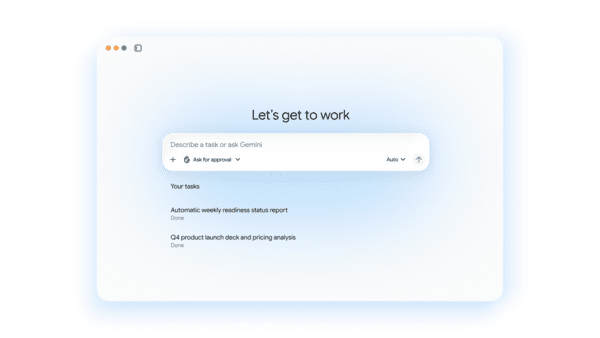
Google Cloud unveiled its integrated AI agent, “Gemini agent,” at “Gemini at Work 2026” held on the 8th in San Francisco.
The product is designed with a multimodel structure using Google’s “Gemini” and Anthropic’s “Claude,” and when a user sets a goal, it creates a work plan and connects internal enterprise systems and tools.
Gemini agent supports scheduled task execution, event integration, cloud-based long-duration work, enterprise system integration, and security and management functions, and a private preview has been available to select customers since the 8th.
Google Cloud unveiled its integrated AI agent, “Gemini agent,” at “Gemini at Work 2026” held on the 8th in San Francisco, California. The announcement comes as major big tech companies expand development of autonomous AI agents and is part of its push to target the enterprise market. Its scope covers enterprise work across the board.
The product is designed with a multimodel architecture. It uses Google’s “Gemini” and Anthropic’s “Claude,” and includes a feature that lets users choose a model depending on the type of work.
When a user sets a goal, the system creates a work plan and connects with internal corporate systems and tools. Through this, it handles document writing, data analysis, content production, and coding tasks, aiming not just to answer questions but to perform actual work and generate outputs.
The tool supports scheduled task execution and can also run in response to specific events. Its usage environment has been designed to cover web, mobile, desktop, Google Workspace, Microsoft 365, and Slack.
Companies can create a business-use “Coworker Agent.” This Coworker Agent is assigned a separate email address, storage space, and account within the organization. Employees can use it by invoking it in Google Chat or delegating document work to it. Access restrictions are based on the team sharing scope, and the actor recorded in the task history is the agent’s name.
Gemini agent also runs in the cloud, enabling long-duration tasks and allowing work to continue even after the user’s PC is shut down. Supported task duration ranges from several hours to several days. For complex work, it creates temporary sub-agents, and task division is handled in parallel or sequentially.
To maintain workflow continuity, the system uses four different types of memory. In this setup, which is intended to preserve work context, session memory remembers tasks currently in progress, while semantic memory manages accumulated knowledge. Procedural memory stores how work is carried out, and episodic memory stores records of previous tasks.
The company also separated Gemini agent from the base models so that model selection can be made by task. Accordingly, it allows the use of the most suitable model from Google’s Gemini family or Anthropic’s Claude, and plans to expand the selection to private and open models in the future.
It also applied Smart Routing to automatically assign models based on task difficulty and cost. High-performance models are connected for complex reasoning tasks, while relatively low-cost models are connected for simple repetitive work. Companies can also set an AI spending cap for each project.
To support enterprise adoption, Google Cloud expanded the range of integrations with enterprise systems in a direction that strengthens connectivity and usability. Connected targets include Salesforce, ServiceNow, BigQuery, Databricks, Postgres, and Snowflake, and MCP servers are also supported. Integration with Google Workspace has also been strengthened so that the agent can be connected in Gmail, Drive, Docs, Sheets, and Calendar, and used immediately from existing work screens in Google Workspace.
Security and management functions were also strengthened to fit enterprise environments. Separate identities and permissions are assigned to each agent, and audit logs of task execution are retained. For the work execution environment, it set up “Agent Sandbox,” network traffic is routed through “Agent Gateway,” and corporate policy settings are applied to that network traffic.
On this foundation, the company is also expanding industry-specific features. Functions for finance and legal are being offered in preview, with finance support covering investment research, credit analysis, and risk modeling. In legal, processing reflects document access rights and confidentiality requirements, and the company plans to expand the scope to government, healthcare, and retail in the future.
Gemini agent is being offered as a private preview to select customers from the 8th and is currently available only in a limited release. Based on this, Google Cloud is pursuing a strategy to expand its use as an agent platform that connects enterprise data, work tools, and multiple AI models.
Source: TECHWORLD · Kim Seung-gi
Original: https://www.epnc.co.kr/news/articleView.html?idxno=407974
References
This article was produced with the help of an automated content generation algorithm.
Source: TECHWORLD
View originalThis article was summarized and organized by BizCrush based on the original article from TECHWORLD. For exact quotations and full details, please refer to the original article.