Industry-Academia Collaboration for Design and Verification: ADI Nurtures Future Engineers
TECHWORLD ·
✦ AI Summary
ADI supported the development of a battery management system (BMS) for Team RACE, Hanyang University’s automotive research club.
In this project, students handled BMS design, fabrication, vehicle integration, and testing, while ADI provided battery monitoring semiconductors and evaluation boards, along with support for component selection and PCB design.
Team RACE implemented its own BMS using ADI’s ADBMS6830B and isoSPI communication technology to monitor 144 battery cells, and its SOC estimation error (RMSE) was reduced by 54% compared with a commercial BMS.
Analog Devices (ADI) is supporting the training of future engineers by providing semiconductors and technical advice for university student development projects. As an example, ADI disclosed its support for the development of a battery management system (BMS) by Team RACE, Hanyang University’s automotive research club.
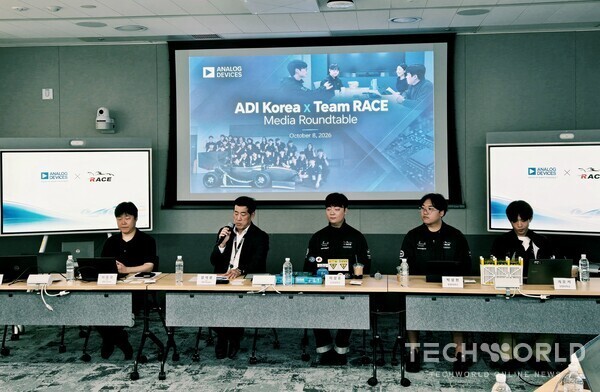
ADI Korea held a media roundtable on the 8th and introduced its industry-academia collaboration with Team RACE. Attendees included Kang Seok-won, president of ADI Korea; Lee Jong-gyeong, vice president; and Team RACE students Lee Sang-hoon, Park Sang-hyeon, and Gye Jeon-seo.
Since 2023, ADI has sponsored the university student Formula car competition and provided participating university teams with semiconductor products and technical information. Its collaboration with Team RACE at Hanyang University is now in its third year.
Team RACE began developing its own BMS after receiving component support from ADI. ADI advised on the circuit design and communication implementation needed for the in-house BMS development.
At the roundtable, Kang Seok-won, Lee Jong-gyeong, and the students explained the process of developing the in-house BMS and their future plans. ADI is also seeking opportunities for cooperation in physical AI and robotics with other universities.
In this project, students are in charge of BMS design and fabrication, as well as vehicle integration and testing. ADI is supporting the effort by providing battery monitoring semiconductors and evaluation boards, along with help selecting components based on development goals and support for PCB design.
This support is an extension of ADI's university support program and its university collaboration framework. ADI operates a university support program centered on technical education and support for student development projects, and it also runs a dedicated organization for university collaboration at its headquarters.
ADI continues to pursue industry-academia collaboration in Korea. The purpose of university collaboration is to use engineers' technical expertise and experience to help students solve problems during development. President Kang said that, for the purpose of supporting customers in Korea, the number of engineering staff at ADI Korea is about twice that of sales staff.
Through this collaboration, Team RACE continues developing an electric Formula car. Team RACE is an automotive research club founded in 1993, with about 40 members currently participating, and this year's vehicle is named 'RH33.' 'RH33' focuses on developing its own BMS and making the electric powertrain lighter.
Gye Jeon-seo said he had been interested in BMS since his first year of college. He said he first focused on safety functions for battery management and later expanded his interest to performance-related functions such as state of charge (SOC) estimation.
Lee Sang-hoon said the team worked on a task that had to complete design, fabrication, and verification within a tight schedule. He noted that ADI engineers provided PCB design guidelines during the process and also supported the selection of peripheral components such as transformers and other IC-related parts.
A BMS is a system that monitors battery cell voltage and temperature, and it also performs state of charge estimation. Team RACE implemented its own BMS capable of monitoring 144 battery cells by using ADI's battery monitoring IC, 'ADBMS6830B,' and isoSPI communication technology.
The students began developing their own system to ease design constraints caused by the size and wiring structure of existing commercial BMS units. In the process, Team RACE distributed sensing chips across battery modules, which made it possible to adjust cell placement and pack size to fit the vehicle.
As a result, the battery pack weight of this year's vehicle decreased from 65 kg to 55 kg, according to Team RACE.
The student said the main reason for the lightweighting effect was not any special BMS function, but the freedom to design directly for the vehicle. As a result, hardware development proceeded more smoothly, and the team secured time to improve the SOC estimation algorithm.
The initial SOC calculation method was based on accumulated current. At first, the team planned to calculate SOC by accumulating current and leave margin in battery capacity to account for estimation error. Later, it improved estimation accuracy by using battery test data.
According to Team RACE's presentation, the SOC estimation error (RMSE) of its in-house BMS was reduced by 54% compared with a commercial BMS. The student explained that, given the nature of a racing team, battery capacity is extremely important for finishing a race. He also said the goal was to estimate SOC precisely in order to judge whether the car could finish within the given capacity.
The in-house BMS was applied to test runs and also passed the competition's battery inspection. However, time was spent interpreting regulations and making on-site adjustments for other inspection items, and as a result the team was unable to participate in the competition's driving events.
Team RACE is preparing for the next season while improving both the vehicle and the BMS. The tasks it is pursuing include vehicle lightweighting and reinforcing BMS safety functions.
For improvements to BMS safety functions, the team identified sensor open-circuit detection and communication fault detection as areas to strengthen. It has also drawn up plans to improve the SOC estimation algorithm.
To this end, Team RACE has decided to expand the use of diagnostic functions in the chips it currently applies. It is discussing the use of ADI products for low-voltage circuits, with the goals of reducing weight and improving stability.
Park Sang-hyeon said the plan is not to upgrade the chips themselves, but to update the system so that it can use existing functions. He also said SOC estimation will be improved.
ADI Korea plans to continue university collaboration to support students' experience in design, fabrication, and system integration while they are still enrolled. President Kang said such experience helps students improve their technical understanding and also helps them assess their aptitudes and career paths, and the target for expanded collaboration is other universities.
President Kang said the significance of this collaboration lies in the fact that there are things that are hard to learn through university education alone, and that students have directly experienced during enrollment what they can only acquire after joining a company.
ADI Korea said it is looking for universities other than Hanyang University that need technical support and is also exploring student development projects. It is also reviewing partners in physical AI and robotics, and plans to expand industry-academia collaboration by taking into account conditions such as the availability of technical support personnel.
Source: TECHWORLD · Kim Seung-ki
Original: https://www.epnc.co.kr/news/articleView.html?idxno=407964
References
This article was produced with the help of an automated content generation algorithm.
Source: TECHWORLD
View originalThis article was summarized and organized by BizCrush based on the original article from TECHWORLD. For exact quotations and full details, please refer to the original article.