CEO Lee Hwa-young Presents Cyber Resilience at Korea-Mongolia Cybersecurity Cooperation Program
TECHWORLD ·
✦ AI Summary
The Korea Internet & Security Agency (KISA) and the Ministry of Science and ICT held the "Korea-Mongolia Cybersecurity Cooperation Program" in Ulaanbaatar, Mongolia, from the 5th to the 7th.
The program was a venue to flesh out the cybersecurity policy and technology cooperation proposed by the Mongolian government after the Korea-Mongolia summit.
At the event, key information and communications infrastructure protection, cyber threat response amid the spread of AI, trends in post-quantum cryptography (PQC), and a shift centered on cyber resilience were discussed.
The Korea Internet & Security Agency (KISA) and the Ministry of Science and ICT held the "Korea-Mongolia Cybersecurity Cooperation Program" in Ulaanbaatar, Mongolia, from the 5th to the 7th. The program provided a venue to flesh out cybersecurity policy and technology cooperation proposed by the Mongolian government after the Korea-Mongolia summit in July and move it into practical discussions.
At the event, the two countries shared case studies on protecting key information and communications infrastructure. They also shared examples of responding to cyber threats amid the spread of AI.
The two countries also shared trends in post-quantum cryptography (PQC) technology. PQC is a cryptographic technology designed to counter attacks based on quantum computers.
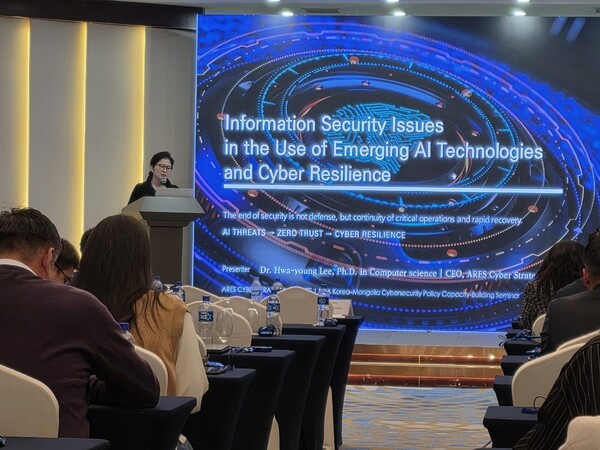
At the event, Lee Hwa-young, CEO of Ares Cyber Strategy Institute, delivered the keynote presentation. Lee said the ultimate goal of cybersecurity is not blocking attacks itself, but securing continuity of core operations and enabling rapid recovery. He then emphasized the shift from a conventional defense-centered paradigm to one centered on "cyber resilience."
Lee pointed out that it is impossible to block 100% of attacks, and presented as his topic a framework shift from blocking to recovery. Assuming an environment in which attacks are difficult to stop completely, he suggested shifting the focus of security from blocking to building a recovery system. He also proposed the need to build a resilience framework that proceeds through "detection-isolation-business continuity-recovery."
Lee presented AI agent and deepfake threat response as topics. Against the backdrop of the arrival of the agentic AI era, in which AI has direct authority to act, he argued that not "technical performance" but "the scope of delegated authority and the Least Privilege principle" are the new security boundary.
To support this, he included a proposal for a "quantitative measurement model (CRR and ARM)." He explained that CRR (Cyber Resilience Rating) is a model for diagnosing an organization’s resilience structure, while ARM (Active Resilience Metric) is a research model that measures real-world response speed (MTTD, MTTI, etc.). He also presented a direction for a model that measures both resilience level and response speed.
Lee said strong solidarity between the two countries is necessary to respond to cyber threats that cross borders. Finally, he proposed a direction for building a cyber safety net centered on actual recovery performance as a goal, based on cooperation between the two countries to respond to transnational threats.
Source: TECHWORLD · Lee Gwang-jae
Original: https://www.epnc.co.kr/news/articleView.html?idxno=407955
References
This article was produced with the help of an automated content generation algorithm.
Source: TECHWORLD
View originalThis article was summarized and organized by BizCrush based on the original article from TECHWORLD. For exact quotations and full details, please refer to the original article.