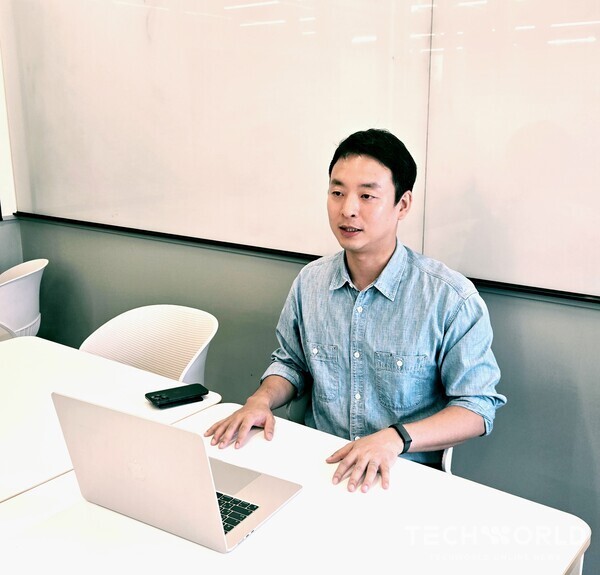
Lee Geon-chan of Upstage:
TECHWORLD ·
✦ AI Summary
Upstage is expanding sales channels for its in-house AI model, Solar, to offer it to more enterprise customers.
Solar has stronger document analysis and work assistant performance, and it also provides a domestic inference environment and a no-customer-data-storage option tailored to each customer’s security requirements.
Upstage is widening its sales routes through external channels such as OpenRouter, Hermes Agent and Cafe24, while also combining its own services and partner collaborations.
Upstage is expanding sales channels for its in-house AI model, Solar, as it seeks to win enterprise customers. Lee Geon-chan, a lead at Upstage, said the company is broadening sales channels to offer Solar to more customers. Solar has strengthened document analysis performance and work assistant capabilities, and it also provides inference environments tailored to each customer’s security requirements.
Upstage is an AI company led by CEO Kim Seong-hoon and was founded in 2020. The company has developed and supplied the large language model (LLM) Solar and has also developed and supplied document processing solutions. In May this year, it completed its acquisition of AXZ, the operator of portal site Daum, and in June this year it acquired the AI agent platform Timeley. As a result of the AXZ and Timeley acquisitions, Upstage has expanded its business scope into service operations.
Upstage is participating in the government’s sovereign AI foundation model project, and it also serves as the lead company in the project consortium. In July, it released the model weights and technical report for Solar Open 2, developed through the sovereign AI foundation model project, to support in-house deployment and derivative model development by companies. Upstage also participates in KT’s "AI for Everyone" consortium, where it provides Solar-family models for general conversations and document analysis.
Upstage’s cloud business division handles API supply for Solar and document AI and is responsible for applying them to real enterprise workflows. It also handles customer acquisition and sales-channel expansion, as well as technical support for service integration and implementation.
Lee Geon-chan, Upstage Cloud GTM lead, said in an interview with TechWorld on Sept. 30 that the key to model selection is actual work performance. He said customers first check whether a model can handle the tasks they want to delegate.
He added that after confirming required performance, customers consider whether switching to the model is convenient, and then review how easy it is to move away from the model they have been using. He also said they look at price competitiveness after required performance is met and then consider cost as well.
As demand in document analysis and work assistant use cases is being discussed, expanding customer touchpoints through external platforms has been proposed as a direction. Lee Geon-chan said multi-model platforms such as OpenRouter are continuing to spread.
As a result, he said dependence on specific models is declining, and customers are finding it easier to choose models suited to their work. He also said the growing importance of real-world usage experience is becoming the basis for judging competitiveness.
According to him, demand for Solar at customer touchpoints has been confirmed in personal work assistants and document analysis. He said customer interviews confirmed demand for Solar as a personal work assistant, and also confirmed demand for Solar in document analysis. He described Korean-language output quality as a strength of Solar, and said Korean input accounts for a large share of Solar usage via OpenRouter.
The lead said that successful real-world results are needed and that customers keep using the product only then. He also said customer evaluations found Solar useful for personal work-assistant tasks and for generating additional outputs after document analysis. In line with such assessments of real-world use, Upstage unveiled Solar Pro 4 in August.
Solar Pro 4 is characterized by stronger long-document analysis and stronger multi-step tool use. Upstage then introduced Solar Mini 4 on Oct. 1. The goal of Solar Mini 4 is high-volume agent tasks.
Upstage is advancing the sophistication of its document processing products. Upstage Studio is designed to connect dispersed information across contracts, invoices and other documents, and it is used for verifying linked information and for follow-up tasks based on that information. In addition, Upstage Studio’s feature expansion is moving from extracting information from individual documents to comparing across documents and then to handling work processes.
Along with expanding its product lineup, the company has also widened its distribution routes. In addition to its own console’s API key issuance and connection method, it has sought other routes for supply. As a result, Solar can now be selected on OpenRouter, and it can also be selected on platforms customers already use, such as Hermes Agent.
Lee Geon-chan likened this to Solar opening in a store where users can compare and choose among multiple models. He also said this means Solar can now be supplied to more customers than when it was offered only through the company’s own console. In South Korea, Cafe24 loaded Solar Pro 4 into its own "LLM Router" in September.
The Cafe24 case means e-commerce operators and developers can now use Solar in their existing API environments, and it is an example of an added supply channel. The company’s partner collaboration model combines service deployment and project supply. For SaaS companies, it provides models for use in their own services, while with SI providers it collaborates through the contracting and operation process for AI deployment projects.
The company is also seeking new coding platforms and new agent platforms. For the platforms it identifies, it is proposing model supply and joint promotion.
Lee Geon-chan said that, in terms of Solar supply, there are cases where it is incorporated as part of a partner company’s product, and cases where it is applied to projects. He then said it is important to build supply routes that allow even customers who cannot be met face to face to use the product.
Along with this direction, Upstage plans to expand Solar usage in its own services. Through Timeley, Upstage supports agent deployment for local governments, and it also supports agent deployment for public institutions and educational institutions.
As a next step in service expansion, the company proposed adding a conversational agent after search and summarization.
Enterprise customers are said to place importance on security when considering adoption. In response, Upstage provides an environment where inference runs only in South Korea to meet data-processing requirements, and it also offers an option not to store customer information.
The lead introduced a case in which it provided API services to a fintech company that needed to process large volumes of customer information during a specific period. The API service is characterized by the use of domestic inference resources. Based on this case, Upstage is discussing adoption with other South Korean companies.
He said the company provides a domestic inference environment to prevent data from being transferred overseas, and continues to offer AI tailored to different security requirements by customer, such as for financial companies and manufacturers handling sensitive information. He added that the reason it offers both commercial APIs and open-weight models that can be deployed directly is to address customers’ data management conditions and operating methods.
In this context, he presented Solar Open 2 as an option for companies that want to run models on their own infrastructure. He said this is an extension of the company’s direction to match each customer’s security requirements while also addressing differences in operating environments through a variety of delivery formats.
He also cited security and inference efficiency as major tasks. Upstage said it is pushing to respond stably to rising demand, while also working to manage computing resources and cost efficiency. It also said it is optimizing models with several chip companies.
Collaboration with domestic NPUs is part of that effort. In July, Upstage, AXZ and FuriosaAI announced a partnership, which involves loading Solar onto the NPU "Renegade." The purpose of that partnership, it said, is to power Daum’s AI summarization service.
Lee Geon-chan said that as demand is rising to operate smaller models efficiently on NPUs, the company is investing money and personnel in optimization. He said it is deploying related resources in line with increasing demand for efficient NPU operation of smaller models.
He said that to use chip performance effectively in real services, models and hardware need to be adjusted at the same time. He also said that simply installing a high-performance NPU does not make it work efficiently right away.
To that end, technical staff from both companies are carrying out joint optimization, he said. He added that discussions are also under way with several chip companies.
Lee Geon-chan also said that organizational barriers should be eased by sharing development discussions and having business teams review demos. He stressed that communication among technical, product and business teams is important if customer needs are to be reflected in products.
Upstage shares information so that business staff can review developer discussions through the internal messenger. Lee Geon-chan said business staff’s understanding of technology is linked to product proposals for customers, while developers’ understanding of market needs is linked to developing models customers require.
He said the business team’s role is to understand the direction of technological progress and pass on the functions customers need to the development team. He said that to quickly strengthen the competitiveness of a late mover, the two teams must understand each other’s circumstances and exchange views openly.
He said there have also been cases in which business staff directly created demos under this understanding. At "Open Day," members of the business team created and presented game-like demos using the product.
Lee Geon-chan said he personally creates demos before meetings with client companies to explain how the product can be applied to work. He said that by using AI development tools, business staff can directly implement what they have planned.
He said that in the process of creating demos for customers, the team comes to understand the product’s functions and limitations, and that what it learns is used in discussions with the development team. He also said Upstage aims for a horizontal organization, and that because customer needs must be linked to technological development, the technical, product and business teams are in close communication.
Upstage continues to pursue service businesses using Daum and Timeley while simultaneously supplying enterprise models and document AI. In this process, it is securing customer demand through cloud APIs and partner channels, and its main future tasks are turning secured demand into continued usage and converting that demand into revenue.
Source: TECHWORLD · Kim Seung-gi
Original: https://www.epnc.co.kr/news/articleView.html?idxno=407691
References
This article was produced with the help of an automated content generation algorithm.
Source: TECHWORLD
View originalThis article was summarized and organized by BizCrush based on the original article from TECHWORLD. For exact quotations and full details, please refer to the original article.