AI That Helps People Sees, Reads, and Interprets Facial Expressions Through a Camera
IT DAILY · · 3 views
✦ AI Summary
At the AbleAI booth, visitors experienced "EmoAI," and the demo continued after setting a benchmark facial state and analyzing expressions. The analysis results could be provided to counselors as reference material, and the company said the system could also be used to convey a person's facial expressions as audio to people with visual impairments. The event also featured a range of AI technologies, including the noncontact caregiving solution "McKare," a smart bidet, "Malhamyeon Cheokcheok," and real-time captioning services.
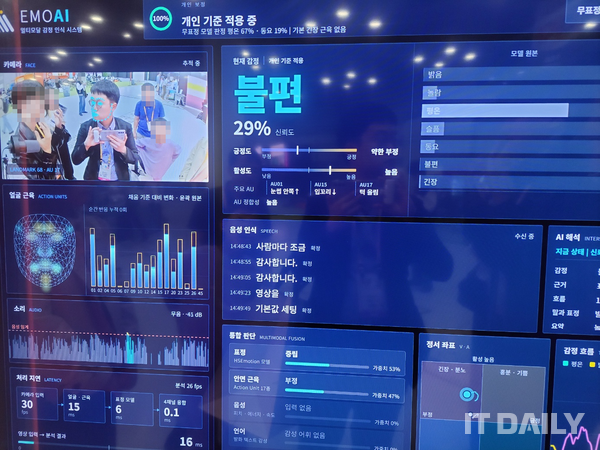
At the AbleAI booth at Smart Life Week 2026, held on the 7th at COEX in Seoul, visitors experienced "EmoAI." The live demonstration began with a step to capture the user's benchmark facial state. Before the demo, a staff member asked the reporter to keep a neutral expression and explained that because facial shapes and muscle movements differ from person to person, it was necessary to set an analysis baseline.
The demo then continued with an analysis of the reporter's expression in front of the camera. On the display, a facial analysis screen appeared, and blue dots and lines were shown over the face. The result of the reporter's expression analysis was the word "uncomfortable."
AbleAI introduced how "EmoAI" can be used. The company said the analysis results could be provided to counselors as reference material. It also said the system could be used to convey facial expressions as audio to people with visual impairments who have difficulty checking the other person's expression.
The exhibition hall featured more AI technologies designed to assess a person's condition or support service use. Exhibits included a caregiving solution that monitors breathing and movement without wearable devices, a service that lets users control a smartphone app through voice commands, and a real-time captioning exhibit that provides the language requested by participants. Coverage of each booth focused on the intended function and the conditions required for practical use.
Among them, EmoAI was presented as a case showing how emotion analysis can be used as a counseling aid. EmoAI's function lies in analyzing eyebrow, eye, lip, and chin movements. The company said it first sets a personal baseline and then observes changes over time.
The company also said it takes voice volume and tremor into account. The information provided combines facial and voice data with the flow of the conversation. Its purpose is to serve as a reference for counselors.
The counseling analysis also includes the time gap between questions and answers. That is because the context of delayed responses and silence differs depending on whether the question is for fact-checking or about feelings. Accordingly, the report noted that not only facial and voice cues but also question type and conversation flow must be considered together to distinguish the meaning of a delayed response or silence.
An AbleAI official said the final decision-maker is a person and that the company's role is to provide reference material. The emotion classification shown on the screen was presented not as a way to determine a person's psychology or recommend a specific decision, but as a function that helps users track changes in the counseling process.
At the same venue, the use of smart glasses for people with visual impairments was also introduced. These smart glasses analyze the other person's facial expression with a camera and provide the analysis result through the glasses' voice output.
The smart glasses were introduced as an example of a tool that provides conversational reference information to people who have difficulty checking facial expressions directly.
At the LG CNS booth, visitors could also try McKare, a noncontact caregiving solution by JCF Technology. The experience took place while lying in a bed, and the measurements were displayed on the screen above. The solution was introduced as one that does not require wearing a separate device on the wrist or chest. The photo shows the measurement display of JCF Technology's noncontact caregiving solution, "McKare," and the photo credit reads Kim Byeong-ju.
McKare uses radar and heat-sensing sensors to monitor a user's condition without contact. It tracks heart rate, breathing, and movement, and depending on the features included in each version, it also detects whether a person is present in the space and whether a fall has occurred. The detected information is provided through the web and app, and it also has an abnormal-signal alert function. The goal is to reduce the burden of wearing and charging devices and to help caregivers check for changes in condition.
The booth also explained how a fall could be handled through robot use and connection to medical staff after detection. However, there was no live demonstration of the actual process of calling medical staff or emergency responders. A booth representative said that medical referrals require consideration of approvals, costs, family requirements, and liability issues. The representative also said it is necessary to decide who will check the alert and how they will respond, and that real care linkage becomes possible only after a confirmation and response system is established.
At the same booth, Canada Health introduced a smart bidet that analyzes bowel movements. This smart bidet analyzes stool shape and color, and the analysis information is provided through an app. The app also offers guidance on lifestyle habits such as water intake and exercise. No separate measurement action is required, and the focus is on observing changes in bowel movements during normal bathroom use.
The Seoul AI Foundation provides "Malhamyeon Cheokcheok," a conversational mobile AI agent. "Malhamyeon Cheokcheok" is a service that helps control smartphone apps and performs necessary tasks within apps based on the user's voice requests. Its support covers everyday app use such as transportation, mobility, video viewing, and delivery orders.
The accompanying guide materials included command methods, execution confirmation steps, and stop procedures. First-time users must set Android accessibility permissions. After a task is completed, the result can be checked, and execution can be stopped with the stop button.
Along with this, a separate "Digital Companion Handbook" was also distributed. The "Digital Companion Handbook" is a guide that explains screen operations step by step. It includes finding bus and subway routes, calling a taxi, using a mobile health insurance card, sending photos, and ordering and paying for deliveries.
The handbook was designed to help people who have difficulty using smartphones learn the functions they need in daily life.
At this event, BizCrush introduced an in-house developed game that lets visitors experience its service based on communication between animal characters, and also introduced a service that delivers foreign-language speech as real-time captions. The company said it used its captioning service for the event's discussions and stage sessions.
The BizCrush service supports 60 languages and provides a function that recognizes and translates speech in up to 3 languages. Participants could use the service by accessing it via a QR code, and no separate app installation was required.
Participants could view captions in the language they wanted, and each person could choose the language they wanted to read separately from the shared screen in the venue. The service also includes a function that extracts technical terms, abbreviations, and product names and reflects them in translation.
At the site, image generation and direct robot-control experience programs were operated at the Google Cloud and Hancom AX Lab booths. At the Google Cloud booth, one activity involved taking a face photo and using Nano Banana to create a virtual image suited to a travel destination.
When the reporter chose Finland as the travel destination, a staff member asked about the season of the visit, the clothes wanted, and the activities the reporter hoped to do there. The face image generated afterward differed somewhat from the actual appearance.
The exhibition experience was divided into city video editing and robot operation. On one side, visitors could try editing videos of major places in Seoul, and at the Google Cloud booth, AI was used to display an image with hanok houses placed around Gwanghwamun-daero.
During this process, a request was made to fill Gwanghwamun-daero with hanok houses. However, because the exhibition conditions required the original street scene to be preserved, the company explained that there were some limitations in implementing that request. The representative also introduced examples of how such exhibition services are used by companies and institutions.
At Hancom AX Lab, visitors could operate a robotic arm with a joystick and buttons to write their names. At first, the controls felt unfamiliar, but by watching the screen and adjusting the direction, it was possible to write on paper successfully. In addition, robot-motion experience programs such as a game to move colored boxes were also operated. The representative also mentioned research applications involving the implementation of a brain-computing model based on information about Drosophila neural connections and neurotransmitters.
Hancom introduced AI and robotics training courses for use in industrial settings and job-preparation education. A site representative explained that NVIDIA AI Campus runs AI agent and robotics engineer courses. The materials included robot control and simulation practice, as well as a process for applying movements learned in a virtual environment to real robots.
Source: IT DAILY · Kim Byeong-ju
Original: https://www.itdaily.kr/news/articleView.html?idxno=242088
References
This article was produced with the help of an automated content generation algorithm.
Source: IT DAILY
View originalThis article was summarized and organized by BizCrush based on the original article from IT DAILY. For exact quotations and full details, please refer to the original article.