HPE Unveils 4 Servers Powered by 6th-Gen AMD EPYC
IT DAILY ·
✦ AI Summary
HPE announced on the 8th that it had unveiled four next-generation enterprise servers under the HPE ProLiant Gen13 lineup.
The new products are equipped with 6th-generation AMD EPYC server CPU and focus on expanding compute performance, memory bandwidth, and I/O throughput.
The new lineup consists of the DL525 Gen13, DL585a Gen13, XD245 Gen13, and XD285 Gen13, and is scheduled to roll out and be supplied sequentially from this year through 2027.
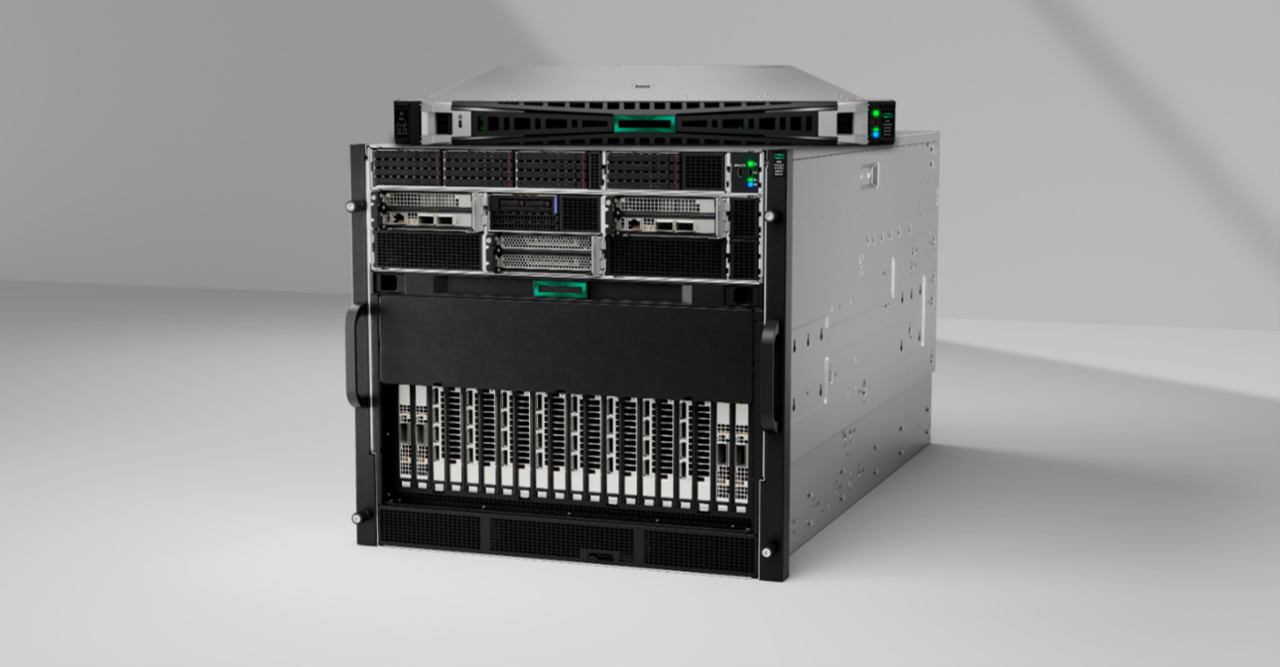
HPE announced on the 8th that it had unveiled four next-generation enterprise servers under the HPE ProLiant Gen13 lineup. HPE ProLiant (Photo: HPE) The four newly unveiled models are equipped with 6th-generation AMD EPYC server CPU. With these additions, HPE has expanded its enterprise server lineup by rolling out four Gen13 servers based on 6th-generation AMD EPYC.
The new lineup is aimed at significantly expanding compute performance, memory bandwidth, and I/O throughput. Through this, HPE said it aims to accelerate agentic AI, large-scale inference, data analytics, and high-performance simulation workloads. The new product family is built on the AMD EPYC 9006 SP7 processor.
The lineup has been segmented to match different workload environments. Among them, the DL585a Gen13 is designed as a GPU-dense platform. HPE presented the product family as divided according to workload-specific environments.
In particular, the DL585a Gen13 supports up to 8 double-wide PCIe GPU and also supports PCIe Gen6. HPE said the product is optimized for high-load AI tasks such as RAG fine-tuning and agentic AI.
The DL525 Gen13 is a 1-socket 1U rack server with specifications that support up to 256 cores, 16-channel high-bandwidth memory, and MRDIMM. The product is suitable for financial fraud detection system (FDS) and large-scale data analytics.
The OCP-compliant systems announced alongside the lineup are the XD245 Gen13 and the XD285 Gen13. The XD245 Gen13 features a 1OU 4-node direct liquid cooling (DLC) architecture that maximizes compute density. The XD285 Gen13 is a 2OU 2-node air-cooled model suited to general-purpose data center environments and stably supports CAE and large-scale scientific computing.
Security improvements and operational efficiency gains were also introduced. Based on the built-in controller HPE iLO 8, HPE introduced the Auto-SED feature, which protects idle data immediately upon first boot. HPE also introduced the MPA feature, based on HPE iLO 8, which requires approval from two administrators.
HPE expanded quantum-resistant cryptography (PQC) support across communication paths and used its proprietary Silicon Root of Trust to verify component replacement integrity in real time. Through integration with the cloud-based management solution HPE Compute Ops Management, HPE said it cut server management time by up to 50% and improved operational visibility.
The new products are scheduled to roll out and be supplied sequentially by model from this year through 2027. The DL525 Gen13 will be launched first this year, while the DL585a Gen13 is expected to launch in early 2027. The XD245 Gen13 and XD285 Gen13 are expected to be supplied sequentially in 2027.
HPE is also offering a financial program to reduce the cost burden at the start of adoption. To ease initial costs, it is supporting the 90/9 Advantage financial program, which operates with no payments for the first 90 days after adoption and then a 1% monthly rate for the following 9 months.
Executives from both companies linked the products' performance, security, and operational stability to AI workload support enabled by combining them with AMD CPU. Krista Satterthwaite, HPE senior vice president, highlighted optimized performance, built-in automatic security, intelligent operations, and proven reliability as strengths of HPE ProLiant Gen13, emphasizing that it provides a trusted foundation for customers to pursue current modernization and innovation and respond to future changes in demand. Dan McNamara, AMD senior vice president, said the core scalability, memory bandwidth, and I/O capabilities of the 6th-generation AMD EPYC server CPU are combined with HPE ProLiant, adding that this combination supports customers' enterprise AI workload deployments and provides the underlying elements of security, operational control, and long-term platform flexibility.
Source: IT DAILY · Kwon Young-seok
Original: https://www.itdaily.kr/news/articleView.html?idxno=242085
References
This article was produced with the help of an automated content generation algorithm.
Source: IT DAILY
View originalThis article was summarized and organized by BizCrush based on the original article from IT DAILY. For exact quotations and full details, please refer to the original article.