HPE Accelerates Enterprise AI Innovation With Next-Gen AMD-Based Servers
TECHWORLD ·
✦ AI Summary
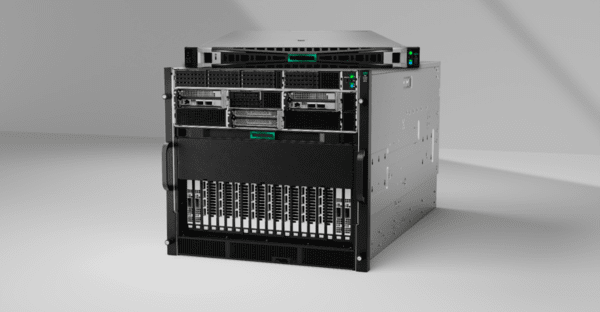
HPE announced four HPE ProLiant Gen13 servers equipped with 6th Gen AMD EPYC server CPUs.
The new systems expand computing, memory, and I/O capabilities and support agentic AI, inference, analytics, virtualization, simulation, and modeling workloads.
HPE iLO 8 and HPE Compute Ops Management were combined to enhance security, visibility, control, and reliability.
HPE announced four HPE ProLiant Gen13 servers equipped with 6th Gen AMD EPYC server CPUs. The new systems are designed to expand computing, memory, and I/O capabilities.
The new systems are designed to help enterprises accelerate agentic AI, inference, analytics, virtualization, simulation, and modeling workloads. They also help strengthen security across distributed IT environments, simplify operations, and improve reliability.
The announcement comes as AI systems evolve beyond simply generating insights and toward taking autonomous action. As a result, trust is becoming increasingly important as a prerequisite for scaling these systems.
According to McKinsey's "2026 AI Trust Maturity Survey," about two-thirds of companies said there are obstacles to scaling agentic AI in earnest. Those obstacles included security and risk concerns, limited visibility, and the difficulty of managing autonomous systems.
HPE ProLiant Gen13 combines the innovative technology of HPE iLO 8 with enhanced visibility and control features in HPE Compute Ops Management to help customers address those obstacles. HPE iLO 8 supports automatic protection, infrastructure reliability, and post-quantum readiness, and the combination provides customers with a trusted infrastructure foundation.
Krista Satterthwaite, senior vice president and general manager of HPE's Compute division, said the challenge for enterprises is turning agentic AI and inference investments into business value without increasing operational complexity and risk. She said ProLiant Gen13 delivers optimized performance, built-in automated security, intelligent operations, and proven reliability for those workloads, enabling customers to pursue current modernization and innovation while securing a trusted foundation that can flexibly respond to future needs.
Dan McNamara, senior vice president and general manager of AMD's Computing and Enterprise AI division, said HPE and AMD have built server expertise over dozens of years and have maintained a deep engineering partnership through close collaboration across processor, platform, and system design. He cited core scalability, memory bandwidth, and I/O capabilities as strengths of 6th Gen AMD EPYC server CPUs, adding that combining those CPU characteristics with the ProLiant experience helps customers deploy demanding enterprise AI workloads. He added that customers gain differentiated security, operational control, and long-term platform flexibility.
The HPE ProLiant DL585a Gen13 server was presented as a high-density platform aligned with this direction. The server supports up to 8 double-wide PCIe GPUs and 2 AMD EPYC 9006 SP7 server processors. It is also designed with future expandability in mind to support PCIe Gen6 connectivity.
The server lineup includes features that support high-performance workloads such as AI inference, virtualization, RAG model fine-tuning, analytics, and agentic AI. It was introduced as a way to maximize GPU utilization across every layer, maximize token throughput, and maximize PCIe bandwidth.
Among them, the HPE ProLiant DL525 Gen13 is a compact 1U single-socket system optimized for performance. The system is equipped with one AMD EPYC 9006 SP7 server processor, which has up to 256 cores.
The HPE ProLiant DL525 Gen13 supports high-speed DDR5 and high-performance MRDIMM, and provides a 16-channel high-bandwidth memory architecture and PCIe Gen6 connectivity. The product is configured for highly data-intensive workloads and is optimized for fraud detection, market data processing, risk and pricing models, EDA, simulation, and AI inference.
HPE also unveiled the HPE ProLiant XD245 Gen13 and HPE ProLiant XD285 Gen13. These systems are designed for large-scale compute-intensive applications and are configured to maximize computing performance in a smaller footprint.
The target servers comply with the OCP (Open Compute Project) standard and combine high-density computing with shared power and cooling systems to support data-intensive AI and HPC workloads.
The HPE ProLiant XD245 Gen13 server uses a 1OU (Open Rack Unit) 4-node DLC (Direct Liquid Cooling) design to deliver high compute density and runs up to 8 AMD EPYC™ 9006 SP7 server processors.
The HPE ProLiant XD285 Gen13 server adopts a 2OU 2-node air-cooled design, expanding the architecture's applicability to a wider range of data center environments. These systems are designed for rack-scale processing of large-scale simulations, complex computational models, and datasets.
These systems provide infrastructure flexibility, including capacity and bandwidth for CPU-intensive workloads, cooling options, and accelerator options. Examples of applicable workloads include CAE (computer-aided engineering), weather and climate modeling, scientific research, and financial modeling.
Source: TECHWORLD · Lee Gwang-jae
Original: https://www.epnc.co.kr/news/articleView.html?idxno=407943
References
This article was produced with the help of an automated content generation algorithm.
Source: TECHWORLD
View originalThis article was summarized and organized by BizCrush based on the original article from TECHWORLD. For exact quotations and full details, please refer to the original article.