Domestic Home Appliance Consumers Favor Practicality, with Purchase Timing Varying by Category
TECHWORLD ·
✦ AI Summary
Criteo released its "2026 Home Appliances and Electronics Consumer Trends" report and analyzed 2026 home appliance and electronics purchasing behavior based on commerce data from hundreds of brands and retailers around the world, as well as survey results from more than 6,200 global consumers.
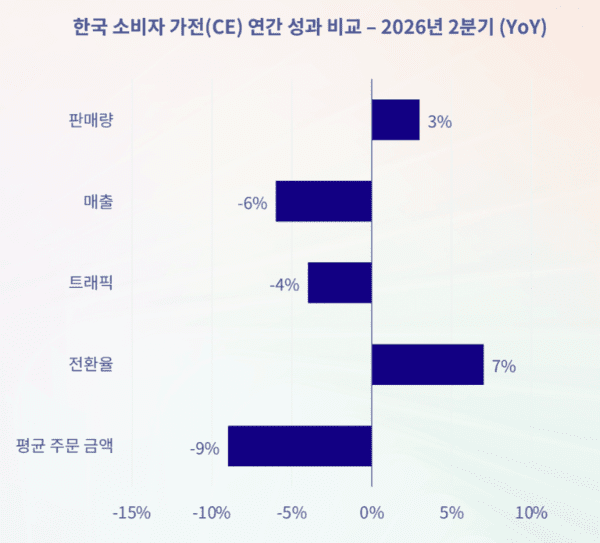
In domestic home appliance and electronics commerce data for the second quarter, traffic fell 4% year over year, but the conversion rate rose 7% and sales volume increased 3%, while AOV fell 9% and overall revenue decreased 6%.
Domestic consumers spend longer researching and comparing before purchase and use multiple channels and AI. Among them, 77% took at least one week from their first search to deciding, and 46% took more than two weeks from starting an online search to completing a purchase.
Criteo released its "2026 Home Appliances and Electronics Consumer Trends" report and analyzed home appliance and electronics purchasing behavior in 2026. The analysis was based on commerce data from hundreds of brands and retailers around the world, as well as survey results from more than 6,200 global consumers.
Based on this, Criteo said domestic consumer spending is shifting toward more practical products. It also analyzed that domestic consumers are spending more time researching and comparing products before making a purchase.
In domestic home appliance and electronics commerce data for the second quarter, traffic fell 4% year over year. In contrast, the conversion rate rose 7% and sales volume increased 3%.
However, average order value (AOV) fell 9%, and overall revenue decreased 6%. Criteo said that despite the increase in sales volume, spending may have shifted to practical products and parts/consumables.
Category-level data supported the earlier trend. Sales of single-burner portable induction cookers rose 42%, and blender sales increased 37%, while desktop computer sales fell 49% and TV sales dropped 26%.
Differences by category were also evident in the timing of domestic shopping events. The peak observed season increase for all home appliances and electronics came on November 3, with the overall increase at 39% versus the October baseline. The increase in water purifiers and filters came on November 11, at 485%, while humidifiers peaked on November 3, at 426%.
As sales increases and decreases, as well as peak growth timing, differed by category, it was confirmed that domestic shopping event effects varied by item. Category-level data was presented as evidence supporting this trend.
Consumer behavior analysis found that domestic consumers conduct research and comparisons before purchasing. Among domestic consumers, 77% took at least one week from their first product search to deciding on a product to buy, and 46% took more than two weeks from starting an online search to completing a purchase, exceeding the global average of 39%. By contrast, same-day purchase completion came in at 5%.
Global analysis found that the average purchase journey involving both apps and the web lasted 32 days, more than twice as long as a web-only purchase journey. Consumers who moved between apps and the web explored an average of 2.7 brands and checked an average of 10 SKU, while consumers on web-only purchase journeys checked an average of 1.9 brands and 6 SKU.
Criteo said that home appliances and electronics require sufficient information gathering and comparison before purchase. It also said buyers spend more time verifying product information and comparing alternatives.
Criteo analyzed that the more app-involved the journey, the broader the range of products, SKU, and brands checked, and the deeper the exploration process becomes. This aligns with the pattern of reviewing more brands and SKU in purchase journeys that involve both apps and the web.
The domestic survey found that consumers use multiple channels throughout the purchase journey, including online marketplaces, brands' owned channels, and offline stores. Among domestic home appliance and electronics buyers, 31% used offline stores, 56% used online channels, and 13% used both online and offline channels. Among domestic home appliance and electronics buyers, 62% used online marketplaces.
The share using official brand websites was 31%, and the share using brand-owned stores, including flagship stores, was also 31%. In response, Criteo said that in home appliance and electronics brands, the importance of strategies that connect multiple touchpoints across the customer journey is growing, rather than evaluating the standalone performance of individual channels.
At the same time, 53% of domestic home appliance and electronics buyers were found to have used an AI chatbot or AI assistant at some point in the purchase process. That means this 53% figure is above the global average of 48%.
On a global basis, in the first half of 2026, the share of product detail page visits coming from ChatGPT was about twice that of traditional search traffic. In addition, most Criteo clients in the home appliance and IT sectors record at least one sale per month through ChatGPT.
The survey found that domestic consumers are influenced by AI recommendations in their purchase decisions, but they tend not to rely on them exclusively and instead actively search and compare on their own. Among domestic AI-using consumers, 58% said AI-recommended or AI-introduced products affected their purchase decisions, a figure similar to the global average of 61%.
Among domestic consumers, 41% preferred first reviewing the entire product lineup and then filtering by preferred criteria, a share above the global average of 39%. By contrast, the preference rate for personalized product recommendations was 28%, and the preference rate for expert-curated product lists was 23%.
Regarding these trends, Kim Do-yoon, CEO of Criteo Korea, said the caution of domestic home appliance and electronics buyers is intensifying and the diversification of purchase journeys is advancing. He added that consumers compare products across retailers and channels, move between online and offline experiences, and actively use AI to explore and evaluate products, while still wanting to make the final choice themselves.
Kim Do-yoon, CEO of Criteo Korea, emphasized that brands need a commerce data-based cross-channel, full-funnel strategy. He also stressed that it is essential to connect every stage of the purchase journey with accurate product information and highly relevant experiences.
Source: TECHWORLD · Lee Gwang-jae
Original: https://www.epnc.co.kr/news/articleView.html?idxno=407948
References
This article was produced with the help of an automated content generation algorithm.
Source: TECHWORLD
View originalThis article was summarized and organized by BizCrush based on the original article from TECHWORLD. For exact quotations and full details, please refer to the original article.