OpenAI Expands GPT-6 Across ChatGPT, Introduces 'Intelligent UI'
TECHWORLD ·
✦ AI Summary
OpenAI will roll out GPT-6 Sol to ChatGPT Plus, Pro, Business, and Enterprise in stages starting on the 8th, and expand GPT-6 Luna to free and high-tier users starting on the 9th.
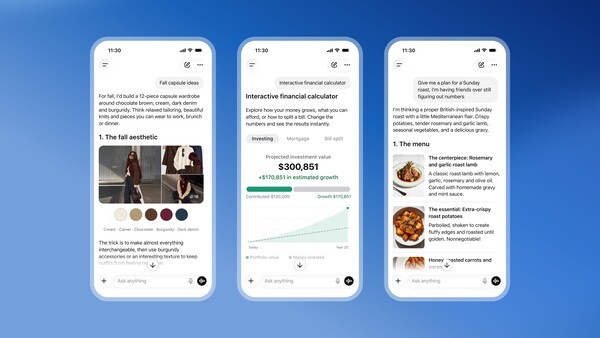
Intelligent UI configures response screens for each question by combining text, images, charts, maps, and buttons, changing the display format to fit travel plans, comparisons, and explanations of complex concepts.
OpenAI released math research results from an internal frontier AI model and also updated response display methods and safety training.
OpenAI will expand GPT-6 across ChatGPT and introduce 'Intelligent UI,' a feature that shapes the response screen according to each question. OpenAI said it will roll out GPT-6 Sol to ChatGPT Plus, Pro, Business, and Enterprise in stages starting on the 8th, and expand GPT-6 Luna to free and high-tier users starting on the 9th.
Intelligent UI is a feature that configures the response screen for each question. It can change how answers are presented by combining text, images, charts, maps, and buttons. For questions about travel plans, it presents routes and maps together, while for questions that require comparisons, it arranges information in parallel. When explaining complex concepts, it uses interactive elements so users can see how results change when input values are modified.
OpenAI said GPT-6 was trained not only to determine the content of answers, but also the way information is laid out, whether visual materials are needed, and how users should interact with it. As a result, a system will be introduced in which both the content of responses and the screen layout are adjusted together to match the type of question.
OpenAI also released math research results generated by an internal frontier AI model, further extending the use of AI into the research area. The move shows that service feature expansion and broader research use are advancing together.
This update involves both changes to how responses are displayed and safety training. With the response format changed, searches and multi-step tasks will first show preliminary confirmations before full processing is complete, and additional results will be provided sequentially. In web search questions under OpenAI's internal evaluation criteria, GPT-6 Instant's response start speed improved by an average of 44% compared with GPT-5.6 Instant.
Safety-related training has also been strengthened. The high-risk areas targeted for reinforced abuse prevention include cyberattacks, biology, and violence. The update applies to ChatGPT's Chat, while the Work and Codex operating models are excluded from the changes.
Separately, WSJ reported that OpenAI disclosed math research results generated by an internal frontier AI model on the 6th. OpenAI tested the model's proof-generation capability on about 4,000 math problems, and the test results were organized into 372 result groups before being made public.
OpenAI applied Lean to some of the results. Lean is used for computer verification of mathematical arguments. OpenAI also released materials related to the model's reasoning process and computation volume. In addition, OpenAI held discussions with the mathematics and AI advisory group at the Institute for Advanced Study (IAS) on how to release the research results and on verification procedures.
However, even if AI-generated proofs are formally valid, they still need to be verified for originality, and they also need to be assessed for academic significance. In this regard, WSJ reported that OpenAI formed an advisory group to reflect feedback and criticism from mathematicians. WSJ also reported that OpenAI adjusted its publication process to release large-scale research results in batches.
OpenAI plans to supplement the explanation in the research manuscript and improve citation information. It also plans to release additional Lean proof materials. The goal is to continue academic verification of AI-generated math research results.
Source: TECHWORLD · Kim Seung-gi
Original: https://www.epnc.co.kr/news/articleView.html?idxno=407924
References
This article was produced with the help of an automated content generation algorithm.
Source: TECHWORLD
View originalThis article was summarized and organized by BizCrush based on the original article from TECHWORLD. For exact quotations and full details, please refer to the original article.