When Robots Stop, Is Seoul Still Safe? Conditions for Adopting an AI-Robot City
IT DAILY ·
✦ AI Summary
At the Physical AI Forum and the 2nd Seoul Urban AI Forum at Smart Life Week 2026, participants discussed the conditions for introducing AI and robots into cities.
At the Physical AI Forum, operating rates, safety, field demonstrations, and on-site data such as work speed and time between failures were key issues.
At the Urban AI Forum, participants said AI can handle demand analysis and alternative comparison, but humans should be responsible for setting public service goals and making final policy decisions.
At the Physical AI Forum held on the 7th at Seoul COEX as part of Smart Life Week 2026, and at the 2nd Seoul Urban AI Forum, the real-world conditions for introducing AI and robots into cities emerged as a common issue in discussions of on-site robot use and the autonomy of urban AI. Both sessions focused on what is needed for technologies to go beyond simply performing functions and instead operate reliably in the field and connect to citizen services. In particular, participants discussed the conditions for moving from the stage where robots carry out specific actions and AI presents analytical results to the stage where they operate stably on-site and provide services citizens need.
At the Physical AI Forum, robot developers raised operating rates, safety, and demonstration conditions as challenges. They also said that introducing AI and robots into city settings requires verification of actual work performance and of response systems for accidents. Post-deployment performance and accountability were identified as common issues across both discussions, and the question raised in the title about what happens when robots stop and whether Seoul remains safe was also discussed in that context.
At the 2nd Seoul Urban AI Forum, urban and transportation researchers emphasized policy goal setting, stakeholder consultation, and the scope of data use. On the use of AI in transportation policy, participants said demand analysis can be automated and alternatives can be compared automatically, but the person who decides the standards for allocating public services should remain human. In the end, the common issue raised at both forums came down to this: if AI and robots are to be introduced in cities in practice, performance verification, accountability, and policy standards must be discussed together.
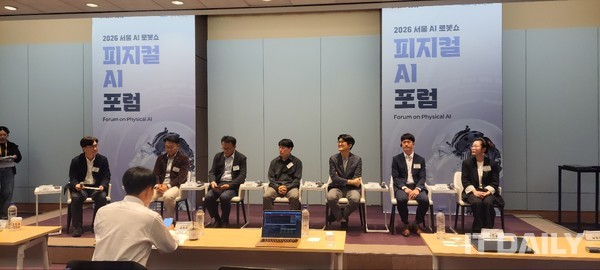
The Physical AI Forum was held on the 7th at Seoul COEX as part of Smart Life Week 2026. The forum discussed the commercialization, safety, and field demonstration challenges facing robots, with the need for on-site data such as work speed and time between failures presented as a key issue in proving business viability. Panelists included Kim Ik-jae, head of KIST AI·Robot Research Institute; Kim Jeong-gyun, executive director at Now IB Capital; Lee Jae-wook, head of LG Electronics HS Robotics Lab; Hwangbo Je-min, CEO of Lion Robotics and an associate professor at KAIST; Shin Dong-jun, a professor at Yonsei University; Nam Chang-mo, vice CEO of Robros; and Aoi Fukawa, vice president at Galbot.
Moderator Kim Ik-jae, head of the Korea Institute of Science and Technology (KIST) AI·Robot Research Institute, asked about the actual operating rate of humanoid robots and also about their average time between failures. He then asked how their processing speed compares with that of humans for the same tasks, leading the discussion toward assessing both stability and productivity together. Average time between failures refers to the average operating time between breakdowns.
The discussion also extended to the context that stable task performance is equally important in the robots-as-a-service (RaaS) business. The point was highlighted that even in businesses that provide robots as a service, stability and productivity must be judged on the basis of field demonstration data. The photo was taken by reporter Kim Byeong-ju.
Nam Chang-mo, vice CEO of Robros, said his company’s robots began full-scale use after the first half of this year and are still at an early stage of commercialization. As a result, he explained, there are not enough statistics that can be disclosed externally, and it is also difficult to present uninterrupted stable operating time.
Nam said that judging business viability in the field requires more than demonstration movements; it is necessary to confirm performance in terms of how continuously the robot can carry out the same task in actual settings. He explained that actual throughput and operating burden vary depending on the speed of repetitive work, and that they also change depending on the frequency of failures or interruptions.
Nam said AI plays an important role in actual work speed. He explained that hardware’s ability to move at high speed alone is not enough, and that situational awareness and the ability to connect appropriate actions are needed. He also said AI is affected by the characteristics of robot hardware, and added that Robros is developing its systems by integrating reducers, hands, and full-body control.
The discussion moved to the issue of how long performance should be verified. Nam said many domestic projects evaluate performance in 3- to 6-month intervals and raised the need to continue long-term field deployment. He said the key to robot demonstration in Seoul lies in time and patience.
There was also concern that short evaluation cycles make it difficult to sufficiently identify what emerges during field deployment. The demonstration period affects the confirmation of operating rates and also affects differences in working environments and the accumulation of exceptional cases. Accordingly, adopting companies and development companies need to decide what tasks to verify and over what period, making the setting of verification scope and duration an issue as important as technology development itself.
Lee Jae-wook, head of LG Electronics HS Robotics Lab, proposed long-term demand from the public sector. He said the government should look 5 to 10 years ahead and prepare demand so that large companies, SMEs, and startups have a chance to enter the market. The idea is not just to provide demonstration opportunities but also to secure demand channels that can be used afterward.
The way robots ensure safety when operating around people is changing. Lee said the conventional way to ensure robot safety was to stop them. However, he said robots used in environments close to people cannot be made safe simply by making them stop.
Lee explained that mobile and bipedal robots may fall over during the stopping process. He also said mobile robots may leave their limited work areas and come close to people. In addition, he said the movement of robot arms and hands is also a risk factor for collisions.
Because of these characteristics, Lee said it is necessary to consider the safety of AI judgments, the proper functioning of sensors, and system security against external attacks. He also explained that judgment errors can lead to physical actions, so AI safety and machine safety need to be checked at the same time.
In response, Nam said the company is developing ways to secure walking stability through simulation. He also said it is developing motions that reduce surrounding risks in the event of a fall and is applying methods that slow a robot’s movement when a person approaches.
Difficulties related to insurance and administrative procedures were also raised. Lee mentioned having experienced difficulty in obtaining insurance during Seocho District’s delivery robot demonstration, and he also mentioned difficulties in coordination among administrative agencies. Along with that, compensation tools for accident damage and a one-stop channel for handling demonstration procedures were presented as essential infrastructure for robot operations.
The discussion then turned to ways of jointly designing the environment in which robots operate. Lee explained that opening the door of a washing machine requires considerable force and complex movements. He introduced an integrated approach in which appliances automatically open when they receive signals from robots, and said elevators can be called through communication rather than through button operation by the robot.
Along with this, an approach to dividing tasks between robots and surrounding equipment was proposed. The point was made that if appliances and building systems take on some functions, robot movements can be simplified. That is why, at deployment sites, equipment performance and integration with surrounding systems must be reviewed together.
Opinions were presented that technical design and research directions should be tailored to actual tasks and user conditions. For robots, it was pointed out that the form factor should be chosen differently depending on the work to be performed. Hwangbo Je-min, CEO of Lion Robotics and an associate professor at KAIST, explained that a humanoid in an environment where it cannot use both arms and both hands is an inefficient platform. He said quadruped robots are suitable for movement-centered work such as military or police patrols, while humanoids are suitable for work that uses both arms and both hands.
A case in which design was changed through user participation was also introduced. Shin Dong-jun, a professor at Yonsei University, said that while developing a bicycle system for people with paraplegia, he reflected the users’ upper-body movements and posture in the control and interface design. He also said that conditions difficult for developers to experience firsthand can be identified through feedback from the people concerned.
This sense of the issue also extended to urban research and policy discussions. At the Urban AI Forum, participants pointed out the need to confirm real demand from the early stages of research. Agnieszka Wąsiewicz-Babnik, director of the Maxwell Center at the University of Cambridge, explained that after spending time and money to create a solution, one may realize the wrong problem was being solved. She then emphasized the need to speak early with actual users such as policymakers and city administrative officials.
The 2nd Seoul Urban AI Forum was held on the 7th at Seoul COEX as part of Smart Life Week 2026. The forum discussed the autonomy of urban AI, policy judgment, and data use, focusing on defining the boundary between the functions AI can handle in city operations and the policy decisions that must remain human responsibilities.
The discussion moved toward the view that analytical and comparative functions used in transportation networks and similar systems can be handled by AI. The forum presented demand analysis and alternative comparison as technical tasks for AI, while treating the question of how far to separate AI’s responsibilities from human policy judgment as a major issue.
By contrast, human roles were presented as setting goals for public services and adjusting stakeholder interests. Panelists that day included Professor V. Varalakshmi Farooq of Toronto Metropolitan University, Professor Xiaofeng Li of the University of Wisconsin-Madison, Professor Kim Seong-hu of Korea University, Agnieszka Wąsiewicz-Babnik, director of the Maxwell Center at the University of Cambridge, Umberto Pugliano, head of research strategy and partnerships at MIT Senseable City Lab, and Professor Thomas Schroepfer of the Singapore University of Technology and Design (SUTD). The photo was taken by reporter Kim Byeong-ju.
Professor Kim Seong-hu of Korea University cited a case of reorganizing a public transportation network and explained that AI can optimize a demand-responsive system. He said, however, that when reorganizing a public transportation network, policymakers must consider groups with low transportation accessibility, people who cannot use needed services, and multiple stakeholders together. He explained that the approach presented is one in which AI provides policy analysis and impact assessment, after which humans consult and make decisions.
Kim said alternative evaluations differ depending on whether the goal is improving overall usage efficiency or supporting areas with low transportation accessibility. He also said there is a need to distinguish between expanding the range of calculations AI can perform and deciding which results should be prioritized. He added that because AI still carries the possibility of errors, key processes require careful expert design.
Kim explained that the basic data used in policy analysis are also subject to verification. He said origin-destination data contain information on people’s departure and arrival movements and are used as input for transportation demand forecasting. He also emphasized the importance of consistency in the models and procedures that generate origin-destination data.
Regarding the use of personal information, Kim said the first task is to distinguish what information is needed for each analytical purpose. He cited gender, age, income, occupation, vehicle ownership, and about 40 days of travel history as information items used for research. However, he said gender and age are not essential in emergencies for predicting travel routes, and that the required information may differ when analyzing travel purposes.
Kim said that before expanding the amount of data, the task is first to determine the scope of personal information needed for analysis. He also explained that separate consent is required for survey information, travel history, and app-based location information. In addition, he said the content of the information used and the expected impact must be clearly disclosed.
Kim said that if a model developed on the basis of consent from survey participants is applied to the entire population, a problem arises regarding the use of records from non-consenting individuals, and he presented this as another issue that must be reviewed.
Source: IT DAILY · Kim Byeong-ju
Original: https://www.itdaily.kr/news/articleView.html?idxno=242073
References
This article was produced with the help of an automated content generation algorithm.
Source: IT DAILY
View originalThis article was summarized and organized by BizCrush based on the original article from IT DAILY. For exact quotations and full details, please refer to the original article.