Hoseo Semiconductor Power Grid Targeted for 2028; Skilled Labor and Materials-Parts-Equipment Preparation Remain Key Tasks
IT DAILY ·
✦ AI Summary
At the Oct. 6 parliamentary audit, the feasibility of supplying electricity and water to the Honam semiconductor industrial complex and the timing of transmission line construction emerged as key issues.
The government said it can supply 6.3 GW of electricity and 650,000 tons of water per day to the Honam industrial complex, and moved up the target date for power supply to the end of 2028.
At the audits of the Ministry of Trade, Industry and Energy and the Ministry of Climate, Energy and Environment, discussions also covered financial support of up to KRW 6 trillion, securing skilled workers, demonstration projects in materials, parts, and equipment, building the Trinity fab, and unresolved support for the ASML supply chain.
At the Oct. 6 parliamentary audit of the Ministry of Trade, Industry and Energy and the Ministry of Climate, Energy and Environment, the selection of a semiconductor site in Honam and financial support emerged as key issues. The government said local electricity supply and local water supply are both possible for the Honam semiconductor industrial complex. However, it explained that both the transmission line design stage and the transmission line siting stage are still in the preliminary review phase. The government brought forward the target date for building the power supply line for the Honam semiconductor industrial complex to the end of 2028.
Under the government and companies’ public plans, the need to align factory and infrastructure construction schedules and secure personnel was presented as a prerequisite for actually securing production capacity. At the parliamentary audit, lawmakers noted that demand for skilled workers needed for factory construction is expected to surge. Concerns were also raised that competition for labor could intensify with shipbuilding and steel.
In the materials, parts, and equipment sector, verification for mass production and commercialization after technology development were presented as tasks. In the process of company participation, it was said that customer-company verification of developed products and linkage to process application for verified products are needed. The government emphasized the need to swiftly build a Trinity fab for evaluating products made by domestic materials, parts, and equipment companies. It also said the area of support for ASML’s participation in the extreme ultraviolet (EUV) lithography equipment supply chain has not yet been decided.
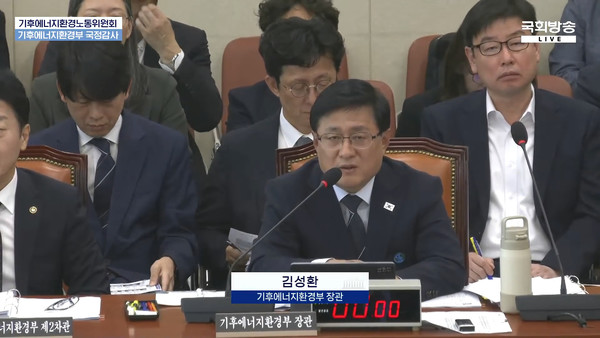
At the Oct. 6 parliamentary audit of the National Assembly’s Climate, Energy, Environment and Labor Committee, the feasibility of supplying the electricity and water needed to build the Honam industrial complex was a major issue in the audit of the climate ministry. On the day, Climate, Energy and Environment Minister Kim Sung-hwan responded to related questions.
Minister Kim said electricity of 6.3 gigawatts (GW) could be supplied to the Honam industrial complex, and 650,000 tons of water per day could also be supplied.
In response, People Power Party lawmaker Lee Jong-bae pointed to the actual supply capacity of existing power facilities and renewable energy. He also raised the issue of drought response.
Democratic Party lawmaker Shin Jeong-hoon argued that electricity generated in Honam and transmitted to other regions should be used. Shin also suggested that existing water resources should be used for industrial demand.
At the same time, the target timing for building the factory connection line to send electricity to factories was also shortened. The ministry plans to begin power supply by the end of 2028 after building the first-stage supply line, moving the schedule forward by one year from the previous target of the end of 2029.
Minister Kim explained a plan to branch off about 32 km of the existing 345-kV transmission line and divide the construction sections to shorten the construction period. However, he said both whether design work has begun and whether the site has been finalized are still in the basic review stage.
Power demand was presented as depending on changes in the scope of fab expansion. Rebuilding Korea Party lawmaker Seo Wang-jin said the demand for the four fabs currently planned is about 6.3 GW and asked about the power demand if the number expands to nine fabs. Minister Kim said that in the case of nine fabs assuming expansion, about 14 GW would be needed. While distinguishing between current planned fab demand and expansion-assumed demand, Kim said the power grid plan would be re-examined during the process of drawing up the 12th Basic Plan for Electricity Supply and Demand.
The water supply plan was presented as a combination of using existing dam reserves and additional securement projects. The ministry announced the plan on June 30, proposing to secure 650,000 tons per day by supplying 300,000 tons per day from Dongbok Dam, 150,000 tons from Juwam Dam and Jangheung Dam, 100,000 tons per day from Boseong River Dam, and 100,000 tons per day from Naju Dam.
Water securement was presented as a combination of raising the height of Dongbok Dam and converting and substituting water supply for Boseong River Dam and Naju Dam, based on a plan to secure an additional 250,000 tons per day from Dongbok Dam’s supply. For Boseong River Dam, part of the water for power generation would be converted to industrial water, and for Naju Dam, water from the Yeongsan River would be substituted for part of agricultural demand, allowing the use of the water secured by Naju Dam.
The ministry said it plans to work out detailed supply methods and schedules through consultations with companies.
It was then noted that skilled workers in welding, piping, and electricity are needed at the factory construction stage. Analyses presented at the parliamentary audit and by the office of Democratic Party lawmaker Kim Won-i pointed to the possibility that labor demand at semiconductor construction sites in Gwangju could rise sharply in a short period and that such demand could overlap with nearby industries such as shipbuilding and steel.
Based on estimates by Company A in the semiconductor construction industry, the daily number of skilled workers to be deployed was presented as 1,453 at the end of 2028, 23,268 at the end of 2029, and 31,567 at the end of 2030. However, these figures are Company A’s estimates of daily on-site deployments and are not confirmed hiring numbers.
Rep. Kim pointed out that competition to secure skilled workers could intensify if construction proceeds in Yongin and elsewhere. He linked this to the fact that the jobs needed for semiconductor construction also play key roles in shipbuilding and steel, meaning workforce gaps could emerge in existing industries if workers move.
Kim particularly noted that the risk of labor outflow is high at small and medium-sized shipbuilders and steelmakers. He also explained that it takes time to train new workers.
Kim said it takes 1 to 2 years to train pipe fitters, and more than 2 years to train welders and instrument technicians. He called for advance preparation in light of these job characteristics.
He also called for support to automate processes and introduce AI at small and medium-sized shipyards and steel companies. He added that measures to bring back skilled workers who have left the field should also be prepared.
Meanwhile, Trade, Industry and Energy Minister Kim Jung-kwan spoke at the Oct. 6 parliamentary audit of the National Assembly’s Trade, Industry, Energy, SMEs and Startups Committee. At the audit, the process of deciding on investment in Honam semiconductors and the verification procedure for financial support became points of contention, and the scale of financial support was up to KRW 6 trillion. People Power Party lawmaker Cho Ji-yeon argued that the ministry’s submitted materials and the company’s explanation did not match regarding whether the company intended to make a first investment in a specific region. In response, Minister Kim Jung-kwan explained that the government had suggested candidate sites but that the company was the final decision-maker, and said he would check the discrepancy pointed out in the materials.
People Power Party lawmaker Kim Do-eup raised issues with the breakdown of the up to KRW 6 trillion support package and also questioned the exemption from the preliminary feasibility study. In response, Minister Kim explained the structure of autonomous budget planning by local governments.
The ministry released an explanatory document on Sept. 11. According to the document, the funding has the character of up to KRW 6 trillion in financial incentives for the integration of Gwangju and South Jeolla Province, and its use is limited to building a semiconductor production base in the Honam region.
The support is structured as a future contribution to the semiconductor support account within the integrated local government support fund, and the entity that will use it is the integrated special city. The integrated special city plans to draw up an annual fund management plan reflecting company investment plans and infrastructure construction demand, and execution will take place after review and approval by the support committee. The central government plans to review the appropriateness of the project plan, with the items for review being scale, funding requirements, and implementation measures.
The disclosed execution structure is a framework for reflecting company investment and infrastructure demand in annual plans. However, apart from the discussion of the total amount, the task of linking the necessary facilities at each factory construction stage with the timing of fiscal spending remains unresolved.
In the materials, parts, and equipment sector, the issue of sales performance after successful technology development was raised. According to an analysis by the office of Democratic Party lawmaker Jang Cheol-min, 772 completed materials and parts technology development projects were counted over the past 5 years.
Among them, 455 projects had no sales generated, and the share of such projects was 58.9%. Government contributions invested in those projects totaled KRW 1.1468 trillion. The analysis was not limited to semiconductors, but covered materials and parts technology development projects in general. Projects with no sales included a project to develop and commercialize a vacuum pump for semiconductor processes.
The ministry, however, explained that even after a success determination, performance may be delayed by testing prototype products. It also said performance could be delayed after a success determination because of sales contract negotiations with customer companies, and because mass production lines are built after the success determination.
The ministry said performance could be delayed after a success determination due to certification and standardization, and that projects could also be halted because of deteriorating corporate management. It therefore explained that it is difficult to single out technology development failure or lack of demonstration alone as the sole cause of no sales.
At the parliamentary audit, Minister Kim Jung-kwan identified materials, parts, and equipment as the biggest weakness of South Korea’s semiconductor industry and stressed the urgent need to build a demonstration fab. When Democratic Party lawmaker Heo Seong-moo asked about China’s challenge to the semiconductor industry, Minister Kim said South Korea needs to maintain its technological edge in advanced fields such as high bandwidth memory (HBM), and also said semiconductor fabs need to be built quickly.
The Trinity fab is being pursued as a facility that supports evaluation of mass-production conditions for new products from domestic materials, parts, and equipment companies. The ministry unveiled the business plan in Nov. 2024, and the plan included installing about 40 process and metrology tools in the Yongin semiconductor cluster and providing performance evaluation linked to customer companies as well as consulting from SK hynix expert engineers. The Trinity fab concept is focused on helping materials, parts, and equipment companies evaluate their products under the same conditions as mass production lines.
SK hynix said in July that commercialization would be difficult without an actual semiconductor fab verification process. It then said it plans to build a Trinity fab of about 1,000 pyeong within Phase 1 of the Yongin semiconductor cluster and open it from 2027.
The government’s support for materials, parts, and equipment companies is explained along two axes. One is support through the Trinity fab, which is a facility that provides materials, parts, and equipment companies with opportunities to verify products in a mass-production environment. The Trinity fab’s evaluation environment is the mass-production environment of domestic chipmakers, and for the development results of domestic materials, parts, and equipment companies to lead to sales, evaluation is needed, as are process application by customer companies and purchases by customer companies.
The other is support for entry into the ASML supply chain. However, the selection of specific targets for support to join the supply chain of overseas equipment manufacturers has not yet been completed. The remaining task for support to enter the ASML supply chain is also to clarify the areas and the targets involved.
Democratic Party lawmaker Jeon Eun-su pointed to the possibility that supplies of ASML EUV lithography equipment could be disrupted depending on international developments and called for support for domestic companies to produce equipment and to join domestic supply chains. In response, Minister Kim said the targeting areas have not yet been decided, but that the government will distinguish the areas eligible for support and will back demonstrations by materials, parts, and equipment companies.
Source: IT DAILY · Kim Byung-joo
Original: https://www.itdaily.kr/news/articleView.html?idxno=242038
References
This article was produced with the help of an automated content generation algorithm.
Source: IT DAILY
View originalThis article was summarized and organized by BizCrush based on the original article from IT DAILY. For exact quotations and full details, please refer to the original article.