Ha Jung-woo: The Public Sector Should Be AI's First Buyer to Support Overseas Expansion Through Domestic Track Records
TECHWORLD ·
✦ AI Summary
Ha Jung-woo, the full-time vice chair of the National AI Strategy Committee, said the public sector should serve as the first buyer to support the sustained growth of domestic AI companies.
He presented a structure in which public procurement creates initial demand and track records, which are then connected to private-sector adoption and overseas expansion.
He said key tasks for AI expansion are public procurement, improved model usability, and field talent development.
Ha Jung-woo, the full-time vice chair of the National AI Strategy Committee, said the public sector should serve as the first buyer to ensure the sustained growth of domestic AI companies. He said this would help turn technology development into revenue and create a virtuous cycle in which domestic deployment records support private-sector adoption and overseas expansion.
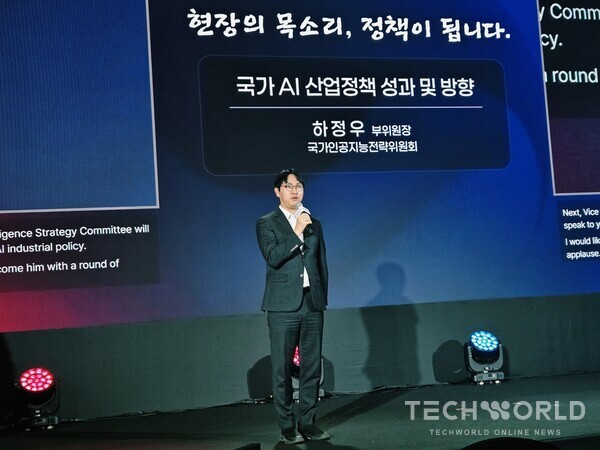
Vice Chair Ha attended the AI Industry Policy Talk Show at AI Festa 2026, held on the 6th at COEX in Seoul, and explained measures to foster the industry and Korea's AI strategy. The event was hosted by the Ministry of Science and ICT and organized by the Korea AI and Software Industry Association (KOSA) and the AI Festa Organizing Committee. At the event, he answered questions about using independent models, participating in the public market, and AI transformation (AX) for small and medium-sized enterprises.
In his opening remarks, Vice Chair Ha presented sustainable growth, a leap into the world's top three AI powers, and securing a role in the global AI core supply chain as national strategic goals. He said the public must be able to benefit from the growth opportunities created by AI without exclusion, and that society must respond swiftly to changes such as jobs.
Given the assessment that as frontier AI becomes more advanced in problem-solving and coding, the risk of it being misused for cyberattacks also grows, the need to secure safety capabilities was emphasized. It was also stressed that, on the premise of maintaining the pace of technological progress, response capabilities and countermeasures to risks must be prepared.
The need to participate in international discussions was also mentioned. The main actors in executing the strategy were identified as companies, startups, and academic researchers.
The government's role was presented as supporting technological innovation so that it translates into industrial results. It was also said that the government should broaden opportunities for regional industrial growth and for young people, and that technological innovation should not stop at academic papers but lead to tangible outcomes in industry, the economy, and society.
Power, AI semiconductors, GPUs, and data centers were presented as foundational elements. Last year, alleviating GPU shortages was a priority task, and going forward, the challenge was to connect the secured infrastructure to industrial use of AI agents and physical AI. In addition, because supply chain risks remain due to dependence on overseas technology, the need to strengthen the competitiveness of domestically produced AI semiconductors was also raised.
The Q&A focused on business foundations that could sustain company growth after government support. Ha said there is a sustainability issue once government support is scaled back, and explained that the government's role as first buyer is important. He also said there is a need to create initial demand through public-sector purchases of products and services.
Ha explained that companies must link the track records they secure to private-sector adoption. He also said government budget spending can improve competitiveness. In other words, he presented a structure in which public procurement creates initial demand and track records, which are then connected to private-sector expansion.
As an example, he pointed to 'Mudeunui AI.' He said the reach of government fee support could be expanded to application companies, companies providing API and MCP services, model developers, and infrastructure and data center operators. He also said that allocating participation opportunities to multiple companies was a necessary condition.
Another necessary condition was presented as a user's transition to paid use after recognizing the service's value. Ha said that if such a structure is in place, a self-sustaining market can be formed. He added that government support must spread across multiple supply stages and ultimately lead to paid usage for a market to remain sustainable.
A trend was presented in which track records and demand secured in Korea should be used as a steppingstone to win overseas customers and expand globally. The possibility of using domestic track records to secure overseas customers was raised, and the need for public and private demand for domestically produced NPU and AI solutions, as well as a foundation for global market entry, was also mentioned.
Ha said overseas expansion should be pursued based on domestic track records. He also said it is necessary to aim for technologies, services, and products that can expand globally, and explained that the government's strategy is also reflecting and managing that direction.
Questions were then raised about how to respond to rapid updates from overseas models in connection with independent AI models. Questions were also raised about the ease of use of independent AI models.
In response, Ha explained that it is necessary to secure frontier AI development capabilities. At the same time, he said the burden on companies in introducing and operating models needs to be reduced.
As part of the measures, he proposed providing lightweight models in parallel through knowledge distillation. Knowledge distillation was described as a method of transferring the knowledge of a large model to a smaller one. In addition, he identified a harness, an execution framework that supports model tool use and task execution, as a necessary component.
The speaker argued that to improve the effectiveness of the foundation model project, it is necessary to avoid ending the effort with the model itself. He proposed including a business package as a way to secure harness competitiveness. He also explained that including a harness would improve access in the public and industrial sectors.
On performance evaluation, he suggested that in addition to benchmarks, actual usage by global developers should be reviewed. As an evaluation item, he said the degree to which domestic models are selected within external model platforms should be examined. He also said that whether operations are safe and whether the model can respond to cyber threats should be included in the evaluation criteria.
However, he stated that the combination of lightweight models and harnesses, as well as the improvement of the evaluation method, were his personal views as a researcher. He also said he expects the Ministry of Science and ICT to disclose the specific form of implementation for the independent model and frontier AI projects after the National Assembly audit.
Further review was carried out on expanding public participation in AI and nurturing regional talent. In the public sector, an issue was raised about the need for infrastructure that meets security requirements. Along with that, measures for SME participation were also brought up.
Ha pointed out that there is a shortage of infrastructure to support public AX. He mentioned that one possible direction is to designate some data center space exclusively for public use in the future. However, he said the plan for dedicated public zones has not yet been finalized.
In response to questions about SME participation in the common public AI infrastructure, he pointed out the difference between the initial planning stage and the current agent-centric technology environment. Accordingly, he said the Ministry of the Interior and Safety will review follow-up public AI transformation measures, and that during that process, it will examine the limits of company participation and the limits of technology utilization.
As a measure for regional and SME AX, a plan linking technology supply with talent development was proposed. It envisioned AI training for skilled experts at demand companies and defined the scope of joint work with technology-company developers, from problem discovery to prototype production and operations.
Ha said that providing technology alone is not enough. He explained that it is necessary to run a parallel program to train field engineers, to jointly cultivate field engineers in the relevant specialties, and to aim for the trained personnel to create more opportunities and contribute to AI transformation across regional industries.
He also proposed an idea to connect this with existing voucher programs. The proposal included linking demand and supply companies through a structure designed for that purpose, as well as connecting this to field talent development and participation by young people who have received AX training.
Ha presented public procurement, improved model usability, and field talent development as the tasks needed to spread AI. He then said the direction should connect infrastructure and technology investment to company revenue and follow-up businesses, and presented the expansion targets for those results as regional industries and opportunities for public growth.
Source: TECHWORLD · Kim Seung-gi
Original: https://www.epnc.co.kr/news/articleView.html?idxno=407839
References
This article was produced with the help of an automated content generation algorithm.
Source: TECHWORLD
View originalThis article was summarized and organized by BizCrush based on the original article from TECHWORLD. For exact quotations and full details, please refer to the original article.