Humanoid Deployment Requires Solving Data, Control, and Cost Together
TECHWORLD ·
✦ AI Summary
Dennis Hong said that the prerequisites for humanoids to be used in the field are securing the data needed for tasks and stable control technology.
He explained that humanoids can use human environments and tools, but that for specific tasks they may be less cost- and performance-competitive than dedicated robots.
Accordingly, he said it is necessary to choose field-tailored design and field-tailored control methods and to consider both the benefits of using existing spaces and tools and the limitations of each task.
The prerequisites for putting humanoids to work in factories and daily life are securing the data needed for tasks and securing stable control technology. Dennis Hong raised the issue that these conditions must come first for humanoids to be used in the field.
Humanoids have the advantage of being able to use spaces and tools designed for people. However, for each task, they may be less favorable than purpose-built robots in terms of cost and performance.
For that reason, he said, it is important to choose field-tailored design and field-tailored control methods in order to improve adoption benefits. The point is that humanoid use should be approached by considering both the advantage of using human environments as they are and the limitations of each task.
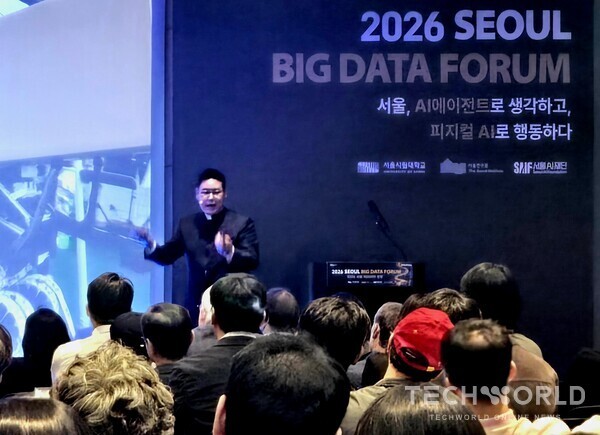
Dennis Hong, a professor in the Department of Mechanical and Aerospace Engineering at UCLA and director of RoMeLa, delivered the keynote speech at the opening of the '2026 Seoul Big Data Forum' at COEX in Seoul on the 6th. The forum was hosted by the Seoul Metropolitan Government and organized by the University of Seoul, the Seoul Institute, and the Seoul AI Foundation, and it is an affiliated event of 'Smart Life Week (SLW) 2026,' the AI and ICT fair held at COEX from the 6th to the 8th.
Speaking on the theme, 'The Moment Intelligence Gets a Body: The Era of Physical Intelligence Unfolded by Humanoids,' Professor Hong introduced robot development cases from RoMeLa and explained the potential of humanoid applications. In the process, he described the difficulty of securing training data and emphasized the need to combine existing control technology with AI.
Professor Hong explained the need for humanoids from the perspective of human living and work environments. Stair heights, door handle positions, and tool shapes are designed around human standards, and he said that robots carrying out multiple tasks are better off with body structures similar to those of humans. He said humanoid form is advantageous when adapting to environments and tools designed for people.
He also explained that in manufacturing sites, if robots can handle the same tools in human workspaces, the burden of overhauling all equipment for automation is reduced. He said that using existing spaces and tools in manufacturing sites is one of humanoids' advantages.
Regarding disaster response, he said it is difficult to predict the assigned task before arriving at the scene. Accordingly, he said, robots that can use human tools are helpful. He stressed that using existing spaces and tools in manufacturing and disaster response is one of humanoids' advantages.
Professor Hong said humanoid robots can be deployed in positions where people work even while keeping existing processes unchanged. At the same time, he said, it is just as important to understand the disadvantages of humanoids as it is to understand their advantages.
Professor Hong said humanoids are not suitable for every task, and that if the work is a single fixed task, a function-specific robot form can be designed. As an example, he pointed to robot vacuum cleaners and said that for cleaning floors under furniture, a low, flat structure is more suitable than a humanlike one.
Professor Hong said the standard for choosing robots in manufacturing sites is the nature of the task. He explained that humanoids are structurally complex and expensive, and that for tasks requiring precision, speed, or large force, dedicated industrial robots may have the upper hand. He added that when introducing robots, the benefits of using existing processes, the introduction cost, and task performance must all be considered together.
Professor Hong said there are also differences depending on the actuation method. As comparison targets, he cited ARTEMIS, unveiled in 2023, and Boston Dynamics' existing hydraulic Atlas, saying hydraulic systems have the advantage of generating large force but come with burdens such as fluid leaks, noise, and heat. He added that ARTEMIS uses electric actuators.
ARTEMIS is equipped with electric actuators designed to provide elasticity and force control, along with foot force sensors, as a means of maintaining balance. Professor Hong introduced videos showing the robot maintaining its posture even when pushed from the outside and maintaining its posture while walking over irregular ground. He also showed a case of carrying boxes.
Beyond walking and task execution, robots also need the ability to judge surrounding conditions. Professor Hong also demonstrated scenes from RoboCup, the international robot soccer competition. In those matches, robots recognized the positions of the ball, opponents, and obstacles, and decided on movement and passing.
The key feature of this case is that the robot made autonomous judgments and moved without human remote control. A subheading raised the challenge of force and impact that are not captured on video, as well as data acquisition.
The way robots respond to various situations is also changing. The traditional method was to separately design environmental perception, behavior judgment, and motion control. An evolving approach is end-to-end learning, which connects sensor input and action output through training. This approach is based on environments in which developers find it difficult to predefine responses for every situation, and its purpose is to teach behavior from data.
Robot training requires data of a different kind from text or images. Needed data items include physical information such as joint position, speed, acceleration, the force applied when grasping objects, and impact and friction from contact. Professor Hong pointed out that it is difficult to collect such data in bulk from the internet, and identified this as a challenge for physical AI.
In this context, simulation can be used to generate data by running multiple virtual robots simultaneously. A problem, however, is the gap between the virtual environment and reality. As a result, 'Sim-to-Real' can occur, in which the behavior learned in simulation is imperfectly implemented on actual robots.
An example of the cause of these problems is that real-world conditions such as slippery or uneven floors are difficult to fully reproduce. Accordingly, additional refinement is needed. Professor Hong said that no matter how sophisticated a simulation is, it can never be exactly the same as reality, and that it is impossible to fully reflect elements such as slippery floors in the real world.
One way to obtain real-world data for robot training is to secure real-world data through teleoperated task demonstrations. However, collecting enough data across diverse situations requires manpower and time. In addition, robots can be used for autonomous repeated experiments, but in that case there is a risk of falls and part damage. Such autonomous repeated experiments also bring repair costs.
Professor Hong introduced the example of 1X's home robot NEO to explain the link between teleoperation and data collection. In this case, real household data accumulates as people perform housework remotely. He explained that the idea is to improve the robot's autonomous performance based on the accumulated data.
Professor Hong said there are also limitations to using prerecorded video footage. Video makes it possible to observe motion, but it is difficult to directly measure the amount of force used to grasp an object or the impact at the moment of contact using video alone. While explaining these limitations, he drew an analogy, saying that one cannot learn to skate simply by watching videos of Yuna Kim's figure skating.
RoMeLa is developing a wearable device for collecting hand-motion data for robots. Professor Hong explained that a person wears the device while working, allowing motion data for a robotic hand to be collected. He cited object manipulation and tool use as application examples for the device.
Professor Hong said the purpose of this research is to efficiently secure accurate data for everyday tasks. He explained that this is a line of research aimed at accurately and efficiently securing case data for daily work.
Professor Hong also introduced the development of the actual robot Cosmo, a character from the film 'The Electric State.' Ordinary robots are designed in forms tailored to motion performance. Cosmo, by contrast, had to house actuators and computing hardware inside a predetermined character body shape and size.
Cosmo also needed motion-based emotional expression in addition to walking and object manipulation, and it also needed interaction with people. Professor Hong explained that in the process of implementing these expressions, the team faced challenges different from conventional task-oriented research.
The research team compared control methods using the same robot. One team used model-based control, a method based on the mathematical representation of the robot's structure and physical laws. The other team used learning-based control, a method in which behavior is learned from data.
Professor Hong presented a comparison video of a small quadruped robot. While explaining the comparison, he said learning-based control may make it possible to implement natural motion. However, as challenges for application to actual robots, he said unresolved issues remain, including overcoming the gap between simulation and reality and addressing mechanical burden caused by repeated motions.
Using ARTEMIS and BALLU as examples, Professor Hong explained cases in which the appropriate control method changes depending on the robot's structure. ARTEMIS was presented as a robot designed in-house. It was modeled using a mathematical model based on the robot's physical characteristics, and that model was used to control walking.
Professor Hong explained that in the case of ARTEMIS, machine learning was not used because there was no data. He also said that because it was a robot designed in-house, all the parameters were known. On that basis, ARTEMIS was presented as an example of model-based control.
BALLU is a lightweight robot supported by the buoyancy of helium balloons. Although the risk of damage in the event of a fall is low, it is sensitive to wind and surrounding conditions, and its movement is difficult to model precisely.
For this reason, the BALLU research combined physical analysis and learning. The research team identified the actuator characteristics using hardware data and performed simulation calibration, then applied reinforcement learning after calibration. Professor Hong said the data secured by continuously moving BALLU in the lab was used for training. As a result, the team implemented walking and turning motions on the real robot.
Meanwhile, RoMeLa released ARTEMIS mechanical design materials, ARTEMIS actuator-related materials, and ARTEMIS control-related materials for the purpose of helping other researchers develop robots and control technologies. This broadened the foundation for use in other research.
However, even after learning-based motion implementation, challenges remain in analyzing and correcting the causes of errors. Professor Hong pointed out that changes to the robot structure incur retraining costs, and explained that missions related to human life require verification of stable operation. He also said that knowledge gained from understanding motion principles can be used to correct errors, develop new robots, and develop prosthetic arms and legs.
He said it is important to identify the essence of the problem, and that it is important to choose tools suited to that essence. He then reiterated the importance of fundamentals.
He also said that the conditions for humanoids to be used in the field include task-appropriate design, sufficient data, and stable control, all of which must be in place together. In this keynote speech, he presented as challenges the combination of conventional control technology and AI learning according to robot structure and task, and the verification of performance and stability in real-world environments.
Source: TECHWORLD · Kim Seung-ki
Original: https://www.epnc.co.kr/news/articleView.html?idxno=407838
References
This article was produced with the help of an automated content generation algorithm.
Source: TECHWORLD
View originalThis article was summarized and organized by BizCrush based on the original article from TECHWORLD. For exact quotations and full details, please refer to the original article.