Workday Redesigns Work Around AI Agents, Expands Partner Ecosystem
IT DAILY ·
✦ AI Summary
Workday Korea held a press briefing on the 7th at its office in Yeoksam-dong, Gangnam-gu, Seoul, to share this year’s business status, AI strategy, and plans to expand its partner ecosystem.
Heo Jeong-yeol, head of Workday Korea, described this year as a year to reset the foundation for growth and set organizational restructuring and partner ecosystem restructuring as tasks.
Workday presented AI agents, skill-based talent management, global HR operations, and partner-based build capabilities as its main growth pillars, and officially launched 'Workday Learning, powered by Sana.'
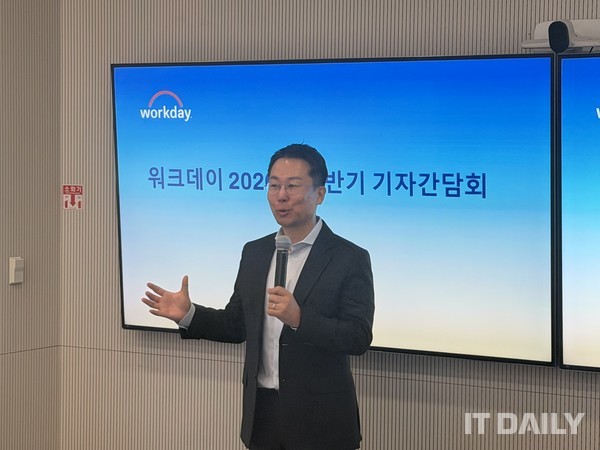
Workday Korea held a press briefing on the 7th at its office in Yeoksam-dong, Gangnam-gu, Seoul, to share this year’s business status, AI strategy, and plans to expand its partner ecosystem. The presentation was led by Heo Jeong-yeol, head of Workday Korea. The photo was taken by reporter Yang Seung-gap.
At the press briefing, Heo Jeong-yeol, head of Workday Korea, outlined Workday’s business performance this year, its AI strategy, and its plans to expand its partner ecosystem. He said the decision-making standards for enterprise companies are time, risk, and money.
Heo Jeong-yeol, head of Workday Korea, said Workday’s AI strategy is one of the few rare alternatives that addresses the challenges of time, risk, and money at the same time. He also said the company is rebuilding the foundation for growth by emphasizing AI- and skill-based talent management, the theme of the subheadline.
Heo Jeong-yeol, head of Workday Korea, described this year as a year to reset the foundation for growth and start over. Accordingly, he identified organizational restructuring and partner ecosystem restructuring as this year’s tasks for Workday Korea.
He also set expanding business opportunities with major domestic conglomerates and companies with a high proportion of global business as this year’s business focus. He said the company plans to broaden opportunities with those firms by reshaping its organization and partner framework.
Customer priorities are changing. Rather than the technology itself, companies are focusing on how AI is applied to actual HR work, and they are also paying attention to the safety of AI deployment and the centralized management of workforce data spread across multiple countries on a single platform.
Head of the Korea office Heo said interest in the practical impact of AI agents is increasing. Areas of interest for AI agent adoption include recruiting, payroll, performance management, and employee self-service.
In response to this demand, the company identified AI agents, skill-based talent management, global HR operations, and partner-based build capabilities as its main growth pillars. Among them, skill-based talent management refers to managing workforce based on employees’ capabilities and skills during the transition to an AI-native organization.
Heo said capabilities already held are important in the shift to an AI-native organization. He added that skills need to be continuously managed and updated to match rapidly changing industries, stressing the importance of skill-based talent management.
The core of the AI strategy is 'enterprise AI that actually works.' The strategy is designed to predict necessary tasks, propose decisions, and connect them to actual execution by using HR and finance information inside the company along with business context.
For implementation, the company emphasized connecting HR and finance data with business processes on a single platform. Heo said contextual understanding is important for inference performance.
Heo also said that approval structures, permissions, compliance, and audit trails required by companies must be reflected from the design stage of AI agents. Accordingly, he said more emphasis is being placed on designing actual workflows than on simply increasing the number of agents.
Heo said many AI agents are emerging, but the real questions are whether they help actual work, prevent accidents, and can be managed. He added that Workday does not obsess over the number of agents.
Workday said it will push a full refactoring effort focused on a single sub-process that has a major business impact for customers. This redesign is not just a process improvement; it means designing the process from scratch. AI agents are the ones carrying out the redesign.
At the same time, Workday Korea is pursuing a policy to strengthen its partner ecosystem. It is seeking to increase the share of revenue contributed by partners in total business revenue and is also pushing to expand its reseller business. It is also strengthening partner linkage in the sales process.
Workday Korea’s partner strategy is focused more on expanding each partner’s role than on increasing the number of partners. Expanding each partner’s business scope was also presented as a strategic focus.
Workday Korea’s existing partners are Kearney, MegazoneCloud, Mercer, Amazon Web Services (AWS), Samsung SDS, Deloitte, SK AX, NexPrimen HCM, and Metafea. New partners joining this year are Korn Ferry, Platyer, Wanted, Sifty, Greeting, Coiners, PwC, and Deal, bringing the total number of new partners this year to 8 companies.
Heo Jeong-yeol, head of Workday Korea, said expanding the partner ecosystem should not be seen as loosening standards or simply increasing the number of partners. He explained that a range of partner roles is needed, from the stage of reviewing a customer’s talent and AI strategy through build and operations.
Workday announced that it officially launched 'Workday Learning, powered by Sana' on the day. Sana is an enterprise AI company Workday acquired last year, and it has been developing the AI-based learning platform 'Sana Learn.' This solution combines existing Workday Learning and Sana Learn.
Based on Workday’s talent and skills data, the solution supports personalized AI tutoring, interactive learning content creation, and automation of learning operations. The following content is a summary of key Q&A from Heo Jeong-yeol, head of Workday Korea, at the press briefing.
In response to the trend of existing players in the domestic ERP market strengthening AI features, the speaker pointed to Workday’s single-platform connection of HR and finance data and business processes as its competitive edge. That structure was described as a differentiator.
The speaker said the structure, in which HR and finance data and business processes are connected on a single platform, is advantageous for AI’s understanding of data and its application to work. The point was that because business context and data are accumulated together on the platform, it provides a suitable foundation for AI use.
The speaker also said that in sensitive HR and finance areas, it may be more advantageous to use an existing platform with accumulated business context and data rather than directly building and deploying new AI agents. In particular, he said the advantage of using an existing platform lies in time and risk.
The speaker then stressed the importance of data in AI use. However, he said waiting to adopt AI until data preparation is complete could leave a company behind in the speed race.
Accordingly, the speaker suggested that companies first decide what data to collect and refine, and what build process to use. He explained that standards for data and processes must be set first.
The speaker added that data should continue to be accumulated after those decisions are made. He also said data collection and refinement are not one-time tasks but an ongoing process.
As the trend of viewing AI agents as 'colleagues' spreads, a question arose about what differentiates existing HR platforms from agent management platforms. In response, the speaker explained that when AI agents perform real work, they need onboarding similar to that of people.
The speaker also said it is necessary to check whether AI agents are actually demonstrating capability and delivering results. He added that audit and traceability are needed in case of incidents involving AI agents.
He also explained that if the results fall short of the cost of deployment, there must be a way to manage discontinuation. He said Workday provides an 'agent system of record' that manages this entire process.
With the sharp increase in partners this year, questions also arose about whether the company would continue its push to expand partners and what level it aims for in raising partners’ share within the overall business. In response, the speaker said he believes artificially increasing the number of partners is meaningless.
However, he explained that he believes the current partner base alone is insufficient for market expansion. He said there are no plans to slow the pace of partner expansion and added that the company will focus on clarifying each partner’s area of contribution going forward.
He explained that the company plans to build a structure that can allocate business opportunities according to each contribution. In the past, one partner handled both build and operations for a single customer, but going forward, multiple partners may perform different roles for one customer.
Source: IT DAILY · Yang Seung-gap
Original: https://www.itdaily.kr/news/articleView.html?idxno=242058
References
This article was produced with the help of an automated content generation algorithm.
Source: IT DAILY
View originalThis article was summarized and organized by BizCrush based on the original article from IT DAILY. For exact quotations and full details, please refer to the original article.