Open Source Is Core National AI Infrastructure, Government and State-Run Research Institutes Speak With One Voice
IT DAILY ·
✦ AI Summary
Experts from Korea's industry, academia, research, and government gathered at Open Source Tech Day 2026.
The event was hosted by the Ministry of Science and ICT and the NST, and organized by the Open Source Council of state-run research institutes.
Speakers presented open source as the core of national AI sovereignty, ecosystem self-reliance, and competitiveness.
As competition for AI technological supremacy intensifies, experts from Korea's industry, academia, research, and government gathered. They identified open source as a key pillar for securing national AI sovereignty and achieving ecosystem self-reliance. Its status has also expanded beyond a software-sharing culture into a strategic infrastructure that will determine next-generation AI R&D and industrial competitiveness.
Against this backdrop, a plan to foster open source was presented. 'Open Source Tech Day 2026' was held as a venue for related discussions. The event was hosted by the Ministry of Science and ICT and the National Science and Technology Council (NST), and organized by the Open Source Council of state-run research institutes.
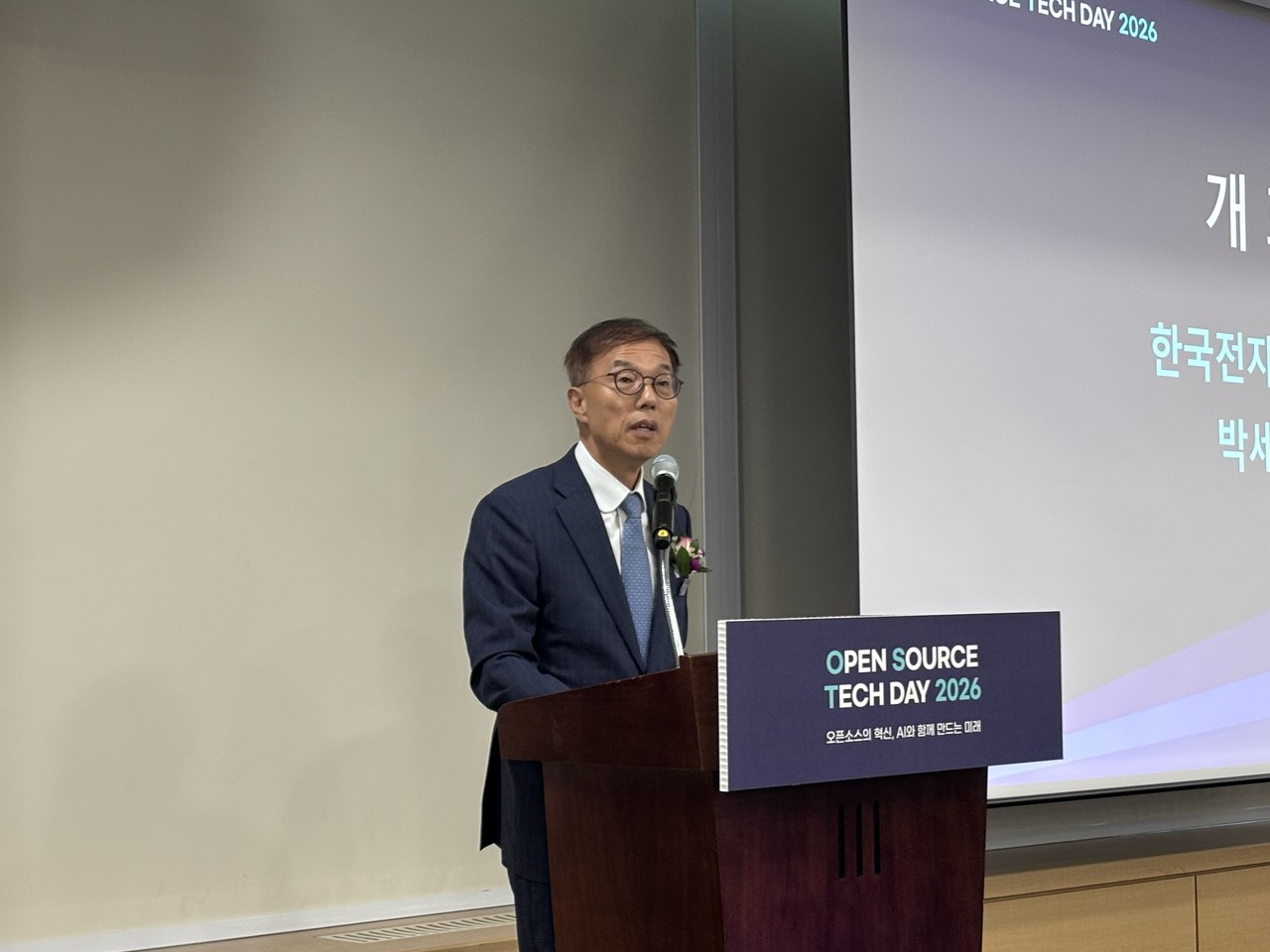
The event began with opening remarks by key guests. Park Se-woong, president of the Electronics and Telecommunications Research Institute (ETRI), delivered the opening address and gave a presentation. Photo coverage of Park Se-woong, president of the Electronics and Telecommunications Research Institute (ETRI), speaking was provided by reporter Kwon Young-seok.
In his opening address, Park Se-woong, president of the Electronics and Telecommunications Research Institute (ETRI), said that it is difficult for individual companies and a single research institute to keep up with the rapidly changing pace of AI through independent development alone. His remarks conveyed the need for a joint response.
Park said that the boundaries between technology and industry are weakening around AI. He added that the global open source ecosystem, where researchers and developers share knowledge, is the core foundation of innovation.
Park said that discussions are needed to encompass Agentic AI, open standards, securing safety and reliability, open computing, and sovereign AI. He also said that, amid the two superpowers of the U.S. and China, collaboration based on open source and the pooling of resources are important to secure national competitiveness.
Amid this trend, Kim Young-sik, chair of the NST, gave a presentation at the event. The photo was credited to reporter Kwon Young-seok.
In his congratulatory remarks, Kim Young-sik, chair of the NST, formally called for a full-scale expansion of the open source ecosystem and also raised the need for practical risk management. This, in line with the president's remarks, highlighted both ecosystem expansion and the need for management.
Kim Young-sik, chair of the NST, said the council started with 8 institutions in its initial phase and said he would expand it in earnest into a system involving all 23 government-funded research institutes. He also expressed his determination to bring together collective intelligence.
As recent National Assembly audit issues were discussed, both the advantages and risks of open source were mentioned. The essence of his remarks was that the advantage of open source lies in its rapid pace of development, while the risks include hacking vulnerabilities, malware distribution, and license disputes.
He said state-run research institutes will push ahead with measures to proactively address these shortcomings. He also expressed his will to support the creation of a healthy ecosystem. The photo was taken by reporter Kwon Young-seok.
Next, Kwon Oh-min, director of the Software Industry Division at the Ministry of Science and ICT, shared a concrete policy roadmap from the government through a presentation at the event. Kwon Oh-min said open source is the foundation of national AI competitiveness.
Kwon Oh-min introduced the 'Open Source AI SW Development and Utilization Support Project' as a program to be pushed ahead with in 2026. He also outlined goals of advancing the open source portal by 2027, expanding license verification support by 2027, and raising participation by domestic companies in the ecosystem to about 70%. He added that institutional reforms to ease legal risks for AI training data and to respond to intellectual property disputes will also be pursued in parallel.
The event also presented institutional support measures alongside technical discussions. In a video congratulatory message, Rep. Hwang Jeong-a of the Democratic Party of Korea said she would push to establish open source AI as a national strategic technology and presented measures for legislative and policy support. Hwang proposed GPU infrastructure expansion, data openness, and improvements to the public procurement system as areas of support, and also said she would continue legislative and budgetary support.
During the event, Park Won-jae, head of the Software Policy and Research Institute (SPRi), gave a presentation. Park said he would support effective policy linkages between on-site research results and industry feedback, and said he would continue proactive research.
The program continued after the opening ceremony. It consisted of keynote speeches on global open source trends and the national AI strategy, as well as technical sessions by track. The photo was taken by reporter Kwon Young-seok.
Source: IT DAILY · Kwon Young-seok
Original: https://www.itdaily.kr/news/articleView.html?idxno=242044
References
This article was produced with the help of an automated content generation algorithm.
Source: IT DAILY
View originalThis article was summarized and organized by BizCrush based on the original article from IT DAILY. For exact quotations and full details, please refer to the original article.