Jeonnam-Gwangju Integrated Special City to Merge Public Institutions 22 to 11, with 12 Set for First-Stage Reorganization
TECHWORLD ·
✦ AI Summary
Jeonnam-Gwangju Integrated Special City has been continuing merger discussions since last July to overhaul its public institution system in line with the launch of the special city.
Of the 41 affiliated public institutions, it plans to merge 22 into 11, and in 6 sectors it has decided to reduce them to 6.
Merger or reorganization methods have been decided for the urban development, tourism, research, information and cultural industries, credit guarantees, and economic promotion sectors, while the remaining 3 institutions were excluded from the merger list.
Jeonnam-Gwangju Integrated Special City has been continuing merger discussions since last July to overhaul its public institution system in line with the launch of the special city and to adjust overlapping and duplicate functions. The special city currently has 41 public institutions under its umbrella: 21 from former Jeonnam, 18 from former Gwangju, and 2 jointly operated institutions.
The special city reviewed merger targets among the 41 affiliated institutions, focusing on organizations with similar names and functions, and plans to merge 22 public institutions under its umbrella into 11. Of these, 12 Gwangju and Jeonnam institutions were selected for first-stage reorganization, and the city has decided to reduce them to 6 across 6 sectors: urban development, tourism, research, information and cultural industries, credit guarantees, and economic promotion.
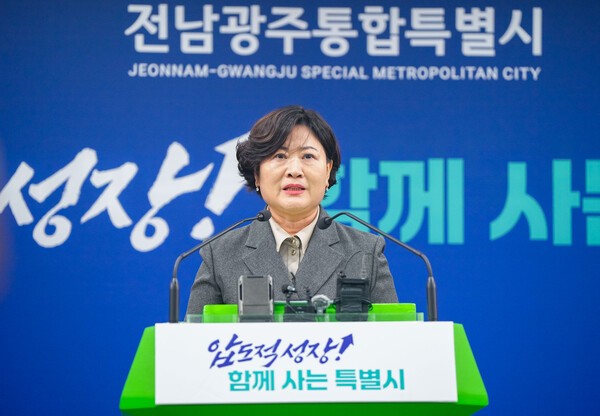
At a "Public Institution Merger Briefing" held on the 21st at the Gwangju government complex, the special city announced the institutions whose merger method had been finalized and outlined the next steps. The special city is operating TFs for each institution, and each TF includes the managing department, the relevant institution, worker representatives, and experts.
In the discussion over consolidating public institutions in Gwangju and Jeonnam, merger or reorganization methods have now been decided first in 6 sectors. The 6 sectors for which the merger method has been finalized are urban development, tourism, research, information and cultural industries, credit guarantees, and economic promotion.
In urban development, a newly established merger between Gwangju City Development Corporation and Jeonnam Development Corporation is being pursued, and the new organization will be named Jeonnam-Gwangju Urban Development Energy Corporation. In tourism, Gwangju Tourism Organization and the Jeollanam-do Tourism Foundation will be merged into Jeonnam-Gwangju Tourism Organization. In research, Gwangju Research Institute and Jeonnam Research Institute will be merged into Jeonnam-Gwangju Research Institute.
In information and cultural industries, Gwangju Information and Culture Industry Promotion Agency and Jeonnam Information and Culture Industry Promotion Agency will be merged into Jeonnam-Gwangju Information and Culture Industry Promotion Agency. In credit guarantees, Gwangju Credit Guarantee Foundation and Jeonnam Credit Guarantee Foundation will be merged into Jeonnam-Gwangju Credit Guarantee Foundation. In economic promotion, a reorganization is planned for Gwangju Metropolitan City Economic Promotion and Win-Win Jobs Foundation and the Jeollanam-do Small and Medium Enterprise Jobs and Economy Promotion Agency, and the reorganized institution will be named Jeonnam-Gwangju Economic Promotion Agency.
Meanwhile, Gwangju Climate and Energy Promotion Agency, Jeonnam Environmental Industry Promotion Agency, and Green Energy Research Institute were excluded from the merger list. The three institutions have been organized around strengthening each institution's specialized functions.
Jeonnam-Gwangju Integrated Special City has made it a principle in the public institution merger process to succeed employees' employment and not impose disadvantages in budget or staffing quotas. The special city is directly involving the institutions in the merger discussions and is coordinating detailed methods and follow-up procedures centered on the TFs.
The special city plans to give advance notice of an ordinance bill for the merger of the 6 institutions for which the merger method has been finalized. It then plans to submit the ordinance bill to the Jeonnam-Gwangju Integrated Special City Council in October, and once the bill is approved, it will prepare the articles of incorporation and related regulations for the merged corporation and carry out follow-up administrative procedures such as appointing executives.
Bae Mi-kyung, spokesperson for Jeonnam-Gwangju Integrated Special City, said the public institution merger is a process of redesigning the public service system, which had been divided between Gwangju and Jeonnam, to fit the special city system. She also said the goal of the merger is to provide better public services to the 3.2 million special city residents, and explained that the city would push to quickly wrap up consultations among the remaining institutions and speed up the necessary procedures, including enactment of the ordinance.
Source: TECHWORLD · Kim Seung-gi
Original: https://www.epnc.co.kr/news/articleView.html?idxno=407259
References
This article was produced with the help of an automated content generation algorithm.
Source: TECHWORLD
View originalThis article was summarized and organized by BizCrush based on the original article from TECHWORLD. For exact quotations and full details, please refer to the original article.