WE-AR Registers Patent for On-Device AI Image Transformation Technology That Runs Without Cloud Transfer
TECHWORLD ·
✦ AI Summary
WE-AR (WE-AR) has registered patent No. 10-3004634 for on-device AI image transformation technology.
The patent is titled "Operating Server and Method for Performing AI Kiosk-Based Image Transformation in an On-Device Environment."
The technology performs person recognition, masking, background replacement, boundary correction, pose analysis, outline analysis, and image processing inside the device itself at AI kiosks in pop-up stores and exhibition halls, without sending captured photos to an external server.
WE-AR has registered a patent for on-device AI image transformation technology. WE-AR is a creative agency specializing in AI and AR, and its CEO is Kim Young-gyun. The registered patent is titled "Operating Server and Method for Performing AI Kiosk-Based Image Transformation in an On-Device Environment," and its patent number is No. 10-3004634. The technology performs AI image transformation on the device itself without sending captured photos to an external server.
The patent is intended for AI kiosks installed in pop-up stores and exhibition halls. Its core functions are carrying out person-region recognition, masking, background replacement, boundary correction, pose analysis, and outline analysis within the on-site device itself. The entire image-processing workflow is also performed inside the on-site device.
Recently, the combination of generative AI and offline experiential spaces has been expanding, and the ways of producing on-site content are also becoming more diverse. As a result, in the exhibition and pop-up store industries, the use of real-time image transformation technology to boost visitor engagement is increasing, along with the use of customized visual generation technology.
The typical method used by existing on-site AI photo services is to send captured photos to a cloud server, transform them there, and then receive them back again. This structure had problems in that waiting times varied depending on network conditions, and there were also security risks of personal information exposure because visitors' photos passed through external servers.
This patented technology processes the entire transformation workflow within the on-site device. It automatically recognizes people in captured photos, changes only the background, and analyzes the subject's pose and outline to generate results resembling the original image. As a result, photos are not taken outside the device, there is no burden of personal information exposure, and transformation speeds can be kept steady even in unstable network environments such as underground stores.
The technology also has the effect of not being dependent on the policies of external AI services. This makes it possible to directly create and apply brand-specific artistic styles, as well as campaign-specific styles. Kim Young-gyun, CEO of WE-AR, said that the top question from brand managers is where visitors' photos are stored, and that this patent is a technical answer to that question.
WE-AR co-inventors Jeong Sang-hyeon and Park Jae-wan said the cloud-based approach could not be directly ported to on-site devices, and that they completely redesigned the processing flow with the goal of maintaining output quality even under limited specifications. They also explained that the technology was completed through real-world operation and modifications at exhibition sites.
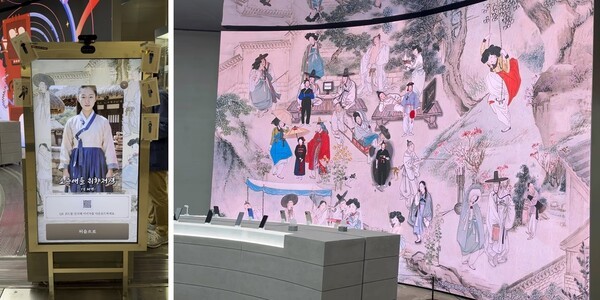
The technology has been applied to exhibition and campaign sites, where it was operated by recognizing the person area after kiosk photography, replacing the background with a scene matching the exhibition concept, and then generating results with a traditional painting style and with period costumes applied. It then displayed the finished images in real time on an on-site LED wall and immediately printed high-resolution photocards, while completing the entire process of shooting, transformation, and output within the on-site device. The technology was also operated at exhibition and campaign sites in Korea.
As a real-world application case of the patented technology, WE-AR created an experience zone that transformed visitors' photos into portraits in the style of Shin Yun-bok, displayed results with Joseon-era costumes applied on an LED wall, and also presented content that printed high-resolution photocards. Through this, it demonstrated the practical effectiveness of the technology through on-site, self-contained operation.
After this registration, WE-AR is continuing to advance the technology by filing additional patent applications in the areas of person recognition, pose analysis, and outline analysis. It has also accumulated on-site operational experience and plans to turn that into technical assets while expanding the scope of application. The expansion target goes beyond exhibition experience zones and pop-up store photo zones to the broader brand experience space.
WE-AR is a content studio that designs brand experiences with XR, 3D, and AI-based interactive content. Its strengths lie in immersive campaign production based on AR filters and recognition-based XR, VR, and MR spatial direction, and it also handles video production using generative AI as well as campaign operations, development, and performance data analysis. Its collaboration history includes Netflix, Samsung, Shinhan Bank, KT, Hana Bank, Dior, adidas, Krafton, and JTBC, and representative cases include the Netflix "Hellbound 2" promotion, Samsung Gaming Hub media wall, and the Dior "Le Balm" AR campaign. In August 2026, it registered patent No. 10-3004634 related to on-device AI image transformation technology.
Source: TECHWORLD · Kim Kyung-joo
Original: https://www.epnc.co.kr/news/articleView.html?idxno=406869
References
This article was produced with the help of an automated content generation algorithm.
Source: TECHWORLD
View originalThis article was summarized and organized by BizCrush based on the original article from TECHWORLD. For exact quotations and full details, please refer to the original article.